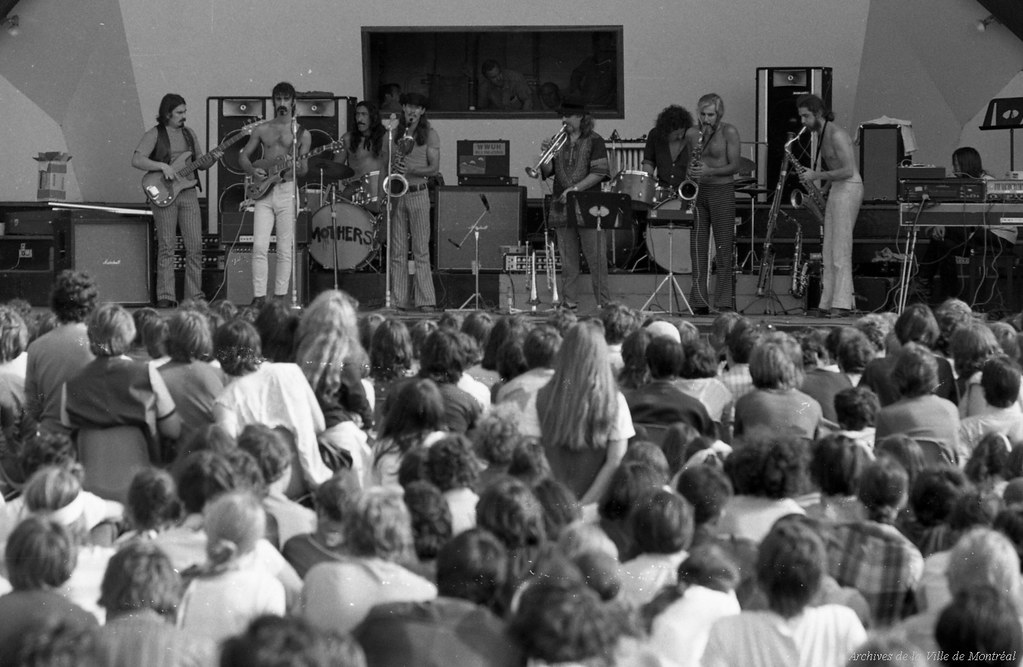
Overview:
This is it. The final incarnation of the original Mothers Of Invention. The band only exists for another 10 weeks or so after Lowell George exits the Mothers in late May, and somewhat surprisingly, there is a pretty significant change in the musical direction of the band in these waning days. We lose the large majority of the old RnB tunes heard in the first half of the year, and there’s noticeably less crazed free improvisation too. There’s still plenty of shorter tunes and classic Mothers of Invention “buffoonery”, but the majority of these performances are split between long jazz-rock jams, and strange, experimental classical pieces that Frank dubbed “electronic chamber music”. I feel that FZ’s drive in the second half of 1969 was to play his guitar more, and to write abstract “serious” music, two things that were not incredibly easy with this rag-tag group of Southern California weirdos he’d acquired over the last few years.
Listening to these shows, it’s clear Frank wants to do so much musically, but he’s limited in what he can do with this band, especially this rhythm section. I love the original Mothers, and I love their strange, unique symphonic-garage-band sound, but I’m sure that’s not exactly how Frank wanted to hear his music performed. He’d been writing all this insane, avante-garde classical music while on the road over the last few years (including the score to 200 Motels, among many smaller works), and these pieces are all being tried out on the stage, but with this band they sound like Stravinsky meets The Leaves. I really enjoy these 60s “electric chamber music” performances, but there’s no contest if we’re comparing them to the bands and orchestras Frank would work with through the following two decades. Additionally, audiences seemed to hate it. I’m not sure that this was anything new to the MOI, but the dismissal of these “serious pieces” seems to have really bothered Frank. So if he’s not happy with his classical music performances, then he’ll use this band for what it was built to do, jam and play some fantastic rock music, but even still they just aren’t up to the high level of musicianship he demands.
Frank records Hot Rats (his first solo album as a performer) at the very end of July, and gets a taste of playing with incredibly talented, quick-learning, virtuosic session musicians. Then he has to return to playing with this advanced bar band. I love Jimmy Carl Black, but he can play like four different drum patterns, and you can hear Frank trying to push past these rhythms while he’s playing. Now this isn’t to say that this last incarnation of the MOI isn’t great, they’re fantastic. While I prefer the Lowell George-half of 1969, there’s still a ton to be enjoyed in these final weeks of the original Mothers of Invention. This era has a very Hot Rats feel to it, with long, grooving jams showing up in nearly every show, along with multiple Gumbo Variations quotes. I love the strange setlists in this era: excellent, high-octane jams mixed with wild, demented chamber music, topped off with a smattering of amusing little pop, rock and RnB numbers. These shows are wonderful, they’re full of energy and they capture this band at the peak of their ability. These Mothers have been roughing it together for years and it comes through in how tight they operate, but it’s just not enough for Frank Zappa. This band had an amazing, unique character to it, with great personality and humor, but at this point Frank really was more interested in musicianship. He had taken these musicians to their absolute limit, and when he realized he’d taken them as far as they could go, where there weren’t any more boundaries for him to push with this group, that was the end. He could never stop evolving, and the former Soul Giants just couldn’t support what he wanted to do forever.
Less than a month after the Hot Rats sessions, Frank calls up each of the Mothers individually, chats for a little while and finally tells them something like “oh by the way, I’ve decided to break up the band”. This was obviously hard for the Mothers, who had no idea news like this was coming (though we know that Frank had considered this, and occasionally voiced his opinions throughout the previous couple years). The only one not to get a phone call was Ian Underwood, who went on to work with Frank for another four years after this. The rejected Mothers were incredibly unhappy with Frank, and while most would return to work with him here and there over the following decades, the Gardner brothers never played with him again. This was difficult for Frank too, because he had become great friends with these guys over the years, but music was his life, and he needed to move onto other projects. I love Frank’s 60s output, but can you imagine how much we would have missed out if Frank had decided to just stick with this original group?
The Band:
Frank Zappa – Guitar, Vocals, Phone Calls
Jimmy Carl Black – Drums, Bets
Roy Estrada – Bass, High Pitched Harmonies
Don Preston – Keyboards, Brown Rice
Bunk Gardner – Woodwinds, Brown Outs
Ian Underwood – Woodwinds, Keyboards, Hot Rats
Motorhead Sherwood – Baritone Sax, Tambourine, Harmonica, Pop Star
Art Tripp – Drums, Percussion, Chiropractic Medicine
Buzz Gardner – Trumpet, “The Other Guy With The Gray Hair”
Recordings Available:
1969 05 30 – Town Hall, Birmingham, UK (Partial Official Release)
click here to listen (to the Weasels Ripped My Flesh title track)
This date was the first gig of the Mother’s UK tour. They played two shows, but all we have is the titular performance from Weasels Ripped My Flesh, which is of course two minutes of unadulterated feedback and noise. The bootleg recording that was labeled as this date was recently found to actually be of the August, Highland Park show (so If you’re thinking of that tape, think again). Luckily, we know a handful of other tunes performed at this show because of a contemporary review (click here to read it in full). Igor’s Boogie opened the show up, and it was followed by “Hot Rats”, which was described as “a fine example of modern American orchestral music”. The Zappa fan community isn’t completely sure what this name refers to at this exact point in time, but it was used as an early title for both The Eric Dolphy Memorial Barbeque and the intro to Music For Low Budget Orchestra at different points in 1969, so it’s definitely one of the two. My gut says it refers to Low Budget here, and Chalres Ulrich agrees so that’s good enough for me (but we still can’t completely rule out the Memorial BBQ either). Additionally, our English reviewer noted they played “Shortly” (the working name for Holiday In Berlin), Bacon Fat, My Guitar Wants To Kill Your Mama and some unidentified chamber music for “unaccompanied trumpet, clarinet and bassoon”. It’s unknown where exactly in the set the Weasels Ripped My Flesh title track comes from, but it’s most likely some show ending improvisations (my hunch is it comes from a take of Octandre, as the February Fillmore East performance of this Varese track ends with similar screeching feedback/noise). Though we only have a two minute noise fragment of these shows, the full thing probably exists in the vault, and it’s another live show I’d love to hear someday.
1969 06 05 – Guild Hall, Portsmouth, UK (Stage A-)
We have a small chunk of the penultimate show of this short tour, captured on a very nice stage recording. There were two shows on this date, but it’s unclear which one this tape comes from. What we do have is a great performance of the two pieces formerly known as the String Quartet, beginning with a long, long intro to the first tune: A Pound For A Brown. We cut in part way through the description of “browning out”, and get some new variations on the phrase including “If you brown out against a screen… that’s called a chipped beef… and if you do it against a window pane in a delicatessen, it’s a pressed ham.” He comments on some English alternatives (“In front of the Queen, you might get a few extra points”), then tells the now regular story (“Bunk’s pants came down and the money was handed over. That gives you a rough idea of how much fun it is on the road with a rock and roll band”). After this he talks about how the piece could “be described as program music” and then gives “a rough breakdown of the schedule of events in the tune: It starts off with little imitations of horns and stuff, which would be sort of like the traffic on the road. Can you picture that? It’s cute. Then it goes into a jolly theme, which would be the gay mood of the Mothers Of Invention on the bus….. And then we go back to the jolly theme again after that’s happened. Shortly thereafter, it builds to a surging climax. Pants come off, buns come out, and it goes into a long improvisation. About a half an hour later, I’ll tell you another bunch of bullshit about the next thing.” After a few minutes of introduction, They begin a lovely, “jolly” Pound For A Brown. The mid-tune traffic-esque improv is short but sweet, and you can hear FZ yell “ready?” to the band before they move into the next section. Frank then rips out a fantastic, fiery solo, before sliding into Sleeping In A Jar. There’s a lovely amount of crazed improv in the theme(s), with Roy’s voice in the middle take, and screeching horns and moaning in the third and final repeat (“oh shit!”). This of course leads into an extended jam, featuring two great, long solos from Frank and Ian. Then suddenly, as Ian winds down, Transylvania Boogie appears! The theme goes on for about two minutes, with the tempo changing throughout the tune. Don begins to solo, but a few seconds after he starts, the tape recorder dies and the event is suddenly over. This is a really lovely performance, captured on a wonderful recording, but it’s really a bummer that there’s not more to it. This tape would make a very nice addition/bonus when listening to another show. It is worth a listen, because it’s an excellent performance, but there’s a lot of String Quartets out there from this year, so it’s not a tape I return to all that often.
1969 06 06 – Royal Albert Hall, London, UK (Soundboard B+/B & Audience B-/C+)
This monumental and historic show is captured on three very different recordings. Frank had the show recorded, and released (or planned to release) a number of bits and pieces from the gig (chunks ended up on Burnt Weeny Sandwich, You Can’t Do That On Stage Anymore #5, the FZ-created posthumous release Finer Moments, and the leaked “Weasel Music” LP, which was originally part of the famed History and Collected Improvisations of the Mothers Of Invention). We can unofficially listen to the entire show, but it’s not exactly available in the finest quality. The majority of the first set is available from an acceptable but far from glamorous soundboard, and the rest of the show is captured on a very lame audience recording. It’s not an unlistenable tape, but it leaves a lot to be desired (especially with any spoken words, which are basically unintelligible).
Anyway, the night begins with Frank’s intro, but it’s not on the soundboard tape, so I can’t make anything interesting out. It seems like a standard “tune up” and “try to do a good job” intro for the time, and when they’re ready FZ announces that they will start “with a piece called Uncle Meat”. There will then be “a brief percussion interlude”, and they’ll go into Some Ballet Music for “flute, clarinet and electric flugelhorn, with vibraphone and castanets.” We get nice performances of exactly that; Uncle Meat is a classic, and it’s followed by 90 seconds of drum duet improvisations. It heads right into the new solo flute intro to Some Ballet Music, which I think is a nice addition to the piece. Once they run out of composed music they segue directly into improvisations. It starts off very similar (it’s always hard to tell where the improv actually starts), but Roy comes in with some Gas Mask vocals after a minute or so (“Chinga!”), and the band just gets tweakier as time goes on. Eventually Frank comes in with these very mellow, peaceful guitar chords, and our flute player (Ian?) performs some unaccompanied variations on the intro to the Ballet music. This leads directly into some conducted/free improvisations (Which Frank planned to include an edit of on Finer Moments as The Walking Zombie Music). It’s some classic, crazed MOI improv, with crazed woodwinds, the swing ditty, and general avant-garde insanity. Eventually someone starts speaking gibberish, while someone else turns on a radio and lets it play while the Mothers continue to improvise. Frank cues a “hands up poo-ah”, and they quickly switch to the 5⁄8 drum riff and more madness. The piece ends with a long stretch of electronic noises, crashing cymbals and a hilarious transition into the one and only Big Leg Emma. After this easy, teenage number, the band stops for a little while, while Frank comments on the sub par PA system (“You didn’t miss anything, that was part of the entertainment folks”). He then begins the long, ever-lengthening intro to A Pound For A Brown.
Frank talks about the Californian surfer “cult” of people with “bleached blonde hair”, “suntans” (“You don’t know what that is here”), and “cut-off pants, which makes them look sort of funky and authentic and nature boy style”. He talks about how surfers do it to get laid, and how “similar mating practices exist in all walks of life” (truck drivers, newspaper writers, etc.). He explains the “curious thing called the brown out” (“reverse your position, drop your pants, and stick your buns out”), along with the classic variations on the theme: the “chipped beef” and “pressed ham”. He goes on to tell the story of the piece (“Bunk Gardner, being the crafty silver-haired devil that he is, quickly computed the difference between a pound and a dollar and had his pants off before anybody knew what happened”), comments that browning out “may be the thing to replace Flower Power” and then describes the program music nature of the piece “The first part of the piece has the simulated effect of London traffic. We do this ingeniously by using actual horns, which you squeeze with your hand that go ooga.” Finally, we’re ready to hear the piece itself, which is “followed by some low-grade rocking out and instrumental improvisation for about the next 20 minutes, or something.” We get a very nice take of the tune, with a brief interruption during the theme (“that was the simulated London traffic, did you get it? You guys are really hep!”) and some amusing horn-heavy improvisations in the middle. Frank whips out a very nice, sizable solo, and heads right into its sister tune: Sleeping in A Jar. We get some moo-ahs and laughs from Roy in the middle theme, and a ton of peeps, yelps and screams during the third and final take. Following this, Frank rips into a delightful, fiery solo (and he must have thought so too because he prepared an edit of it for release on Finer Moments titled Sleazette). Once he wraps up we get a beautiful solo from Ian, and a bouncy solo form Bunk to wrap up the event. Eventually the jam settles down, Frank cues an ominous rumble, and we’re launched into a performance of Interlude! (AKA the ending of Twinkle Tits). It’s a lovely take of a lovely piece, the final known standalone performance, and this brings the first set to a close (“We’re gonna take an intermission for a little while, we’ll be back in 10 minutes. Thank you”). Unfortunately, this is where the soundboard recording ends too, so it’s all audience from this point on.
When the tape returns, we’re in full audience territory. The music is very distant but still listenable, and it’s basically impossible to make Frank’s voice out. Fortunately though, most of his introduction was released on Finer Moments (and a longer edit is available on Weasel Music). Frank seems to introduce “some friends of ours we worked with for quite a while”, and I can’t make this out but I believe he’s talking about road manager Dick Barber and roadie Kanzus J. Kanzus. Frank goes on to say that “during this part of our program, we are going to perform for you various chamber music pieces, and also some zany Mothers Of Invention bullshit…. We have the assistance of a famous pop star to help us tonight during our renowned ballet sequence…. none other than the formidable Mr. Noel Redding.” Yeah you heard right, the Jimi Hendrix Experience bassist is here and he’s going to dance with the Mothers while they perform some weirdo chamber music. He outlines a couple more aspects of the second set (“we’re going to have our road manager, Dick Barber, come out and strangle a rubber chicken and make some funny noises for ya. And, as if that weren’t enough, we’re going to do our version of the birth of Frankenstein, live on stage, including a spark generator and a smoke bomb and a convulsing monster, which we construct out of Motorhead. And, let’s see, what else are we gonna do? We’re going to play a tune called Hot Rats [this either refers to the Eric Dolphy Memorial BBQ, or the Music Intro to Low Budget Orchestra, it’s unclear which], then uh, do some rock n roll, and that’s about it.”) and the band begins to tune up. Frank tells the crowd “here’s some stuff for electric bassoon, electric flugelhorn and electric clarinet”, and they begin the Intro To Music For Low Budget Orchestra! There’a a false start, something funny happens, Frank croaks out “Silence Fools”, and then we get the real take.
It’s a lovely version of the piece, arranged for the woodwinds, and after the familiar section heard on Studio Tan, we get 90 seconds of additional chamber music, unique to June 1969 (this music can also be heard at both of the June Fillmore recordings, again following the Intro to Low Budget music). They finish, the audience claps, and Frank announces the next piece, where I believe he says it doesn’t have a name yet (but this is very hard to make out). There’s a brief tape cut, and the Mothers are now playing the chamber music section later incorporated into Little House! (I believe it’s the same recording too! just without overdubs). Immediately following this they head into some more unreleased chamber music, which is usually referred to as “Weasel Chamber Music” because parts of it can be heard on “Weasel Music” LP (and all of this piece is performed on the 14th at the Fillmore, but with some additional, unreleased music added between the Little House and Weasel sections). They finish this up, and Frank announces the “the entertaining part of this… section. While the well-disciplined Ian Underwood plays selected fragments from Wolfgang Amadeus Mozart’s “Piano Sonata In B-flat” and we make electric noises, some members of our rocking teen combo will hop around on stage in a grotesque parody of the art of ballet dancing, which some of you may find amusing.” They do exactly that, and we get seven minutes of Motzart, with sounds of the Mothers grunting, jumping and making chicken noises layered on top. This is where our special guest Noel Redding comes out and dances with the MOI and their road crew. It eventually devolves into the “Birth of Frankenstein” event mentioned at the start of the set, where “Dr. Preston” will “convert the unwilling Motorhead Sherwood into a walking zombie.” Since we can’t see what’s happening, this amounts to three minutes of whacked improv featuring electric noises, crazed drums and the ⅝ riff. There’s a few different available released versions of this performance, a heavily edited take was released on YCDTOSA5, a nearly complete take of the “Mozart” section was included on Finer Moments, and the entire Ballet, plus a good deal of the following improv, was considered for release on Weasel Music. Eventually Frank cues the swing ditty, and after a couple of seconds of this they calm down from their frenzy. Now that they’re finished with the “intellectual” part of the program, Frank announces that “We’ve had a number of requests for this song. All over America people think this is the greatest tune that ever happened. This is more popular in America than any other song. Americans are really smart and they really know music, you see. And they have excellent taste in the music they buy. And they helped to make this song the masterpiece that is it, by (paying?) so much money, and we figured you people know most Americans, so you can probably dig it too!”
Frank is of course referring to the one and only Louie Louie! They quickly launch into the 60s classic, and Don climbs up to the famed Royal Albert Hall pipe organ to defile it once again. He starts by playing the melody of the tune, and then plays a delightful solo. After a few minutes Ian comes in, and blows a tasty, Hot Rats-esque solo (Don’s on background organ all throughout this too). Bunk follows him with a characteristically bouncy sax solo, and Frank ends the event with a tasty, wah-wah drenched guitar solo (while Bunk continues to play underneath him). It ends with a big crash, followed by a bit of tuning, and a quick transition into Little House I Used To Live In. And this isn’t just any Little House, it’s the basis for all the live parts of the tune on the Burnt Weeny Sandwich version! It’s of course a lovely performance of the theme, and Frank decided to use thirty seconds of the theme, and an edited-down minute of his guitar solo for the official release (click here for a comparison chart – the first minute of Frank’s solo was cut out, along with a couple of other chunks in between). After some delightful soloing and guitar/drum interplay they make a complete stop for a second before beginning Transylvania Boogie. It’s another great take, but it unfortunately only lasts for about a minute before the recording cuts out. We return right before they start The Eric Dolphy Memorial Barbecue. It’s another great take of this weird little number, and in place of the first improv section heard on the studio version, we get a unique little piece of tweaky music that will soon be incorporated into the whacked passacaglia medley (see the Newport, NJ show for reference). There’s then a repeat of the theme, followed by a couple minutes of drum improvisations, then suddenly, Charles Ives! Bunk begins the tune like normal, and we get a condensed take of the piece. Frank runs through the modules pretty quickly, we get a few moo-ahs from Roy, and after the regular nonsense we get a lovely, 2 minute trumpet solo from Bunk. The Mothers quickly fade out when the tune ends, and jump right into a sick Cruising For Burgers! This brings the show to an end, but the MOI return for an encore, and we get to hear the original context to the dialog at the end of the official Little House! Frank let’s us know “if you sit down and be quiet, we’ll make an attempt to perform Brown Shoes Don’t Make It.” The audience recording cuts here and misses the screams from the deranged fan in the audience, but returns for Frank’s iconic “Everybody in this room is wearing a uniform, and don’t kid yourself.” He makes a couple other quips that we’re left off the album ending (“My my…. Go fuck yourself…..”), and we finally get to hear the live Brown Shoes that Frank hinted at on Burnt Weeny Sandwich, but never released. It’s a lovely take, very faithful to the original (with a couple of small variations I’ll point out in the song entry), and it provides an excellent end to this momentous show. This is the final European performance of the original MOI, and it’s a great place to end on. I’d love an official release of this show, possibly paired with other dates on the ‘69 UK tour, or one of my dream releases: A big box of the ‘67, ‘68, and ‘69 London shows. Though this show is not captured on the most fantastic recordings, it’s still well worth a listen for the Zappa lifer. There’s other shows I would recommend from this final era of the MOI first, but I’d still say check out this legendary London show when you get the chance (just don’t expect a sonic treat).
1969 06 13-14 – Fillmore East, New York, NY (Two Early Shows – Audience B+/B & Audience B/B-)
click here to listen to both shows
The Mothers return to the US, and play four shows at the Fillmore East over two days. We have two of these gigs, the first shows of each night, and they offer a very important and interesting glimpse into Frank’s music at this time. FZ had continued to work on his electronic chamber music after the UK tour, rearranging the unmanned pieces and consolidating them into a longer event that he titled “The Mothers Of Invention Electric Bassoon Concerto”. Both available shows feature a long piece of chamber music with that title, but to make things confusing the two performances contain different composed music. The two sets are relatively short (about 40 minutes each), and the Electric Bassoon Concertos are the clear focus of night. These ultimately transitional pieces are great examples of Frank’s insane compositional process, and we’re lucky that these historic performances are captured in pretty good sound quality too.
The recording of the early show on the 13th misses any introductions (if there were any), so we begin right with the debut of the MOI “Electric Bassoon Concerto”, which tonight consists of a very early version of what would become Music For Low Budget Orchestra. In simplest terms, we have a lot of component parts of “Low Budget” in a somewhat unfamiliar order, with chunks of unidentified and unreleased music between the familiar lines (see the song entry for a more detailed breakdown and comparison). The piece begins with the main body of Low Budget (again, interspersed with unheard music), held together by a heavy, plodding beat, and after about three minutes of composed material, the band delves into similar sounding improvisations. This opening kinda sounds like entering Hell, but in a good way. About five minutes in, Frank begins a strange, moody guitar solo that fits the piece perfectly. He plays the I Come From Nowhere riff near the end of his solo, which is the first known appearance of the tune, about 13 years before it would appear on a record. There’s a rumble, and surprisingly, we now have (what we now know as) the introduction to Music For Low Budget Orchestra! It’s a lovely take of the piece, and the entire first performance of the MOI Electric Bassoon Concerto ends with about a minute and a half of music unique to these June concerts, always played following the Low Budget “introduction”. This brings the 10 and a half minute, tweaky chamber opener to an end. The Mothers retune, and FZ then announces that they’re “getting ready to release a single” (“We don’t think it’s really going to be a hit, but we have to try because if everybody else can have singles, why can’t we have singles?“).Frank goes on to say that they asked the audio people “to make it sound just like the Vanilla Fudge”, and that the band have “practiced putting the leg out on the side”. They’ve developed “a sincere, involved, soulful look, which we’re going to use every time we play our hit single, live in person because that’s the way the good groups do it” (“And, by myself, I’ve been practicing how to say baby”). FZ is of course referring to Valarie, the then “unreleased, smash flop, Mothers of Invention single”. We get a lovely take of the classic doo-wop tune, and just when the New York audience expects and band to drop out and Frank to croak out “Valarie you pig” (like at their last Fillmore appearance), they keep playing and Frank says that the’re actually “going to do it real sincere”. He talks for a little bit about the “dance-ably oriented love song”, how they’ll be in “the studio tomorrow to mix this piece of shit together” and that they’ll “probably have it out on the market in about a week” [Frank actually never released Valarie as a single opting instead for a reworking of My Guitar Wants To Kill your Mama, with an instrumental Dog Breath as the B-side]. Frank then finishes by pleading to the audience that “those of you who would like to contribute to our worthy cause, are invited to help subsidize our musical experimentation in the realm of electronic teenage classical music by buying this shitty record, so that we can keep making weird live in concert so we can only sell out part of the time. It would make us feel better knowing that we can eat.” Eternal words right here. Anyway, the tune ends with a big, amusing, cheesy blues walkdown, and right as they wrap up a fan shouts for King Kong.
“Do we have a request for King Kong? I’ve just been handed a note from a person in the audience, who put their head down immediately after handing the note to me, and it has a picture of that guy from the fun(?) cartoons with a Mr. National sort of head, with a talk balloon coming out of it that says, ‘This shit is beginning to rankle my ass’.” This leads to raucous laughter from the audience (and the reviewer), and within a minute we’re listening to the song about a large gorilla. It begins with a very gong heavy intro (“Don’t you think you could stick your leg out to the side when you’re doing the gong?”) and we get a nice, though slightly shortened King Kong. Motorhead starts us off like always, Frank follows with a hot solo after the second theme, and Ian plays a hot, modulated sax solo after him. FZ slows down the vamp for the second half of Ian’s solo, then changes it to the ⅝ riff at the very end. After a minute the vamp drops out and Frank leaves us with screeching horns. It almost seems like Bunk will start soloing, but there’s a sudden transition into Uncle Meat! We get a standard take of the piece, followed by the regular ending drum duet, and just as it sounds like it’s about to turn into some free improv, Frank cues Some Ballet Music and we’re thrown into that now! It’s a pretty regular performance, except that someone interrupts the ending of the opening flute solo, but someone onstage quickly does something funny, the crowd cheers and laughs, and the piece continues like normal. When they finish the MOI head into free improv for a couple seconds before Frank says “thank you very much for coming to our concert all the way from Queens” and ends the show. Music starts to play over the PA indicating that there was no encore for this set (probably a combination of time and FZ being pissed off about the rock audience reaction to his “serious music”). Regardless of the crowd’s reception, this is a very fun little concert. The biggest reason to listen to this is for the one-time-only opening chamber piece, but the rest of the gig is a lot of fun too. Though none of these performances particularly stand-out compared to other shows, they work well together as a little set, and they’re a great insight into what Frank and his Mothers were trying to do in June ‘69.
There’s no known tape of the late show on the 13th, but the early show from the second night at the Fillmore is available. The recording is a little more distorted than the previous night’s, but it’s still very listenable. Frank gives a sizable intro tonight, first talking about something a fan threw on stage (“This would be the basis for some girlfriend to knit some angora dice”) and then commenting on the previous night’s performance: “Well, boys and girls, tonight we’re going to begin just a little bit differently than we did last night. Last night we made a dreadful mistake of trying to play good music for a Fillmore audience. We gave the New York premiere of The Mothers of Invention Electric Bassoon Concerto, and also premiered some of the new ballet music that we’re working on. And uh, there were a few problems connected with this presentation. It seems that there are some members of the audience that just didn’t feel like sitting through that kind of music and so they made noise to interpret it. And I heard that it was probably my fault in two respects. One, for having written such an atrocity. And two, for [not] warming up the audience with some trash before we tried to play some music. So tonight we’re going commercial. And we’re going to start off with a piece of material that has absolutely no musical merit. But which is eminently accessible to a Fillmore audience. We’re even going to tune up before we play this” [Frank then says “Did you hear that one from over there? The young woman has looked upon the cabbage and said it’s a transvestite pineapple.“ – Whatever that could mean].
So the early show begins with a lovely performance of, you guessed it, Bacon Fat! It’s a regular, goofy take, with great guitar licks throughout. After they finish, one of the saxes briefly quotes Lonely Lonely Nights (or possibly another song with that same progression), and Frank announces “We’ll now perform for you, and I must apologize before we do…. an Electric Bassoon Concerto. With dancing and castanets.” He goes on to say that they’re “going to provide you with some visual effects that will help keep your mind on stage, so you don’t get bored or drift off during” the piece and that the “concerto begins with a throbbing teen pulse provided by none other than Jimmy Carl Black: the Indian of the group.” Now despite the names, the two Electric Bassoon Concertos are wildly different from one another. This second performance begins with the Little House I Used To Live In Chamber Music (the music heard after the violin and piano solos in the studio Little House). There’s a tape cut right at the beginning of the music, but I don’t think more than a few seconds are missing. The Little House piece leads into a section of unreleased music, after which we get a long, tasty FZ guitar solo, over the same “throbbing teen pulse”. Frank’s solo is meaner than the previous performance, but still has that lovely air of weirdness that comes from its placement in the middle of these strange, abstract chamber pieces. When he finishes up, The MOI come back in to perform more music heard on the London tape (and the unreleased “Weasel Music” LP – see song entry for more info). They play through the whole unreleased “Weasel Music” piece (as far as we can tell), and this leads into a creepy organ solo from Don, quickly followed by some full band conducted improvisation. Finally, somewhat surprisingly, the Mothers play the introduction to Low Budget Orchestra, followed by the same unreleased chunk of music heard on the 13th (and on the 6th). The performance is capped off by a crash, followed by a segue into some frantic drum improv, with some insane guitar over the top of it.
Eventually we hear a gong creep in, and Frank stops to announce “The legend and lore of Kong Kong, a large gorilla, who smells like the street outside the Fillmore”, before diving head first into the tune. It’s a very similar beast to yesterdays, with lovely solos from Motorhead, Frank and Ian. Motorhead’s solo sounds like a Motorhead solo, FZ’s is fun and fiery, and Ian’s wah-wah sax solo is just as hot. Some cool horn stings appear near the end, and someone drops the Gardner Varieties riff (potentially for the last time ever). The horns play some quick variations on the main theme before FZ cues a sudden stop and says goodnight. They return, Frank fields a wave of requests (“keep talking, get it out of your system”) and announces “the name of this song is Uncle Meat”. We get a lovely, straight performance of the theme, and the night ends without the normal drum duet.
Without the lengthy chamber music pieces, these would be two fairly standard shows, but the addition of these long, unique, “Electric Bassoon Concertos” make these must-hear performances. There’s nothing wrong with the rock band material from these gigs, they just feel like they’re rounding out the setlists, and it’s clear the chamber music is the star of the show. Audience clearly didn’t feel the same way as I did, and it hit newspapers pretty quickly that Zappa was unhappy about the reception. When interviewed after the late June Denver gig, Bunk said that the crowd “really got down on us”, adding that “they wanted to hear what we were playing two years ago and all that old shit”. If you want the best available King Kong, check out another gig, but if you want some exciting, weird-ass chamber music played by a strange, mutated garage band then check these shows out.
[Additionally, Frank met famed conductor Leonard Bernstein after one of these gigs. When asked about the meeting in 1977 FZ had this to say “I only met him once when he came to see Chicago, who was our opening act. I was invited next door to Ratner’s and I met him there, with the guys from Chicago. He didn’t say two words to me; all he did was sit there and deliver a 15 minute monologue on the origins of whitefish. All I know about him is that he’s a sturgeon expert.”]
1969 06 27 – Denver Pop Festival, Mile High Stadium, Denver, CO (Audience A-)
Here we have an excellent audience recording of a lovely summer festival gig. The sound is clear and the fan’s are super into it the entire time; it really feels like you’re right there. The emcee comes out to announce “From wherever they’re from: Frank Zappa and The Mothers Of Invention!” and they immediately rip into a classic Hungry Freaks Daddy (the vocals start off too quiet but this is quickly fixed). Once Frank wraps the tune up, he speaks to the audience: “Hello boys and girls, I must say it’s extremely spiffy to be performing electric music in the middle of a baseball field. And it’s also nice to see the event is so well policed, for your protection.” This inspires him to announce “a song that we haven’t played in about three years”: “The Heats Out Every Night”, otherwise known as the Downtown Talent Scout. FZ tells the audience and the band (because they probably haven’t practiced this tune in about three years) that “it’s in the key of A and it’s just like the Watts riots song but with other words.” (“Trippy huh?”). A fan yells “God I see God!” right as the tune starts, quoting Eric Clapton’s ramblings in Nasal Retentive Calliope Music off of We’re Only In It For The Money. We get a fantastic take of this rare tune, performed over a lovely, chugging, keyboard-y, boogie beat. Frank sings most of the known lyrics (he skips the penultimate “devil grass” verse), and provides some fantastic Gumbo Variations-esque guitar between the verses. More than just licks too, it’s basically like entire solos! Some cool horn riffs emerge during the first guitar break, and the tapers are clearly pissed at people standing up and blocking their view (I could see this dialog bugging listeners, but it’s not too disruptive so I find it pretty funny). After the final verse, Frank rips into his guitar even more, providing another excellent solo (and sorta quoting Help I’m A Rock). Don comes in next with a sick organ solo, and after 12 minutes FZ ends the event with a big fade out and crash (“Now we’re gonna work that one up so we get it good in the show”).
After this epic event comes to a close, Frank announces that they’ll “play something from the Uncle Meat album now”: A Pound For A Brown, which is “a piece of program music” that tells “a story that goes along with the music about the time somebody bet Bunky Gardner, the gray-haired marvelous tenor sax player in the back there, bet him a pound on a bus in England that he wouldn’t brown out”. Frank explains “the process of removing your pants in pants in public”, the different variations of the theme (“mooning” vs “a chipped beef” vs “a pressed ham”), how the story of the famed London bus event is told through the music (“you can follow along with the plot development”), and how they will “continue on with some sort of grotesque improvisation for about half an hour”. The crowd is still yelling “sit down!!!”, but it doesn’t affect the music, and the MOI kick into A Pound For A Brown. We get a fun “traffic improv” section, and a nice guitar solo from Frank, that of course leads right into Sleeping In A Jar. The theme gets deconstructed like usual, with screams from Roy in the middle, and crazed, fun screeching sax in the final repeat. Bunk plays the only solo in tonight’s jam, but it’s a hot one (I think on clarinet?). Then suddenly, Ian starts Some Ballet Music, which begins with the now standard long flute introduction. We get a regular take of the “ballet”, with about 90 seconds of similar sounding improvisations tacked on to the end (though we get some fun, tweaky guitar thrown in here too). Frank then brings the music to a sudden stop and announces “During this part of the composition, I would like to have some audience participation”. He teaches the Coloradoan crowd “three simple things to do that will allow you to make a piece of music instantaneously in Denver”: the signals for clapping, peeping (singing the “highest note possible for a very short period of time”) and vomiting. They successfully try out the commands (“You guys are great, you should form a group. You can call it Denver.”), and Frank cues them a few more times in different arrangements before seemingly running out of stage time and ending the show somewhat abruptly (“They go peep, you clap. You vomit. You vomit. You peep. Great. Well, that’s it. We’ll see you guys later.”). [Frank’s best comment though is “Who knows, somebody might be taping this….”] Though the show is over, our tapers managed to talk to Roy and Bunk very briefly afterwards, and ask them a few mediocre questions, to mildly interesting results. They’re asked about the new album, but don’t seem to know what it is; they talked about the ages of the Mothers, and a few other things (taper: “How’d you get the name Sweetpants?” Bunk: “That’s the way it goes….”). Overall it’s not a very important interview, but it’s neat to hear paired up with this gig. This is a great festival set, captured on a great recording. They only had 40 minutes to perform, but they absolutely made the most of it. We get an incredibly rare, excellent performance of “Heat’s Out”, as well as a handful of classic MOI tunes, all in wonderful quantity. What more could you want?
1969 07 05 – Newport Jazz Festival Field, Newport, RI (Audience B+)
Another excellent festival gig captured on another lovely recording. It’s a music festival set so it’s not a full length show, but it’s a great encapsulation of this final era of the Mothers. The emcee announces “Frank Zappa and the Mothers of Invention!” and Frank comes up to say “Alright, listen. The name of this piece is Igor’s Boogie. It’s scored for electric flugelhorn, two electric clarinets, boy soprano, bass voice, and police calls which come through our amplifiers, over which we have no control.” This is immediately followed by a well timed police call, but thankfully when the Mothers are playing they drown out the interference, so in the end it doesn’t affect the performance. They start the set with Igor’s Boogie, and this is the first “normal” take of the tune, lacking the goofy “little doo-wop” section from earlier in the year. They play through both phases (though they play phase one twice), and a large rumbling noise brings us into some crazed improv. It starts with lots of conducted vocal stuff, with a very brief ⅝ interlude, followed immediately by more conducted nonsense. Frank says something about rhythm I can’t make out about a minute in, signals the band to begin this strange drum riff, and then starts this wild, tweaky, abstract, corrosive guitar solo, with little hints of Octandre throughout. This makes a perfect segue into the first known performance of the ridiculous Passacaglia medley! They launch into the Louie Louie vamp, but instead of the familiar melody, we get this insane abstract horn piece layered on top of it. When they finish Frank announces: “Now we’re going to play the same song, with a different background. So you get to choose between the two, see which piece of popular music you like the best. That was background number one, now background number two”: Cream’s Sunshine Of Your Love. We get the crazed FZ-penned melody once again, this time over the chords to the iconic psychedelic 60s tune, and when they finish Frank throws in some cool guitar licks before heading right into more improvisations without missing a beat. Ian starts to solo, but it very quickly devolves into more insanity. Roy “sings” and laughs while crazed instrumental nonsense continues under him. Frank cues the classic “hands up poo-ah”, which leads into total chaos for a couple seconds before the peaceful resolution into a fun little Boogie. Ian returns to his sax solo like nothing happened, and we get a demented little jam. He plays for a little while, until Frank comes in with the Gumbo Variations opening lick! He jams with Ian for a bit, but while he does it sounds like the band is completely falling apart behind them, and once the beat fully dissolves Frank changes the mood again with a sudden ⅝ riff. Eventually this settles down into a quieter, but still very tweaky vibe. The music gets very electronic, and before you know it they’ve started Some Ballet Music! The solo flute intro is very slow, and somewhat deconstructed tonight, but it leads into a standard take of the piece. After the theme, they venture into some drum improvisations. Frank cues Roy and the band do the weird chicken laugh thing over it, then turns it into the swing vamp for just a few seconds before a hard stop brings the music to a close (and we hear another brief police call). Frank takes this time to introduce a piece “dedicated to the folklore of the surfer cult in California”: A Pound for a Brown on the Bus. We get the regular talk of brown outs, moonings, pressed hams and chipped beefs (“There’s some jargon that you can use on your friends”), the tragic tale of life on an English tour bus (“Wherein, Jimmy Carl Black said, ‘I’ll bet you a pound you won’t brown out on this here bus’”) and the explanation of program music (“The piece that we’re going to play now commemorates this great event in teenage history in story and song. It’s program music. That means that even a teenage audience can follow along with the plot.”).
They begin a lovely take of A Pound For A Brown, with a good middle full-band improv section and a great guitar solo from our head Mother. Like always it leads right into Sleeping In A Jar, with a quick scream from Roy in the second theme, and long, screechy, gnarly chunk of conducted improv in the third take, totally dismantling the ending theme (something funny is happening on stage because the audience laughs and cheers). FZ then kicks off the jam vamp, and we get some woodwind trilling for about 30 seconds before Frank comes in with an absolutely fantastic, scorching guitar solo. After four minutes, this excellent jam comes to a very sudden stop and Frank says goodbye. The crowd clearly wants more, but the festival emcee comes out to lay down the law ([crowd boos] c’mon now, c’mon. Let’s clear the park please….”). This is an excellent gig, a perfect pair with the previous Denver show, and one of my faves from this final era of the original MOI. Additionally there’s video of this concert, but only short, watermarked clips have been made available. I’d love to see the full video someday, I’d absolutely freak out. Finally, Miles Davis played at this festival, saw the MOI perform and reportedly commented that they “did alright for white boys”, which is high praise from Miles. In the end, this is a great show, and a lovely encapsulation of this era of Frank’s career.
1969 07 08 – The Ark, Boston, MA (Soundboard A-)
This lovely recording has a storied history. Frank had this show recorded, and made some mixes of the material, but the tapes were stolen from the head Mother, and subsequently bootlegged, which is why we have this material available. The most popular bootleg was simply titled The Ark, and it eventually ended up as part of the first series of Beat The Boots. But anyway, on with the show. Frank begins the program by announcing that “We have a marvelous treat for you. Jimmy Carl Black, The Indian Of The Group, is going to sing his all-time favorite, ‘There’s A Big Dilemma About My Big Leg Emma’”. He goes on to mention that “the whole grotesque event this evening is being recorded for posterity….. and it’s all being pumped through the PA system and through these three spectacularly placed microphones in the front so we get a realistic recording of exactly what we sound like in The Ark.” The recording is very nice, you can tell it comes straight from the masters, and I believe anything peculiar about the sound (besides like compression) probably originates from the original acoustics of the hall itself.
Jimmy sings his heart out to his large-legged lady, and we get one of the best takes of this tune available. After this Frank stops to talk again here and comments that “You know and I know that the function of that number was just to provide some sort of warm-up trash before we do something heavy” (there’s a lot of FZ dialog in this show, which I think is one of its strong points). Now they’ll play “something a little bit harder to listen to, but which is probably better for you in the long run”: Some Ballet Music. Unfortunately for the Bostonians, the stage isn’t big enough for their normal Ballet performance, so Motorhead and Kanzus can’t “fling themselves across the stage, and give you their teenage interpretation of the art of The Ballet” (“I don’t think it’s too safe to do it here, maybe they can just hug each other a little bit and do some calisthenics in the middle of the stage”). They proceed with the weirdo chamber piece, and tonight’s performance is a little unique. The opening solo flute is paired with scant drums and little horn noises, but the main bulk of the tune is the same. When they run out of composed material, they go into some abstract improv, with woodwinds and drums, and they end the piece with a vomit noise and a crash. They stop once again, and the crowd was surprisingly entertained by that last number (“What a marvelous response from a rock and roll audience!”). Frank then comments on a note he received before the show which read : “Please do some of the following tunes from your records: Brown Shoes Don’t Make It, Go Cry On Somebody Else’s Shoulder, Status Back Baby, ‘Prune In June’, Dog Breath, and the main tune from Lumpy Gravy”. Frank says that they can actually play some of these tunes, but that they hardly ever do, and that there’s a good chance they’ll sound “crappy” (“But we’re gonna go ahead and do it anyway because nobody likes us and they won’t care if we sound crappy”). He goes on to say they’ll play “that crappy old tune, Status Back Baby”, then comments that the last time they played the tune was in Boston (this must refer to some unknown ‘68 performance, or Frank’s misremembering because it was not played at the January ‘69 show with Roland Kirk) and attempts to “remember the words to this sucker”. They perform a great take of the tune, with only the tiniest lyrical missteps (Frank sings “Everyone in towns know I’m a….”). It’s a very fun tune, and this is probably the most listenable live recording we have of it (possibly baring the Detroit ‘68 and Highland Park ‘69 performances). They wind down, Frank fields more audience requests (“Help, I’m A Rock? The Twist? What if we played Help I’m A Rock as a twist?”) and right after someone sings a little bit of something and then Don plays a bit of Henry Mancini tune Charade in response.
After this, Frank gives a long speech about how the Mothers never get any radio airplay either because nobody likes them, or because their “music was crappy” or because they’re “supposedly so dirty, vile and crazy and also a threat to our great nation” (“the people who run the radio stations are on the watch, you know, for our records, when they come in as soon as somebody sends a single to the radio station with our name on it they either melt it, break it, stomp on it or send it in an envelope directly back to the record company from which it came with a threatening note”). So to counteract this they thought “Why can’t we be just like other teen-age rock & roll bands, outside of the fact that we’re all over thirty, and go and cut a single record and try and get the sucker on the radio?”, and they did just that. They “cranked out two miserable teen-age type records with words that couldn’t possibly offend anybody”, and they’ll start this segment of the program with “the B-side of this one, which is a tune called ‘Valarie’” (despite Frank’s claims, Valarie was not released as a single). [Frank also makes an amusing comment about a previously played tune: “By the way, did you know that ‘Big Leg Emma’ was released as a single? I can’t understand why that didn’t get on the radio. That’s just as, that’s just as imbecilic as “Yummy Yummy Yummy”. Well, I think the size of the woman’s leg had something to do with it. A large stomach, that’s one thing. Big legs, I don’t know…” – Could this be the inspiration of the working title of the Gumbo Variations as heard on the Hot Rats Sessions?]. Once they’re ready, they whip out a sincere, incredibly pleasant version of the “reasonably singable” tune. Roy cries and croaks out a “please hear my plea” in the background, Frank shouts “Everybody!” after the second verse, and the song ends with a big goofy blues walkdown (“Thank you. That should have a limited type of appeal in the pure grease market”). FZ then announces “the other side of this charming teen-age record is a tune called ‘My Guitar….. Wants To Kill Your Mama.’ Ready? Here live in person is our deluxe teen-age rendition.” [This one was released as a single, but with an instrumental version of Dog Breath on the flip side, not Valarie].
We get an absolutely killer version of the tune, that’s kind of like a cross between the “My Guitar” single version and the future Weasels Ripped My Flesh release (which was actually recorded before the single; see the song entry for a more in depth analysis on the differences). Frank rips out two short but sweet, fiery solos in the middle of the tune (with a bit of the Gumbo Variations thrown in), and after the second set of lyrics, he proceeds with an even more fantastic ending guitar solo. After a few minutes of delicious guitar (and an unfortunate tape cut/error thing around 6.5 minutes in), Ian comes in with the Gumbo Variations riff and proceeds to whip it out. Ian jams for a few more minutes, and after a little while Frank returns and the two masters just play their hearts for the last three minutes of the tune. After 12 minutes of astonishing playing, Frank ends the event with a hard stop, and the crowd goes wild. Right after this a fan yells for King Kong, which leads Frank to say “‘King Kong’? Well I’ll tell you what. I think what we’re gonna do is play “Uncle Meat” and then, uh, sort of sneak into “King Kong” from that. That would be your teenage medley of two.” They play a classic version of Uncle Meat, which leads into the regular two-ish minute drum solo. What’s irregular though, is near the end cymbals start to crash, a gong appears, and we get a heavenly segue into King Kong! It’s a monster version. Motorhead of course goes first, then the secondary theme. We then get a great solo from Bunk, followed by a cool reappearance of the theme of Uncle Meat on keys over the King Kong vamp (with a couple of King Kong licks thrown in too). They continue to jam, and Buzz emerges a little bit after this, and whips out a fantastic solo, with the regular vamp variations from Frank (he slows down the vamp right off the bat, and cues the ⅝ riff about 20 minutes into the teenage medley). Frank takes a short solo after this, and Don follows after him, but unfortunately the unofficial tape fades out about a minute or so into this keyboard jam (FZ shows says there is a Dog Breath quote in here, but I’ve never heard it, and Charles Ulrich makes no mention of it in The Big Note either). What we do have though are a handful of official releases that give us insight into the rest of the show.
On the posthumous FZ-prepared release Finer Moments, There’s a long jam entitled Uncle Rebus, which consists of an edit of the King Kong jam, starting with the second theme and continuing past what’s available on the bootleg (though Frank did cut out a segment or two, most notably the last three minute that are heard on boot, so there’s still some unavailable material there). In Uncle Rebus, there’s an edit right from Buzz’s trumpet solo to a second FZ solo, the same jam released as Baked Bean Boogie on YCDTOSA5. It’s a fantastic guitar boogie, featuring yet another Gumbo Variations quote, and as far as I can tell it ends the monster King Kong. The audience applauds, and without speaking they start Redneck Eats (also appearing on YCDTOSA5 as Piano/Drum Duet). Finally, the abstract piece ends with a cued group-giggle, and the MOI settle down once again (FZ: “Thank you. Hey Steve, it’s a good place for a reel change”). Additionally, It’s likely that the guitar solo on Holiday In Berlin off of Burnt Weeny Sandwich comes from this performance (the recordings are sonically similar), so we can assume that Holiday In Berlin (AKA Shortly) appeared on this night too. Frank once mentioned in an interview that he remembered them playing the Orange County Lumber Truck Medley, but there’s no known recording of this. Overall, this is an excellent show. We get the definitive live takes of a number of tunes, and very amusing introductions from Frank. It’s one of the best quality boots we have from the original Mothers (because it was stolen from Frank…) and it’s well worth a listen for anyone interested in Frank’s 60s work. Check it out!
1969 08 02 – Wollman Rink, Central Park, New York, NY (Audience B/B-)
This is an amusing little fragment of a show, captured on a sub-par, but definitely listenable tape. This show was a part of the “the Schaefer Beer Music Festival” in Central Park, so I’m not sure if they played a full length concert and this is a short fragment of the show, or if they played like 40 minutes and this is actually the majority of the performance. There are two shows reported on this date, but I suspect that means two sets? I’m not sure about that either. Whatever the case, the recording fades in during a long jam, commonly dubbed the “Central Park Jam”. It’s a great, nearly 20 minute boogie, that takes up the majority of the tape and begins with Mr. Ian Underwood. He jams for a little, but Frank quickly interferes by cuing the ⅞ riff, and signaling everyone to stop except our soloist. He then cues some crazed horns and a plodding drum beat, before returning to the original boogie vamp. We get a barrage of solos from Don, Bunk, Frank, Buzz and finally one of our drummers (probably Art). Frank plays some really fun rhythm guitar during Bunk’s solo, and then plays a long solo himself after. Some cool horn riffs come in over the guitar about halfway through the event, and shortly after this the beat slows down and Frank continues over this new vamp. There’s a very Gumbo Variations-esque line around 13:30, and another sick horn riff shows up right after. Buzz eventually comes in once Frank wraps up, and after a few minutes FZ cues a weirdo version of the ⅝ riff, which leads into a minute long drum solo. This short drum jam heads right into the timeless Bacon Fat, which is concluded by a short tape cut that takes us directly to the start of the less-timeless Oh In The Sky. The tape cuts out again right as Roy finishes, and we return at the start of the crazed Passacaglia medley, beginning of course with Louie Louie. They play the abstruce melody, but surprisingly they don’t head into Sunshine Of Your Love right after, instead, Richard Berry’s vamp continues and Ian starts to solo! The unfortunate thing though is that we only get about 50 seconds of this before the tape cuts out again, this time for good. We know from Jimmy Carl Black’s memoirs that his Swedish ladyfriend Maryanne took the stage in Central Park and sang “all these kinds of operatic things that consisted of noises and nonsense”, but this obviously isn’t on this recording. We also know that famed bluesman Buddy Guy opened for the Mothers tonight, but he didn’t realize how tall the stage was, because he jumped off it at a point, fell about 15 feet and fractured both his ankles. Overall though, this is a fun little document of the original Mothers near the very end of their time as a band, and the long, exciting “Central Park Jam” is well worth a listen. Not a required tape by any means, but one fans of 60s Zappa jams would definitely enjoy.
1969 08 06 – Ravinia Outdoor Music Center, Highland Park, IL (Soundboard? A-/B+/C-; with a brief Audience C+/C patch)
This is an excellent show, captured on a mess of different recordings with confusing origins and of various quality. Originally all that existed was a 30 minute fragment of this show, captured on a rancid little audience tape, but then in 2020 a new recording surfaced! It’s either a stage recording or a soundboard tape (my gut says SBD), and it was originally thought to be of the late May Birmingham, UK show, but close inspection revealed that large chunks aligned with the Highland Park audience tape, and that it’s very likely that most of the recording comes from there (at least as far as we can tell). There were originally two jam fragments tacked on to the start of this recording, but they were determined to be from the Framingham and Unknown tapes respectively, and they were lopped off this Ravinia recording [click here for even more discussion on the true location of this recording]. Anyway, this soundboard recording is great, but frequently flawed. It’s likely whoever was recording (probably Don) was experimenting with tape in strange ways, because it seems like the fast forward button is frequently getting pressed while the band plays. There’s a couple points where it makes a cool effect, but overall I’d rather have the full, unadulterated concert. Additionally, the recording has very weird stereo separation, so I always set my headphones to mono before I listen.
This weird ass recording starts with 40 seconds of Lucille Has Messed My Mind Up! It’s almost certainly from a soundcheck or rehearsal or something, because you can hear the Mothers stopping and starting the instrumental riff to the future Jeff Simmons tune, but it’s still really neat to hear the earliest origins of this Joe’s Garage song. This cuts out, and the real show begins with a sick performance of Redneck Eats. We get two repetitions of the tweaky piano/drum number, sandwiching a minute of tweaky keyboard/drum improvisations. The repeat of the piece is more frantic/unhinged, and a big cymbal crash ends the tune and leads us into more improvisations. They start with some quiet, moody trumpet, and more instruments slowly come in before Frank cues the ⅝ riff and calamity breaks out. Unfortunately, This is where the audience patch comes in and we get about four minutes of music that is technically better than a gap in the recording. It’s nice to have this patch (I like the musical content a lot), but it’s very distant and hissy, a solid C+ at the nicest. Anyway, it sounds like pure chaos here for a second, then Frank stops it and we get a mass of giggles, followed by some more electronic noises, and then the world’s slowest transition into Louie Louie. Frank meanders through the Louie Louie notes at the opposite of a breakneck pace, while one of the horns blows his nose behind him. Louie Louie continues to form, and we get a few seconds of a corroded version before Frank cues a hard stop, and initiates a full band rendition of a “normal” performance. I put normal in quotes because they immediately start the Passacaglia medley! When they finish the first tune Frank announces “Well you’ve just heard the horns play a lolting [sic] melody, and we are now going to perform a musical function on this melody, known as the passacaglia, which consists of changing the harmony with support for the lovely melody. You have just heard this lovely melody supported by another lovely melody, in the key of C, known to the world as Louie Louie. We are now going to support the first lovely melody, via a lovely melody in the key of A Flat, known as Sunshine Of Your Love.” They then crank into a righteous version of the Cream tune, but with the ”lovely melody” thrown on top. The soundboard tape thankfully resumes about halfway through Sunshine, and shortly after this Frank announces that “we are now going to segue into the key of C and play for you a medley, called The Orange County Lumber Truck”. This is a wonderful version of the classic instrumental medley, and the last available complete performance we have from the original MOI. Ian plays a lovely solo in Oh No, (I believe it’s on electric bassoon, which would match Frank’s comments in May in Toronto), and we get no Oh No variations from Frank or the other horns underneath his solo. There’s a small tape glitch in the head of the OCLT (but it barely causes a hiccup) and we get a wonderful jam featuring Frank, Bunk and Buzz. All the solos are fantastic tonight; Frank’s on fire and provides great rhythm guitar throughout, Bunk quotes the main theme of King Kong, and Buzz plays some growling trumpet to end the event. After 16 minutes the tune devolves into more improvisations when Frank suddenly switches to the ⅝ riff. It’s a keyboard heavy variation on the riff, and it’s followed by more avant-garde keys/drum improv. Around two minutes in there’s some kind of crazy tape error, and when reality returns we’re in the middle of this strange, atonal horn riff thing. It quickly turns into the swing vamp, and we get some demented moans from Roy over the cheesy little drum beat (“work baby”). The vamp dies down to just cowbell, and there’s a big crash followed by some electronic improvisations, a hint of more Redneck Eats, and finally some snorks. Frank thanks the crowd, and the band stops to rest and recuperate. He comments that they “must be in farming country”, I think to get a positive reception like they did, and goes on to say “I suppose we should play something greasy for you. [some crazed fan: “YES! GREASE! GREASE!”] The name of this song is Bacon Fat” (“If that isn’t greasy enough for you…”). They rip into a classic version of the RnB tune, but about a minute into the tune we get the first real occurrence of the terrible tape speed issues that sully this recording. The whole last two thirds of Bacon Fat are missing, and what is there is warped and distorted.
The recording cuts out here, and returns during Frank’s intro to the next tune, but the whole beginning to his speech is marred with tape issues. What we can make out is that some fan requested this “crappy song”, and “because we’re in a rural area”, they will oblige the request (“May the Lord have mercy on your soul”). Despite Frank’s comments, we get an excellent version of Status Back Baby, one of my favorite straightforward rock/pop tunes from the original MOI. Luckily it’s a full performance of the tune, no tape issue here. When they finish, FZ announces that they “have another… crappy tune for [us], with quite a bit of entertainment value going for it, because we know that’s what goes over, and we wouldn’t want you to feel that this was not a pleasurable experience here in the park this evening”, so they play something with “absolutely no musical merit called Oh In The Sky”. It’s a standard take of the raucously dumb doo-wop parody, and afterwards they stop again so Frank can introduce “ a song called Uncle Meat. Which is just a… It’s actually a sort of piano exercise. Which repeats three times with different orchestration. Followed by a low grade drum solo. And then followed by Some Ballet Music. Followed by an intermission”, so we get just that. Uncle Meat sounds as lovely as always (and includes amusing spurts of airhorn in a few places), and it goes into a solid, succinct drum solo, which, just as Frank said, turns into Some Ballet Music! The steady drum beat from the solo continues through the opening flute part to the ballet music, but there’s an unfortunate cut that takes out the end of the flute intro and the start of the full band repetition. This is a pretty speedy take of the piece and it leads into a surprisingly unencumbered drum solo. The drum jam ends with a burst of air horn, and then surprisingly we get a third repetition of Redneck Eats. Sadly, there’s some pretty bad tape bleedover from (what I think is) Getting Better by The Beatles, but sped up and (possibly) in reverse. We get another, frantic, energetic performance of the weirdo tune, which brings an end to the first set tonight. Frank announces that “there will be a short intermission”, and the tape cuts out once again. We have about 40 seconds of some Mozart Piano Ballet after this, and it’s unclear if this is intermission music, or an actual performance from Ian akin to the Mozart Ballet heard in London. Whatever the case, It cuts in and out, and when the recording returns for good we’re at the start of an absolutely fantastic, 20+ minute Boogie in G.
It’s an excellent, long, jazz-rock jam, featuring FZ, Ian and Don. Frank kicks us off with a long, tasty solo that includes some sick horn riffs scattered throughout. After eight and a half minutes of riotous guitar, Frank passes the buck to Ian who plays a similarly fantastic, Hot Rats tinged sax solo. After another five or so minutes pass and Frank returns to jam a little more, before handing it off to Don. Mr. Preston plays a very cool organ solo, but sadly a chunk in the middle of it is taken out by tape speed problems. Frank comes back in with his excellent boogie riff (he plays this riff a few times in this jam, making it almost feel composed, especially when the horns join in) and whales on his guitar for another long while. He quotes Dog Breath about 19 minutes in, and after 20 minutes of amazing joyous instrumental heaven, Frank conducts the band to quickly fall apart, and cues a hard ending, which as far as I can tell is the ending to the second set. They leave, the crowd cheers, they return and Frank fields more audience requests by holding a poll: “We already played Louie Louie so hold it. Let’s see, uh, we’ve had a request for Caravan with a drum solo. Now we may either play Caravan with a drum solo or we might refuse to play Caravan with a drum solo. We think we’ll let the audience decide. What’ll it be: Caravan with a drum solo or not Caravan with a drum solo? All those in favor of Caravan with a drum solo. Say aye. All those who think it’s a really shitty idea say aye. Let’s try it again. Caravan [weak aye]. Not Caravan [strong aye!]. That settles it. We’ll play Wipe Out.” So they do just that, performing what’s probably my favorite performance of Wipe Out in existence. They start the tune like normal, and continue through the regular surf-rock-drum-solo, but when the theme returns the MOI play it as sloppily as possible, all at different tempos until they devolve into complete insanity. At this point someone hits fast forward on the tape and we get some insane speed issues that make it feel like this demented Wipe Out has just transported us through space and time. The recording returns to what sounds like a band recovering from an accident, with mellow guitar and horns. Frank then utters “I’m coming down off my trip and it’s a peaceful wonderful feeling. Now that I know where it’s at I see God and everythings alright. A new feeling of meaning has come into my life now that I’m one with the universe”. Once he finishes his speech, he quickly instructs the band to start a march-beat, and then we get the only known performance of Wipe Out as a march! (imagine if surf music first appeared in the late 1800s). It’s an absolutely hysterical, unhinged performance, and it’s a great example of something only the original Mothers Of Invention could do. This peters out, they start to tune-up again, but a final tape speed thing happens and brings the recording to an early close. Overall, despite all the sound problems and the patchwork nature of this recording, I love it. The music is fantastic, and it offers what might be our best insight into the final weeks of the original MOI. It’s pretty far from complete, but I think this is a rare case where the fragmented nature doesn’t hurt the experience too tremendously. I’d recommend any fan of the era check this recording out, and just let this show take you along for the ride.
1969 08 08 – Carousel Theatre, Framingham, MA + Unknown Location (Both Stage A-)
So these are a weird set of tapes. The first chunk of music (consisting of The String Quartet and Bacon Fat) is certainly from Framingham, but the final two tunes (Big Leg Emma and King Kong), are from a separate recording. They were at times lumped in with the unknown ‘68 show (which is actually likely Anaheim ‘68), but the presence of Buzz proves this wrong. It was then lumped in with this show, because it’s a similar sounding, high quality stage recording, but the stereo separation is different so In all likelihood it’s probably not the same recording. There’s a chance they’re from the May Birmingham performance, but this is pretty impossible to confirm. I’ve decided to lump these two tunes in with this review, but really only because these unknown tracks are associated with Framington, and I don’t have any kind of guess where they could actually be from (though Lowell George isn’t present, so it must be from the last era of the OG MOI). I also think they work better together as a kind of hybrid show, just think of this as Framingham ‘69 + Unknown Late ‘69.
The Framingham tape begins with Frank’s surprisingly brief intro to A Pound For A Brown. He must have gotten tired of reciting that long speech about surfer cults and program music, and I think he was tired of playing the pieces in general too because he says he’s “interested to see what will happen when we play this tune, because so far we haven’t done it yet on this tour. Probably gonna be a little messy, but what the heck….” [He says something else the crowd finds funny but I can’t make it out]. They tune up, someone burps a couple times, and then they begin a very nice take of A Pound For A Brown (not “messy” as far as I can tell). The chaotic improv is fun like always, Frank comments that “this is to simulate the effect of London traffic”, and when the head is done, Frank whips out a sick, fiery guitar solo. It’s a little low in the mix (actually it’s more like piano is too high), but it’s still incredibly enjoyable. There’s some cool horn riffs that appear near the end of the jam, and they make a wonderful finale to Frank’s solo as the band heads into Sleeping In A Jar. Tonight’s Jar theme is wildly mutated with tons of fun improv. The end of the second is wildly chaotic, Frank yells “Showmanship! Ah!” during the break, and the third and final theme goes similarly off the rails, with long pauses between the ending notes, and lots of dialog between the Mothers (“nice!” “with the left hand!”). Frank conducts the hell out of the band, continuing to drop comments in the silence between notes (““Hot Damn… here it comes!”, wait a minute…Everybody take your shirt off”). He eventually turns to the audience to hype them up saying “God this is so heavy you wouldn’t believe it…. Ready? [“Yeah!”] Well if you’re ready tell me that you’re ready! [“Yeah!!”] Do you people believe that deep down in your heart that you’re really ready! [“Yeah!!!”] You’re fooling yourselves. Here it is, our [Something?] piece of showmanship for the evening where we wave our arms in the air so it looks like we’re really having a good time”. Then right as Frank stops, the band returns and he proceeds to whip out a long, fantastic solo. There’s another cool horn riff near the end of his jam (though it doesn’t last very long), and after 5 or 6 minutes of fantastic guitar (with a couple of vibe changes throughout), Frank winds down and passes it off to Bunk. Our silver haired saxophone player solos for a little while before Don takes over, and while he plays his keyboard Frank proceeds to screw around with the backing vamp in classic MOI form. They eventually morph into a weird, quiet version of the ⅝ percussion riff to end the jam, and this somehow segues right into Bacon Fat. It’s a lovely version version of the 50s tune, and we even get to hear some excited fan sing along with the “diddley wop” section, which is just fantastic. They conclude like normal, the audience applauds, and the first tape ends here.
The “Unknown Late 1969 Tape” begins with a fun take of Big Leg Emma. Jimmy is fantastic as always, and it makes for a lovely performance. When they finish Frank announces that “we’ll continue with mere entertainment.. We’ll now perform for you a stunning piece of music from the 1950s….”, but the tape cuts out before he finishes. This sounds to me like an introduction to Bacon Fat, but it could be Valarie or any of the other old RnB tunes they’d play (though most of those were abandoned once Lowell left). When the recording returns, we’re thrown into the middle of Motorhead’s solo in Kong Kong! There’s some cool horn stings during this solo, and we’re pretty quickly brought into the secondary theme, followed by a long tasty solo from Frank (he changes his tone around eight minutes in, and it gets real sick here). Buzz plays a tasty solo next, and about a minute in Frank starts to mess around with the backing. The vamp ends up very drum heavy, though it pretty quickly returns to normalcy with some kind of pseudo-boogie riff. Buzz then trades off with Ian, and we get a great jam with excellent rhythm guitar from Frank, and more mutated/conducted backing vamp changes a little later on. Eventually Don begins to solo, but this only lasts for about a minute or so before evolving into weird drum/sax improv and we only get a few seconds of this before the tape cuts out for a final time. My best guess is that this comes from the brief UK tour, due to the presence of Big Leg Emma, the comment about another 50s tune, and that the King Kong solo order somewhat aligns with the late May Appleton show, but this is truly just a (mildly) educated guess.
These two tapes aren’t the most exciting listening experience, mainly due to their unbalanced and fragmented nature, but they’re still a lot of fun. We get two great jams, and two fun little dumb rock tunes, both captured on excellent stage recordings. We may never find out where those last two songs come from, but I think at the very least they pair very nicely with the Framingham clip. They’re not my favorite performances, but they’re worth a listen for fans of the era (they’re just not the first ones I would recommend).
[Also a big thanks to Galeans on Zappateers for his research into these two tapes and the previous Ravinia show! Click here for the form link where he talks about his findings!]
1969 08 10 – Musicarnival, Warrensville Heights, OH (Stage A-/B+)
Here we are, the final available recording from Frank’s first (successful) musical ensemble, and it’s one of the best shows we have. It’s a very nice recording, likely a stage recording (from Don?) but there’s a chance it’s a nicer audience tape. The performance from the Eastern Cleveland suburb cuts in on what’s almost certainly a post-Uncle Meat drum duet. There’s about 90 seconds of percussion improv to start us off, and it segues nicely into a standard performance of Some Ballet Music. The piece ends with a minute or so of the regular, concluding, tweaky drum/woodwind improvisations, and it segues into some very strange Gas Mask-type improvisations with Roy. The bassist screams, moans and laughs, while Frank cues what may be the very last “hands up poo-ah”. Roy then starts to yell “oh God!”, “right there!”, and “leave it right there!”, just like the improv from the whacked piece of the Run Home Slow film score Frank revived earlier in the year (see the “Right There” song entry in the previous era’s entry). This is then followed by a few seconds of wild electronic improvisations, a hard stop, and FZ quickly uttering “The name of this next tune is A Pound For A Brown On The Bus”. He gives a brief overview of program music (“Program music is classical music with pictures that you can imagine in your little teenage minds while the music is going along. Program music was invented in Europe a few hundred years ago for people who are too dumb to just listen to music. And I think that it’s suitably suited for American audiences.”) and I believe he goes on to tell the story of the piece but a cut takes out the end of his story. We get an excellent Pound, with short-but-fun, traffic-like improvisations in the middle, and an excellent, long FZ solo to conclude the piece. This of course leads into Sleeping In A Jar, and we get an absolutely, momentous performance tonight. There’s fun, screeching saxes throughout the middle theme, and the final repeat goes even crazier with more insane sax noises. There’s a long break of silence right as they end the theme (I think FZ’s changing his guitar or something) but it’s broken when Frank rips into an absolutely fantastic, ten minute, ear-melting guitar jam. He just plays and plays, cranking out non-stop amazing guitar. You can really tell he’s ready to escape the constraints of this excellent but limited rhythm section, trying to escape the strict drum beats with constantly insane guitar. Frank just jams and jams, keeping the pace high-octane throughout, and as the event is ending, this absolutely amazing horn riff comes in. It’s chaotic, dissonant, and Frank’s guitar matches the mood perfectly. They reach this wild climax and finish with a excellently timed yet still abrupt stop (and if you couldn’t tell this is probably my favorite Sleeping In a Jar Jam we have).
Just a few seconds after this wild jam ends, Frank cues one of the sax players to improvise, and we get some really mellow, quiet sax improvisations. Roy comes in to sing “operatically” for a little bit, but this only lasts for a minute or so before the tape cuts out. We return at what seems like the beginning of another excellent jam. Bunk starts us off, and Frank begins to play the Italian classic Funiculì Funiculà for a little bit. The younger Gardner blows an excellent sax solo and quotes King Kong shortly after Frank’s italian quote. I assume this whole event is just an improvised boogie-type event, but there’s a chance it’s from King Kong based on Bunk’s quotes (I could see the recording starting right after the second theme). Anyway, he plays an excellent solo (Frank’s rhythm guitar is a little higher in the mix than the saxes, but I’m not complaining) and after 5 or so minutes, Frank returns to blow our minds once again. He starts off relatively mellow, but works up to frenzy pretty quickly. We get more Gumbo Variations teases around 8 minutes in, and Ian joins in on the iconic riff shortly after. Franks slows to a stop not long after this, and Don is the last one left jamming. They come to a hard stop after this, Roy plays a rare bit of acapella bass and yells “the other foot Donnie” (FZ: “Work!”), possibly in reference to Frank’s “leg” comments at the Fillmore in June. Cymbals crash, and Don slowly comes back in to continue his organ jam, while Roy plays a sort of bass solo. Frank then starts to conduct these repeated, fun horn stings for a minute or so, before diving the whole band into controlled insanity. It gets really quiet once again, and we get an odd soundscape consisting of tweaky guitar, sporadic percussion and strange horn/keyboard improv (“work Don!”). This quickly peters out, and we get a ridiculous transition directly into Oh, In The Sky of all things. Roy sings to the best of his ability, the MOI finish the tune, the audience cheers, and you hear Frank play two Chunga’s-esque notes right as the recording cuts out. It returns in the middle of yet another fiery guitar jam; Frank whips it out while the horns blow underneath him, and he plays another fantastic solo (there’s supposedly a Wedding Dress Song quote in here somewhere, but I’ve never been able to hear it). Buzz follows Frank with a short but exciting solo, and Don quickly picks up where he left off with a tremendous keyboard jam. Frank then returns to play with Don, and ends up playing a bit of the Russian Dance from Stravinsky’s Petrushka along with one of the horns. Then shortly after this the band slows way down and Frank starts to play the chords to Chunga’s Revenge! It’s clearly a very early version, just the most basic skeleton of the tune, but it’s still really beautiful and cool to hear it pop up. It comes to an end, Frank cues a quick crash noise to end the piece, and the recording stops for good here. It’s once again not clear if this is part of a bigger composition, or if it’s yet another fully improvised event. If I had to guess I’d say it’s from a very early version of Chunga’s Revenge, or possibly the end of an Orange County Lumber Truck based on the vibe and order of soloists, but there’s no way to confirm this. Whatever the case, this is an absolutely fantastic show. Frank is at his peak as a guitarist with his original band, and you can tell he’s on the verge of outgrowing his original group. The rest of the MOI barely get a chance to play on this tape, and we get nearly half an hour of Frank on guitar. There’s been a rampant shift towards long jams and chamber music over this final era of the OG Mothers, and this show provides the encapsulating moment of that trend. Frank is ready to move onto other musical projects, other stages of his career, and you can just feel a sense of upcoming change and finality in this show. Maybe I’m reading too far into it, but I absolutely love this recording, it’s one of my favorites from the 60s, it’s important both musically and historically, and if you couldn’t tell, I’d strongly recommend anyone reading this to check it out.
1969 08 19 – CJOH-TV, Ottawa, Canada (No Full Recording Available)
The final performances of the original Mothers Of Invention took place on a weeklong Canadian tour. They played London, Ontario on the 13th, Ottawa on the 15th, and then three nights in Montreal on the 16th, 17th and 18th. They had the chance to play for a Canadian TV show back in Ottawa on the 19th, and they took this opportunity, which ended up as the very last gig of the original Mothers. This set was recorded, but unfortunately, only very short bits and pieces have seen the light of day. Frank released about 15 seconds of footage for his VHS Uncle Meat movie, Alex Winter released a 25 second clip of Oh No for his Kickstarter backers, and used another short clip of some Gas Mask shenanigans in the official Zappa documentary. About a week or so after this gig, Frank would call up the eight other Mothers and let them each know that the group is officially no more, bringing a sudden end to the first era of his long and illustrious career. This Ottawa broadcast is an incredibly important show historically, and I bet there’s some terrific music hidden away on those tapes. Hopefully us fans will get a chance to see the full recording someday, but for now, all we have are the previous four years worth of live material from this amazing group.
The Songs Played:
Bacon Fat – “It’s a cheap little number. Requiring a minimum of effort on the part of the combo and the listener alike, and is ideally used for filler material during a concert. In response to requests for things like grease.” This is a revived RnB song from the 50s, and really the only one that Frank keeps in rotation after Lowell leaves in May. Nothing but pure grease here. It was originally recorded by Andre Williams in 1956, and while Frank’s version follows the same basic structure as the original, these live takes have a very different vibe. The original release is very vocal focused, whereas the MOI’s version is horn-heavy (like all their RnB covers). Frank also doesn’t repeat Andre’s mid-tune shouts, so there’s no “chicken was never like this!” in these performances. Frank throws in hot guitar licks throughout the song, and ends the event with a short bit of conclusionary blues guitar. I love this tune, especially those fantastic horn riffs, and Frank must have really liked it too because he even brought it back 19 years later for his final tour.
Big Leg Emma – Frank described this tune as “an attempt to make dumb music to appeal to dumb teenagers”, and I think that’s pretty apt. The bulk of the song is there, but it’s a little faster than the studio take, it’s sung by Jimmy Carl Black, and the lyrics are slightly tweaked. The chorus order on the single take goes “put on weight”, “face broke out” and then ends with a “face broke out” repetition, but the two takes we have from this era have seemingly random chorus orders. In London it’s Face>Weigh>Teeth (the final verse features the unused line “She used to knock me out until her teeth fell out”), and in Boston it goes Face>Weight>Weight. They end each performance with a blues walkdown, as opposed to the fade out heard on the single (and Absolutely Free CD). Overall, this is one of my favorite purposely-dumb FZ tunes; It’s a great finale to this medley and I love hearing it whenever it pops up.
Brown Shoes Don’t Make It – This disturbed epic is played pretty much as heard on Absolutely Free, with a couple of minor variations. Roy sings some extra “Baby, Baby”s over the instrumental section of that chunk of the song (4 times live vs 2 times on the album), there’s an extra little vamp right before the “do it again and do it some more” verse, we get some lovely trumpet from Buzz in the “chocolate syrup” section and there’s a sick Ian Underwood sax solo over the post-“city hall” instrumental section. In place of the orchestral chaos to finish the tune, we get a new, composed instrumental ending (much later heard on Tinseltown Rebellion). The one performance we have is from London, and it’s the same one Frank hints at at the end of Little House on Burnt Weeny Sandwich. We only have one other live performance of this insane song from the original Mothers, so it’s well worth checking this one out (even though the sound quality of this particular recording is lacking).
Charles Ives – This is a Zappa original, inspired by and named after the 20th century modernist composer, who was incredibly influential to Frank. A full performance of the tune has not been released, but a segment was worked into the Trout Mask Replica track The Blimp, Frank released the first part of a performance on YCDTOSA5, and segments of Charles Ives appear on Didja Get Any Onya off of Weasels Ripped My Flesh. It was a somewhat regular number when Lowell George was in the band in the first half of the year, but we have just one performance of this tune from summer 1969, at the London show. The piece has a very loose structure, but every performance more or less has the same building blocks. It starts with long, haunting trumpet notes, before the other horns come in to create an eerily beautiful soundscape. After about a minute of this, Frank cues the rest of the band to play a number of weird little repetitive modules. As far as I can tell there are three of them, each easily repeatable, and have a separate ending cue. Most of the shorter two appear at the end of “Didja”, and the longer one was used in The Blimp (and can be heard on the early CD versions of Weasels). While Frank messes around with these musical modules, he would then cue a number of strange vocal signals, though in the one London performance we have we just get a few “Moo-Ah”s from Roy. After some amount of time, Frank would start the repeating bass, keyboard and drum riff (heard on The Blimp) and let the band solo over this weirdo vamp. Earlier in the year, this would lead into a long, strange jam, but in our one performance from this era we get a condensed version that concludes with a fun trumpet solo from Buzz, and a segue into the next part of the program (it’s actually not far off from the structure of the YCDTOSA5 edit). No matter the performance, this is a very neat, overlooked piece in Frank’s work, and well deserving of a complete official release.
Cruising For Burgers – This Uncle Meat tune shows up a single time in the final era of the Mothers, at the end of the London gig. The song is played as an instrumental, we get two repetitions of the theme (like on the album), and Frank plays some nice guitar throughout. The intro is a little different here (it’s basically always changing). On the studio album we get that short, synth-y introduction, but on this tour we get a chugging guitar intro, that’s my personal favorite (it’s the same intro heard on the 1970 and ‘71 live versions too). This is a lovely little melody, and one of my favorites from this period of Frank’s songwriting.
Downtown Talent Scout – “It’s in the key of A and it’s just like the Watts riots song with other words”. Frank spontaneously revives this obscure tune about police brutality in LA after seeing the intense security at the Denver Pop Festival. The only other known performance comes from the Fillmore in 1966, and based on Frank’s on stage comments that’s probably the last time it was played. He introduces the tune as “The Heats Out Every Night”, and Frank’s above description is right because it’s a long blues jam which FZ talk-sings over. He skips one verse heard on the ‘66 performance (the one about “smoking dandelions”) and changes a couple words here and there, but I assume this is probably because the song is unrehearsed, rather than a conscious choice to omit the lyrics. Frank plays some tasty guitar between each of the verses, and launches into a long fantastic solo once he runs out of words. It’s very Hot Rats-esque, which is one of the best ways something can be described. Frank just jams for minutes on end, and I never want him to stop. This is an excellent one-time only event, and the largest reason to check out the fantastic Denver show.
Electronic Chamber Music (including The Mothers Of Invention Electric Bassoon Concerto, Music For Low Budget Orchestra, Little House I Used To Live In Chamber Music and Weasel Chamber Music) – Frank was experimenting with a number of different pieces that he dubbed “electronic chamber music”, including pieces like Igor’s Boogie, Some Ballet Music, Redneck Eats, and Kung Fu (from the previous era). These are distinct compositions that are all uniquely titled, so I’ve written about them in their own song entries, but there are also a handful of other pieces that Frank was working on in this era. These unique chamber music pieces were only played in June 1969, but Frank seemingly rearranged the material between shows. The material we have access to in this category comes from the show in London, and the two shows at the Fillmore. I’ll attempt to talk about the pieces in chronological order as they appeared (click here for an excellent breakdown in chart form of the music shared between these three shows, thanks IINK!!!). The second set at the London show opens with a performance of intro to Music For Low Budget Orchestra [Frank announces “a tune called Hot Rats” at the start of the set, but it’s not clear what exactly he’s referring to. It most likely is referring to this, but he may have been referring to The Eric Dolphy Memorial BBQ, which reportedly also went by the title Hot Rats at one point]. It’s a pretty bare bones performance, and instead of leading into the rest of the Low Budget, they move into 90 seconds of similar-sounding, unreleased chamber music. There’s a brief pause, Frank says this next piece doesn’t have a name yet, and they start to play the chamber music heard near the end of Little House I Used To Live In! (this was also likely the basic tracks for the segment on Burnt Weeny Sandwich). They play a little over a minute of the familiar chamber piece, and then move into more strange, unreleased chamber music. Parts of this post-Little House music were planned for inclusion on the History And Collected Improvisations Of The Mothers Of Invention on the LP entitled “Weasel Music”, so the unreleased second half of this piece is often referred to as “Weasel Chamber Music”. Okay, so this is the extent of FZ’s electronic chamber music in London, but by the time of their Fillmore shows a week later, Frank has completely rearranged all this material. He titled this new creation The Mothers Of Invention Electric Bassoon Concerto, and played it at both of the available Fillmore East shows, but somehow, both performances are wildly different (despite carrying the same name). The concerto from the first show (on the 13th) is basically a very, very early iteration of the entire Music For Low Budget Orchestra. It begins with the main body of the piece, and it includes three minutes of unreleased material peppered between chunks from the recognizable Studio Tan piece, along with parts that would end up unique to the Jean-Luc Ponty album King Kong! This is then followed by some improvisations and a long guitar solo (with the first known appearance of the I Come From Nowhere Riff!) and once FZ finishes up they play what we know as the Intro To Low Budget Orchestra, followed by the same 90 seconds of unreleased music that ended the London take of the intro! So the second night’s Electric Bassoon Concerto should be the same right? Wrong! It’s almost completely different! The second bassoon concerto begins with a steady “throbbing teen pulse”, an unfortunate cut, and 30 seconds of the Little House Chamber Music. It’s followed by 45 seconds of unique, unreleased music. This segment is weird and cartoony, even featuring coughing/hacking at one point. It leads into another long, moody guitar solo from FZ, and after this they return to chamber music, this time it’s the Weasel Chamber Music, the same heard following the Little House piece in London (the full uncut version, not the edited takes heard on the unreleased Weasel Music LP). After this “Weasel” segment, we get two minutes of organ improvisations from Mr. Preston, then suddenly it’s the intro to Low Budget Orchestra again (complete with the unused ending music present at the other two shows). They finish this, segue into a minute of guitar and drum improvisations, and this brings the second version The Mothers Of Invention Electric Bassoon Concerto to a close. Confused yet? Me too! That’s about the best I can possibly describe this wild music, so if you want to know more listen to the recordings and do your own analysis. This is an incredibly neat period for fans of FZ’s “serious music”, and if you consider yourself in that group then check these three shows out, you won’t be disappointed.
The Eric Dolphy Memorial Barbecue – This Weasels Ripped My Flesh piece reappears in London, and is very similar to the studio take. The written theme is played through once on vibes and once again by the vibes with the horn section, and instead of improv between the themes, Frank inserts the strange horn melody that will soon be incorporated into the whacked Louie Louie/Sunshine Of Your Love Passacaglia medley. After the repetition of the main theme, they conclude the tune with a couple minutes of avant-garde group improvisations. This tune was known as Hot Rats at some point in 1969 (Don Preston has confirmed this), but it’s unclear if that was the name of the piece in early June (It’s most likely that in June Hot Rats was the working title for the Intro to Low Budget Orchestra, but the name probably referred to both pieces at different times). Whatever the arrangement, this tune is a fun little tribute number that’s always appreciated the rare times it shows up in concert.
Hungry Freaks Daddy – This classic Mothers tune continues to delight in ‘69, and was essentially performed as on Freak Out. The big exception being that the “great midwestern headwear store” verse is played like a swinging lounge tune and the second part of the guitar solo is replaced by an instrumental take of the lounge version verse. Frank replicates the lick in the middle of his solo from the studio take (heard about 1:35 into the song) in every performance. Finally, the live ending is a little more fanfare-y then the album, with three dramatic repetitions of the ending phrase instead of one standard one. A very cool version of one of my favorite of FZ’s more straightforward rock tunes.
Igor’s Boogie (Phases One & Two) – More weirdo electric chamber music, directly inspired by Mr. Stravinsky. Earlier in the year this piece had a very strange, doo-wop-esque arrangement, but now it’s very similar to the Burnt Weeny Sandwich version. Phase one is performed like on the studio album, but there are no drums, and Roy operatically sings along with the melody. They play through the first phase twice (the second time is a little quicker), and they then end the performance with a straight take of phase two. It’s nearly identical to the studio take, but with a drawn out last note, instead of the quick cut-off heard on the album. We have one live performance of this arrangement, from the Newport show. Though the doo-wop performances are a little more unique, this is a very interesting piece, and it’s always enjoyable when it shows up.
Improvisations/Jam – “Improvisations” refers to the weird, creepy and perturbed improv The Mothers could burst into at any moment. “Jam”, typically refers to more structured, but still improvised, jazz-rock jams (for lack of a better word), that aren’t connected to any larger song or composition. The 60s were fantastic years for structured and unstructured improv, with regular calamity occurring in nearly every show, possibly connecting any two songs. There’s often screeching sax noises, tweaky keyboards, snorks, and wild drum rhythms that could change at any moment with hand signals. FZ could also cue a number of different musical ideas with these hand signals at any time, like the ⅝ and ⅞ riffs heard on Didja Get Any Onya off of Weasels Ripped My Flesh, or that goofy swing ditty occasionally heard on these tapes. The Mothers would also frequently reference or quote other tunes in these larger jams/improvisations, like how Varese’s Octandre shows up in the first chunk of improvisations at the Newport Jazz Festival. These improvisations were almost always instrumental, though Frank could cue a large number of different vocal noises out of the band with hand signals. High pitched peeps, vomit sounds, snorks, moans, laughs, raspberries, the classic “Hands UP! POO-AAH”, you name it. Frank would demonstrate his hand signals to audiences throughout the year, occasionally attempting to make conducted pieces involving the audience (like in Denver). Roy continues to be some sort of lead vocalist on this tour, frequently screaming, moaning, and cackling on command during group improvisations. A great example of this (from a previous tour) was released on Weasels Ripped My Flesh as the Prelude to the Afternoon of a Sexually Aroused Gas Mask. Because of this, any screeching, chaotic improv featuring the voice of Roy Estrada is frequently listed as “Gas Mask”. Don gets an occasional spotlight on this tour for his “transformations” into his alter ego Dom DeWilde, like during the “Birth Of Frankenstein” event in London. These are heavy on distorted keyboards, and unfortunately a mostly visual experience. Additionally, since Hot Rats was recorded during this era, you can tell Frank is in the Hot Rats state of mind, especially since we ge get quotes of The Gumbo Variations in a number of different jams, like the second improv in Newport and the first jam in Warrensville Heights. Okay, now I’ll break down some of the other interesting free improv moments here. The title track of Weasels Ripped My Flesh comes from insane feedback improvisations in Birmingham. The post-Some Ballet Music improvisations from the London show were released on Finer Moments as The Walking Zombie Music, so these are usually tracked separately. This piece also includes someone “playing the radio” a la John Cage, which the MOI had been known to do on occasion (see Stockholm ‘67). There’s a great, long improvised jam that makes up most of the Central Park recording (creatively titled “Central Park Jam”), and there’s some amusing improvisations in Highland Park, including a strange Louie Louie-tinged intro to the Passacaglia medley and a extensive Boogie in G. The Warrensville Heights is show is filled with great improv, including some group improv following a performance of Some Ballet Music that features vocal quotes from Right There, a long improvised jam with Funiculì Funiculà and King Kong (in addition the The Gumbo Variations mention above), and a second excellent jam with parts of The Wedding Dress Song, Stravinsky’s Petrushka, and the basic chords to Chunga’s Revenge!!! Honestly, compared to previous outings, there is a relatively small amount of free or conducted improvisations, but an uptick in the amount of free-form jams. I imagine Frank was getting tired of the sound of the original MOI, and on top of that was more focused on his composed music, and Hot Rats-style jazz-rock jams. But despite that, this is a great tour for improvisations, and it’s a good thing too, because it’s the last time we’ll have free improv this out-there for the remainder of Frank’s career.
King Kong – “The legend and lore of Kong Kong, a large gorilla, who smells like the street outside the Fillmore”. This Uncle Meat classic returns once again in this era, and makes a fantastic vehicle for extended jams. We only have four performances of this epic from this era, I suspect Frank was getting tired of it after years of continuous gorilla music. Anyway, the Mothers play the perfectly composed intro and follow it with a long jazz-rock jam where really anything can happen. Various band members solo depending on the performance, with the rhythm section providing a very steady beat and FZ conducting the band along the way [See the solo chart below for a breakdown on the individual takes]. Nearly every performance starts with some fantastic jungle-y percussion (cymbals, big drums, a gong, etc.) before crashing into the iconic main theme. This always creates a fantastic segue from the previous tune and sets the perfect tone for the long jam. The theme of the piece gets faster as time goes on, and this year Frank has Art play the theme on vibraphone, which adds a nice color to the composed aspects of King Kong. Starting in September ‘68, Frank added a secondary theme to the piece. This chunk of music was originally played on its own in 1967, but it worked its way into King Kong right before the ‘68 European tour. It’s a cool, swinging piece of music that fits the tune perfectly. Motorhead would always take the first solo after the main theme, and after his crazed baritone sax solo, they would play the secondary theme. To end the tune Frank would either cue the secondary theme, segue into some improvisations, segue into another song, or just stop the jam cold. I’ve decided to count these post-Kong improvisations as a standalone piece rather than parts of King Kong (mainly for the sake of categorization), but there is a solid argument to be made that these improvisations are a continuation of the larger jam. The frantic sax riff from the “Gardner Varieties” makes its final appearance at the second available Fillmore show. FZ would regularly mess around with the backing beat during these performances, most often during Buzz’s solos, but occasionally during Ian’s too. The sudden changes always bring new life into the jam mid-song, and make listening even more fun. The two Fillmore performances are a little shorter than the average King Kong, and performance from an unknown location is missing the primary theme and the very ending of the jam. The Boston take is a special one, because it’s hooked up to Uncle Meat in a “teen-age medley of two”. They start with Uncle Meat, and during the following drum duet they make a really cool segue into the jungle intro to the monster tune. After the secondary theme, Frank hints at the future third theme of King Kong (which will debut the following year) and a little while later there’s a reprise of the theme of Uncle Meat over the vamp to the main tune. The bootleg recording ends prematurely, but Frank released (what’s probably) his ending solo from the jam on YCDTOSA5 as Baked Bean Boogie, and a large chunk of the Boston King Kong was released on Finer Moments as Uncle Rebus. Overall, each King Kong from the original Mothers is uniquely terrific, and this is just one of the many reasons to collect as many tapes as possible from the 60s.
Little House I Used To Live In – This Burnt Weeny Sandwich masterpiece was nearing a completed state in 1969. We think of the entire tune as “Little House I Used To Live In”, but Frank likely thought that title referred to the opening solo piano piece, which the original Mothers never performed live. The Mothers would play the rock theme to the piece live though, and it went by a variety of names including The Duke, The Hunchback Duke, The Return Of The Hunch-Back Duke or The Return Of The Son Of The Hunch-Back Duke. At this point in time the piece is kinda part way between the Burnt Weeny Sandwich [BWS] and Fillmore East 1971 versions. To attempt to put it simply, on stage in 1969 we get the music on the BWS version between the opening piano and the violin solo (from 1:43 to 4:18), with the addition of a proto-version of the ‘71 intro heard on the Fillmore East album. We have one performance of the rock section of this tune from this band, and the take ends following Frank’s fiery guitar solo with solely drum accompaniment. When he’s finished, he starts to play Transylvania Boogie (maybe he was considering this as an ending to the piece?). The “Fillmore” intro during this era is very different from what we’re used to. It’s much quicker, and somewhat stilted compared to the ‘71 take, and there’s no guitar breaks (we get a short horn riff instead). And this goes without saying but the 60s versions of the Fillmore are significantly sleazier sounding, like anything the OG Mothers got their hands on. The one performance we have was actually recorded by FZ, and he used parts for the fantastic Burnt Weeny Sandwich version. The chamber music section was performed in this era too, but it was not yet connected to the rest of “Little House” or “The Duke”, so I’ve written about it in the Electronic Chamber Music entry. Little House is one of my favorite FZ compositions and it’s super cool to see it develop on stage. I would recommend every performance of this perfect song be sought out (and check out this page on IINK for more info comparing versions of this tune).
Louie Louie – “All over America people think this is the greatest tune that ever happened.“ FZ and The Mothers could (and would) burst into Louie Louie at any moment. Frank (from what I can infer), had a career-long, love-hate relationship with Richard Berry’s famous tune, and every permutation is sorta halfway between a tribute and a parody (The song was a regular request from drunk patrons in the MOI’s early bar-band days, along with Caravan with a drum solo). We have one “normal” performance of this tune in this era from the legendary London show. FZ claims that “This is more popular in America than any other song.” and then rips into the classic three chords. We get a long, jamming version of the tune, starting with Don Preston on the Royal Albert Hall pipe organ (just like their ‘67 performance). Don plays the melody of the piece, then solos for a little while, and he’s followed by Bunk, Ian and finally Frank. This is a great version of a timeless tune. Louie Louie is an absolute staple of Frank Zappa’s work as a whole, and the 60s shows have some of the best available examples. [Additionally, The MOI would play this tune as part of the Passacaglia medley, but I talk about this in a separate song entry.]
Lucille Has Messed My Mind Up – This future Joe’s Garage classic makes its earliest known appearance in Highland Park (well, we assume it’s from Highland Park). It’s most likely from a soundcheck, because you can hear the band stop and start the tune, but what we get is a 40 second snippet of an instrumental backing to the chorus of this song, with the horns carrying the melody. The performance cuts in and out, so it’s hard to tell much more than that. It’s a very nice arrangement, and it’s too bad we don’t have a complete performance of the tune from the original MOI.
Mozart Ballet – Ian plays a beautiful version of Mozart’s Piano Sonata No. 13 in B-flat major, K. 333 (also known as the “Linz Sonata”) in London, while the rest of the Mothers (and Noel Redding) dance around and make grotesque noises. It’s an amusing event, but it was certainly more entertaining to be there in person and actually see the “ballet”. Additionally, a short snippet of this Piano Sonata ( or possibly another Mozart piece) is available on the Highland Park tape, but the recording is so low quality and fragmented it’s unclear if this is an MOI performance or simply intermission music played over the PA.
My Guitar Wants To Kill Your Mama – We have one performance of this classic tune from this era, on the famous recording from Boston. At this point in time the tune is actually more like a mix between the original Weasels take and the single version called “My Guitar” which has a different bass line, an additional organ part, and lacks the classic horn riffs. Our one known performance starts like My Guitar, but right before you’d expect the second chorus, the horn riff from the original version kicks in and Frank solos over a verse of that. He then sings the second chorus ove the single vamp, and plays a second, longer solo over the same organ-heavy riff. After this, they play the woodwind/acoustic guitar section from the album, but without the sped-up woodwinds (so we just get the backing) and with the Hippie Riff (the riff from Flower Punk and Pins and Needles) in place of the acoustic guitar solo. The horn-based-Weasels-vamp continues as Frank sings the final two verses and solos yet again. As Frank proceeds to jam his heart out, the horns stop and we’re back to something closer to the single version (though the horn riff pops up again a couple times throughout the ensuing jam). Frank plays and plays, until eventually, Ian takes over with an excellent sax solo. The straight member of the group plays for a while, and the event ends with a fantastic duet from the two Mothers. This long ending jam is absolutely excellent, and very reminiscent of Hot Rats (They both even quote the Gumbo Variations a couple times!). It’s an absolutely amazing performance and should be sought out by everyone reading this.
Oh, In The Sky – This ridiculous FZ-penned doo-wop parody featuring Roy Estrada on lead vocals returns at a final few times in August. The only words to this little ditty are “oh, in the sky” in the first half and “Nite Owl” in the second half (a reference to the 1955 Tony Allen song). Roy screams the lines out over a simplistic doo-wop progression for a couple minutes to the horror of the audience (but to my demented delight). A surreal but hysterical moment whenever it shows up.
The Orange County Lumber Truck Medley – The classic instrumental medley returns in late ‘69, popping up at least once, in Highland Park (it was probably played in Ottawa too, but we only have a tiny fragment of Oh No available). The songs featured in the medley, in order, are Let’s Make The Water Turn Black, Harry, You’re A Beast, The Orange County Lumber Truck, Oh No and The Orange County Lumber Truck again. The horns carry the melody for all four pieces, and without a lead singer, Oh No is lyric-less (though even with Lowell it was performed this way). In previous eras, between repetitions of the ending “dreams” section of Oh No, Frank would typically play a tasty guitar solo, and as he begins to wrap up, Bunk and Ian would asynchronously play the “in your dreams” theme under Frank, but this is slightly different in late ‘69. Now we get a lovely woodwind solo from Ian in Oh No (I believe on electric bassoon, if Frank’s comments in Toronto from May hold up), with no variations on the theme to be found. After this they head into a reprise of the Orange County Lumber Truck, and following the reprise the band goes into a long jam with a number of other solos until Frank decides the tune is over [In Highland Park it’s Frank, Bunk, and Buzz]. There’s no set ending to the jam; when Frank decides they’re done with the tune, he simply signals the band to stop and/or go into the next piece. No matter the performance, this is an excellent arrangement of some of Zappa’s most celebrated compositions, and a treat for years to come.
Passacaglia Medley (including Louie Louie & Sunshine Of Your Love) – Okay, so this is a weird one. A passacaglia is “an instrumental musical composition consisting of variations, usually on a ground bass in moderately slow triple time”. Frank wrote a strange, abstract, perverted little melody that fits this description, and he performed it a few times in late 1969 (it’s about 90 seconds long). It first appeared during the London performance of the Eric Dolphy Memorial BBQ, but by July FZ had created a strange little medley of tunes in which to present the passacaglia melody. First, Frank would cue the timeless backing to Louie Louie, while the horns play the screeching, abstruse melody on top of it! When this was done, he would announce something like “Now we’re going to play the same song, with a different background” and start to play Cream’s Sunshine Of Your Love! This tune gets the same treatment as Louie Louie, so the freaky passacaglia melody is once again layered on top. Both backings are played in a slow and plodding manner, which is pretty funny considering the source material. There are three known performances of this medley, from Newport, Central Park and Highland Park. Newport and Highland Park are just like I described, but the Central Park performance is a little different. Once they make it through Louie Louie, the vamp continues and Ian plays a sax solo over the vamp! Unfortunately though the recording ends just a minute or so into the sax jam, so it’s not clear if they just segued into a jam or if they continued with the medley. The Highland Park performance emerges from some Louie Louie improvisations, which I don’t believe were a regular part of the performance, just an exciting in-the-moment event. No matter the variation, this strange little medley is one of my favorite events from the final era of the original Mothers, the perfect combination of weirdo classical music and 60s garage rock.
A Pound for a Brown On The Bus – This timeless Uncle Meat instrumental continues to entertain in this era. The Mothers play a beautiful version of the tune that actually kinda sounds closer to the first half of the take titled “Legend Of The Golden Arches” from Uncle Meat than the track with the piece’s actual title. This song was always played preceding Sleeping In A Jar, in a medley titled The String Quartet (the two songs were actually written as one piece with this title). The tune starts with the crazed woodwind intro heard on the studio album, and Frank plays a mellow, subdued version of the opening line on guitar. The horns then take over the theme, and after one entire repetition of the piece they segue into a tweaky, yet pretty, woodwind duet from Bunk and Ian. We get one more quick reprise of the main segment of the theme (at least I think of it as that), before Frank launches into a tasty guitar solo. Some of his best playing of the 60s comes from performances of A Pound For A Brown, and he always concluded these guitar jams by cueing the start of Sleeping In A Jar. Frank stops introducing the song as the String Quartet in late March/early April, and begins calling the piece by its now regular name “A Pound For A Brown On The Bus”. Then in May, he starts to tell “The Story of A Pound For A Brown”, which is about the “surfer cults” on the west coast of the US, and how Jimmy Carl Black bet Bunk Gardner a British Pound to brown out on a London tour bus (long story short: he did). His story gets even longer in this era, adding more detail and naming further variations on the brown out (browning out against a screen door? That’s a chipped beef. What about a delicatessen window? Well that’s a pressed ham). Frank’s retelling is always amusing, and with it we get a slight change in the tune. He describes the piece as “program music” during these shows too, meaning that it tells the “brown out” story through the music. So to coincide with this, the formerly mellow mid-tune woodwind improv is now a bit of wild, horn-heavy, full band insanity for a little while to represent the sound of “London traffic”. Frank will sometimes even interject during the theme to say things like “this is to simulate the effect of London traffic”. Not a big change, but it is noticeable (though by August Frank seems to get tired of the speech, and he either omits it like in Framingham or shortens it like in Warrensville Heights). No matter the performance, this is an all time great FZ tune, and along with Sleeping In A Jar, one of the defining pieces of the era.
Redneck Eats – This short piece of atonal music later worked into 200 Motels shows up a couple of times on this tour. It was eventually included as part of Bogus Pomp, and also goes by a number of other names (including Piano/Drum Duet, Like It Or Not and Piece One). The piece is about a minute and 40 seconds long, and roughly corresponds with the last half of the music listed as Redneck Eats on the 200 Motels soundtrack. The tune is a duet for piano and drums (most likely played by Ian and Art), and on at least one occasion, in Highland Park, was played twice in one show. It’s actually arguable it was played three times at this show, because the first performance consists of two takes of the theme, sandwiching some tweaky improv. It’s a deliciously abstruse number, and surprisingly amusing when it shows up lodged between other tunes.
Sleeping in a Jar – This Uncle Meat tune returns and continues to be, surprisingly, one of the Mother’s biggest and best vehicles for jams and improvisations. We get a majestic (though at times mildly comedic) instrumental take of the piece, which was always preceded by A Pound for A Brown in a medley known as The String Quartet (the two songs were actually written as one piece with this title, though Frank stops using the name in April). It’s a pretty wildly different performance compared to the album version, and one I strongly prefer. There’s a new, crazed 20 second intro, and it’s followed by three partially lovely, partially whacked takes of the theme. They slow to a crawl for the “mom and dad are sleeping” section and play in a loose, lounge-y style and Frank would then conduct the ending “sleeping in a jar” line note by note. Between the second and third takes of the theme, there’s a frantic woodwind bridge that’s unique to the live performances. For each successive repeat of the titular line, Frank would further deconstruct the tune, conducting more and more vocal and instrumental madness out of the band. At the end of the first two repetitions, Frank would play a little bit of guitar, but after they play the theme a final time, he solos for real, and leads us into an awe inspiring jam, typically featuring solos from a number of the Mothers. [check out the solo table below for a breakdown on what happens in each performance]. The jams in this era are usually shorter than the previous year of performances, and often feature one extended solo instead of multiple. Frank would almost always solo first, but Denver performance highlights Mr. Bunk Gardner. FZ considered releasing an edit of his Sleeping In A Jar solo from London under the name Sleazette on the shelved album Finer Moments (which eventually saw the light of day in 2012). Like in the last era, there’s no boring performance of this tune, and the fantastic jams they contain are another great reason to listen to recordings from this band.
Some Ballet Music – This is an abstract ballet piece written for “flute, clarinet and electric flugelhorn, with vibraphone and castanets” that the Mothers would dance around on stage to (when they have enough room to do so). It’s roughly five minutes of weirdo-chamber music, and the first half or so of the piece would later be incorporated into the beginning of the studio version of Greggery Peccary (“if it’s wide enough, everyone will know……”). The second half of the tune remains unreleased, with the exception of a short line included in The Dance Of The Just Plain Folks in the score of 200 Motels. This piece premiered earlier in the year, but Frank modified it a little for the UK tour. It originally started with a full rendition of the Greggery Peccary section, but in this era it begins with a solo flute performance of the Peccary portion, followed by the full performance of the rest of the tune (as heard on the previous tours). I believe Frank is conducting the rhythm of the flute intro, so the performances vary slightly from night to night (in Boston and Highland Park there’s drum accompaniment with the flute). Frank claimed that the piece doesn’t have an ending, so they would usually drift off into similar sounding improv as soon as the written material ends, and Frank would either stop the band after a little while, move into more far-out improvisations, or segue into the next song (though at the Fillmore it ends cold and closes the gig out). This is a good example of the kind of electric chamber music Frank was experimenting with around this time, and it’s actually one of the most played numbers on this show, popping up at least seven different times.
Status Back Baby – This fun tune is pretty much played as on Absolutely Free, except Frank added this awesome sax riff between lines in the verses. That and the extra energy that comes with live performance make these late sixties versions of this song my absolute favorite. Status Back Baby makes its grand return to the stage at the Boston show (despite Frank’s trepidation), and we get a second lovely performance a month later in Highland Park. This is a great song, and I’m glad Frank decided to revive it for the last couple weeks of the OG MOI.
The String Quartet – This title refers to the medley of A Pound For A Brown and Sleeping In A Jar, which were written as one piece. The two songs were always played together in the 60s, but they have very distinct feels. Frank introduced these songs as The String Quartet in 1968 and early 1969, but by April ‘69 he started to refer to the whole event as A Pound For A Brown (or he chose just not to introduce Sleeping, it’s unclear). Since the two tunes are distinctly different and better known by their Uncle Meat names, I’ve given them each separate song entries. (but people still call the medley “The String Quartet”, so I figured I’d throw in an entry).
Transylvania Boogie – Frank rips into this Chunga’s Revenge tune twice while in the UK, both times at the end of a longer jam. It emerges in Portsmouth at the end of a Sleeping In A Jar jam, and the next day in London at the end of a Little House solo. We get delightful, full band renditions for each performance, but unfortunately both takes cut off before the MOI can finish. Frank messes with the performances slightly, altering the tempo of the piece at a moment’s notice. Don starts to solo for a second at the very end of the Portsmouth take, but I can only assume improv follows the London performance. This is a great little tune, and always a treat when it shows up (even if it’s incomplete).
Twinkle Tits (AKA Interlude) – “A little teenage overture”. This jazzy, instrumental number shows up a few times in 1969, and was never really titled. Fans gave it the name “Interlude”, but Frank eventually used the piece of music as an ending of a larger composition entitled Twinkle Tits in early 1970, during the “Hot Rats 2” sessions. Unfortunately though, he lost interest with the project, and the tune remained unreleased until 2023’s Funky Nothingness. There’s no improv in this piece, just a nice, catchy melody. The ‘69 live arrangement has a unique, beautiful guitar/trumpet intro, whereas the studio and ‘70 live versions have a quick variation on the ending chords to start the final segment of Twinkle Tits. It’s a very pleasant piece and something that should be heard by any fan of Frank’s instrumental music (along with the complete Twinkle Tits and the rest of Funky Nothingness).
Uncle Meat – This classic Zappa title tune returns in 1969, and is a fairly regular number. The theme is played three times, once on alto sax and vibraphone, once on vibraphone and keyboards and a third time with the full band. The tune ends with a beautiful little coda (unique to the ‘69 live performances) and a drum duet from Art, Jim and/or Frank. The Boston show has a special performance, because the tune is linked up to King King in a “teenage medley”. They even have a reprise of Uncle Meat over the King Kong vamp between solos in the ensuing jam! Uncle Meat is a lovely tune, one of Frank’s most memorable melodies, and I love that it’s frequently played in this era (though the long drum jams aren’t exactly my favorite thing).
Valarie – “Thank you. That should have a limited type of appeal in the pure grease market.“ The MOI perform this doo-wop classic (originally released by Jackie and The Starlights in 1960) a couple times in this era. It’s a sincere take, and is pretty similar to the Burnt Weeny Sandwich version, but with a few differences. It’s played a little faster live, they start right at the “la la la la lala” intro, Roy’s backing vocal lines (not heard on the BWS version) are borrowed from Deserie by The Charts (unrelated to the Ruben and The Jets tune) and the event ends with a big blues walkdown. Previously, Frank would give a long, comedic speech in the middle of the tune, but he drops it in late May/early June, in an attempt to actually have a hit recording and make some money. Frank claims numerous times that they’re going to release the song as a single, but this never materialized. At the Fillmore he gives a lecture about how they’re actually “going to do it real sincere” and then asks the crowd to please buy their upcoming single to “subsidize our musical experimentation in the realm of electronic teenage classical music”, which really amuses the Fillmore crowd who are used to the former “Valarie you pig” takes. The tune returns again in Boston, but this take is completely straight. Overall we get a surprisingly straightforward, beautiful performance, which isn’t always what you’re expecting from the Mothers Of Invention.
Wipe Out – Yes, on at least one occasion in this era, The Mothers play this classic surf rock song (originally released by The Surfaris in 1963). Someone asks for Caravan with a drum solo, but the crowd shoots it down so Frank decides to play Wipe Out instead. They start with a lovely straight version of the theme, followed by a classic surf rock drum solo. When the theme returns though it’s totally corrupted, because the MOI are all playing it at different tempos until the band seems to completely collapse. This is the followed by an insane tape speed error (which isn’t how the track was experienced live, but I do feel it fits the vibe), and when the recording returns Frank is playing some mellow guitar chords and giving a little speech about how “A new feeling of meaning has come into my life now that I’m one with the universe”. He quickly starts a march-like beat after this and then returns to the timeless surf melody, giving us what’s probably the only Wipe Out march in existence. It’s a totally hysterical performance, and a great example of something only the original Mothers Of Invention could do. I unironically love Wipe Out, and I’m ecstatic whenever it shows up in Frank’s work.
Solo Table:
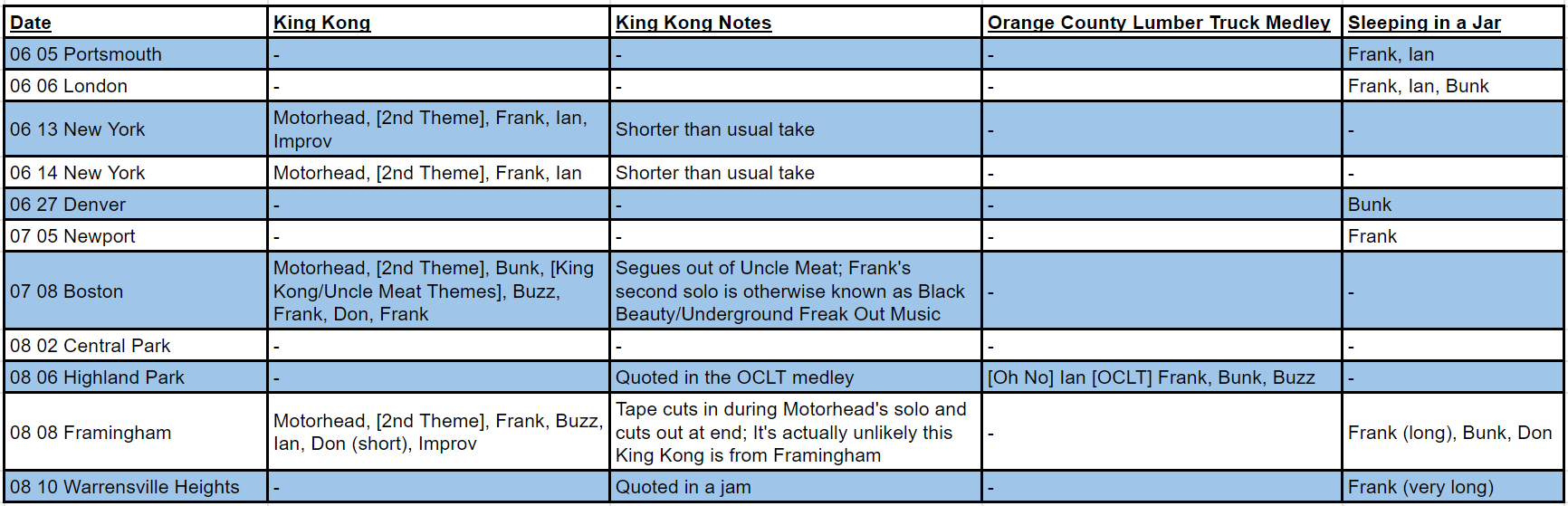
 Life On The Road