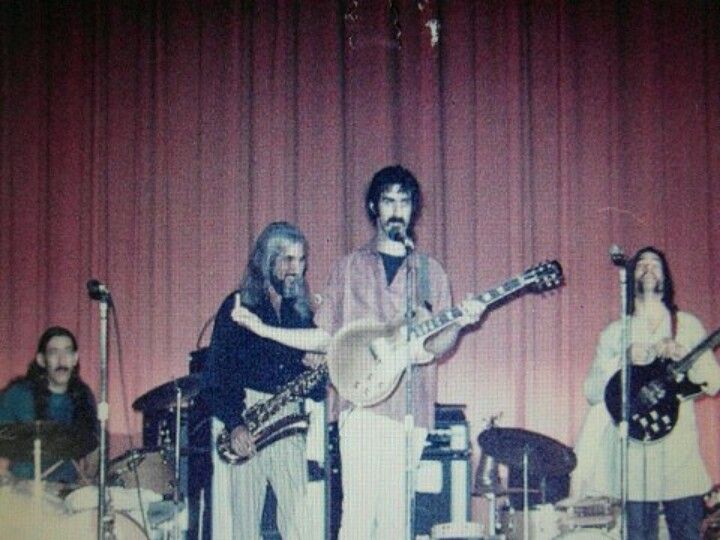
Overview:
The Mothers hit a high point with this 10 piece line up. Frank brought guitarist/vocalist Lowell George and Bunk’s brother and trumpet player Buzz Gardner into the Mothers immediately after their European Tour in the fall of 1968, ushering in a new era of the band. Buzz brings a fantastic jazz influence to the jams and improvisations of this group (he really kicks King Kong up a notch), and Lowell contributes fantastic vocals and slide guitar throughout these shows. His wailing and occasional German ranting during improvisations (like on Didja Get Any Onya off of Weasels) are defining aspects of this tour, as is his excellent slide guitar, which allowed the band to play a number of excellent 50s RnB and doo-wop covers straight from Frank’s teenage years. Buzz’s introduction changed the musical landscape too; his ability to sight read made it possible for Frank to experiment further with his weird tweaky electronic chamber music on the stage, introducing pieces like, Igor’s Boogie, Kung Fu and Some Ballet Music in this period. Along with this, Art’s percussion increasingly emerges in this era, with vibes popping up more and more in composed pieces like King Kong and Uncle Meat. Frank continued to develop his hand signals too, adding more vocal and instrumental cues to the Mothers’ repertoire, which are heavily apparent in improvisations and the piece Charles Ives. Frank was rapidly becoming more and more of a band-leader, continuously getting more comfortable talking to the audience and presenting their electric buffoonery live on stage to more and more people. This era is the largest the original Mothers ever got, and it’s reflected in their biggest sound yet. Everything feels so right here. They can play an insane number of songs, across a wide number of genres, and seemingly do anything. The Mothers’ sleazy bar band vibe just works so well with these 50s songs, but they nail all the “serious pieces” too! Fantastic tunes, crazed improv, excellent jams and endless humor define this era of the band, and I believe they mix all these things together better than any other era of the original Mothers.
Despite my previous praise, Lowell later claimed that “he performed no real function in the band” [I’ve got no better source on this than Wikipedia sadly], and I don’t really disagree with him here. He was hired to replace Ray Collins as lead vocalist, but he almost never sings lead, and you can only ever hear him play guitar when he’s soloing. He’s frequently relegated to percussion instruments or harmonica in larger tunes, but again this is rarely noticeable. He honestly feels kinda like a second (better) Roy in some of these improvisations, providing dual moans or screams with the bassist. It’s not completely clear why, but Lowell left the band in late May, right before the Mothers’ UK tour. A number of differing reasons have been given for the split, the most likely one (in my opinion), is that Frank saw Lowell’s talent as a performer and writer, and suggested that he start his own band, paving the way for Little Feat (I think having a talented guitar playing in this early period of FZ’s career probably scared him a little too, at least according to Jimmy Carl Black). Whatever the reason, Lowell’s exit signaled the end of the original Mothers, as they only existed for another ten weeks or so after his departure, but while he was in the group the band was at a creative high point. Frank Zappa and his Mothers Of Invention put on some of their most inspired and lively shows of the 60s in the first half of 1969, and these recordings prove that fact.
[And like I mentioned in the last page: Lowell George and Buzz Gardner joined The Mothers in late November 1968, but we basically have no recordings from their first two months in the band (apart from a single song). It’s simpler and cleaner to categorize this incarnation of The Mothers as the first half of 1969, which is why I’m doing it that way. So, just keep in mind that drawing the line between the ‘68 and ‘69 MOI like this isn’t entirely accurate, but it is easier.]
The Band:
Frank Zappa – Guitar, Vocals, Disk Jockeying
Jimmy Carl Black – Drums, Lewd Pulsating Rhythms
Roy Estrada – Bass, “More”
Don Preston – Keyboards, Transformations
Bunk Gardner – Woodwinds, The Silver Fox
Ian Underwood – Keyboards, Woodwinds, A Terrible Virus
Motorhead Sherwood – Baritone Sax, Tambourine, Stage Presence
Art Tripp – Drums, Percussion, More Lewd Pulsating Rhythms
Lowell George – Guitar, Vocals, Harmonica, Güiro, Small Feet
Buzz Gardner – Trumpet, Nepotism
Recordings Available:
1968 12 06/07 – The Shrine Exposition Hall, Los Angeles, CA
(YouTube blocks the Weasels Demo/The Artisan Acetate)
The earliest recording we have from this updated Mothers of Invention, comes from the opening track of the bootleg known as the Artesian Acetate, which has recently been discovered to be a working version of Weasels Ripped My Flesh! The acetate was compiled by Frank as an early version of what would become Weasels, and eventually found its way into the bootlegger community. The proto-album opens up with a performance of Wipe Out, that the label lists as coming from the “Shrine Auditorium”. The original MOI never played the auditorium, so it likely comes from the very closely titled “Shrine Exposition Hall”, which The MOI did play. The Zappa fan community has somehow determined that this performance is most likely from the December ‘68 shows at the Shrine, and not the later event in January ‘69. The December shows were a big deal with a lot of friends of the Mothers opening up, including Jeff Simmons, The GTO’s, Alice Cooper, and Wild Man Fisher. Anyway, this one track opens up with a fan member requesting the band to “play something plastic”. Frank suggests Wipe Out, and then proudly proclaims that “ We don’t mind prostituting ourselves for you! Wipe Out….” They burst into a fun, surprisingly straight version of the tune, before delving into conducted improvisations with crazed horns and drums, and a bit of the swing vamp too. Eventually Roy starts to vocalize, and right when he starts Frank says to “sing Wipe Out!”. Roy laughs and starts to sing “I wanna wipe out, a wipe, I wanna wipe out, a wipe…..”, which eventually cascades into more moaning, singing, laughing, and heads right back into the composed theme of Wipe Out, which ends the set (“We’ll be back in a little while… Thank You!”). Overall it’s a fun track, but I can’t say much on the whole show based on this one song. Maybe we’ll see a vault release some day? [For more information on the event, check out its entry on IINK here.]
1969 01 31 – War Memorial Auditorium, Boston, MA (Audience B+)
“I suppose the reason we’ve been brought to this festival is to provide some sort of comic relief. We’ll do our best to tickle your funny bone, but somewhere along the way we had hoped to cram in a little bit of music”. The Mothers’ performance at the Boston Globe Jazz Festival recently surfaced, and it was well worth the wait. This show is fantastic, mainly because of a special guest: legendary jazz woodwind player Roland Kirk! (he wouldn’t add Rahsaan to his name until the following year). Roland was blind, so he was joined on stage by his friend and assistant, percussionist Joe “Habao” Texidor, who helped the mad saxophone player understand what was going on onstage. Frank explained the encounter in an interview with ZigZag magazine a few months later: “We were on the same show and I met him after he had done his part and said ‘Would you be interested in playing with us?’ And he said he didn’t know. And I said ‘Well, you’ve never heard the group before, you don’t know what we do. If you like it, come on out on stage and start playing, and we’ll back you up.’ So we’d played for about five or ten minutes and he came wheeling out there with horns hanging all over him and blew his brains out.”
Anyway, Frank dedicates the first piece to Boston mayor Kevin White while the band gets ready, and then proclaims “And now after all that elaborate tuning up, this is what our music sounds like!” Starting with a conducted crash, The Mothers play some insane, discordant, classic MOI improv, with a few “Hands Up, Poo-Aah”s, the swing vamp, Roy’s Gas Mask-esque howls, and an early appearance of Lowell’s faux-German routine. Frank starts a scary vocal jam, which quickly turns dumb when he starts to chant “doo-doo” and the whole band joins in after him. They return to the cheesy little swing vamp, over which drums roll and cymbals crash, signaling the upcoming monster King Kong, one of the best performances of the tune from the 60s. It starts off strong, with lovely solos from Motorhead, Lowell, Don, and Buzz. Roland suddenly climbs on stage partway through Buzz’s trumpet solo, and this is where the show really kicks off. Kirk goes nuts for the remainder of the tune, and we move into an awesome, free-ish jam once he finishes, with contributions from most of the MOI (most notably Buzz, Frank and Bunk). Frank conducts madness throughout, with at least two major vamp changes in the 20 minute jam, and a number of other cues (additionally there’s random waves of saxes throughout Motorhead’s solo and a bit of the swing vamp during Don’s). They eventually delve back into more controlled chaotic improvisations, and finally Frank cues a reprise of the second theme to end this incredible musical event. FZ then cues more weird improv over the ⅝ drum riff, which Roland picks up on pretty instantly, seamlessly blending in with the Mothers’ madness. We get more horn honks, conducted vocal madness, and a number of strange sounds from Kirk, including like sucking sax noises, and weird vocalizations through his horns. This moves into another disturbing vocal jam featuring Roy and Lowell. There’s some more slide whistles, and Frank cues the ⅝ riff again, and Bunk starts to solo over it. When he’s done Roland plays a short solo, but while he does, Frank begins this surprisingly pleasant guitar riff, which the rest of the horn section pick up on. The improvisations get a really grand, triumphant sound (all over the perturbed ⅝ riff), but they turn sour again as Roy starts to “sing” and the horn/guitar riff peters out. This morphs into some brief screeching flute improv from Roland, which leads directly into The Pachuko Hop of all things! We get a fantastic take of the tune, with lots of slide whistle, and a handful of honks from our guest performer. They head right into Behind The Sun (these two tunes are always linked), and we get a series of fun solos from all our lead players. The non-Frank Mothers all go first (In order: Bunk, Lowell, Ian, Don, and Buzz), then Roland steps up for a mean tenor sax solo, and Frank wraps up the jam with some quality RnB guitar work. This riotous performance brings the main set to an end, but Frank quickly returns to tell the crowd “Mr. Kirk has agreed to perform another tune with us… The name of this hot little number is All Night Long, recorded by Joe Houston in ninteenf-, forget it… This is All Night Long. With choreography”. That last comment refers to the sax players (Roland included) lying on their backs and kicking their feet in the air. We get a wonderful take of the tune, with Roland whipping it (them?) out once again, and providing another hot solo in this final tune. The crowd goes absolutely nuts for this finale, and you can just feel the fantastic, high-spirited energy in the room. The musicians leave the stage again, and our recording closes out here. While introducing the final tune, Frank says “a little later for the kids in the audience we’ll play Louie Louie”, and a newspaper review also reported that they played a short version of Plastic People, but if this happened it wasn’t captured on this tape. Once again, this is a fantastic set, showcasing a rare collaboration between two cult geniuses. It’s something that needs to be heard by fans of either artist, and on top of all that it’s captured in great sound. Check this one out!
[Frank and The Mothers played with Kirk again at the Miami Jazz Festival in June ‘69, but there is sadly no known recording of this event. Percussionist Gary Burton joined them too!]
1969 02 08 – Thee Image, Miami Beach, FL (Audience B+/B)
This solid concert is the second of three The Mothers performed in Miami, after a week of recording sessions at Criteria Studios in North Miami. It’s a solid recording, but there’s some unfortunate cuts near the end that hurt the experience. Anyway, to the show. Frank utters “bout ready to go?” to the band before launching into our opener: the first known take of My Guitar Wants To Kill Your Mama, and surprisingly, they play it as an instrumental. The tune works much better with vocals, but this chugging early version is fun too. Frank plays a nice, restrained solo over the end of the song, and leads the group directly into some conducted improvisations featuring wild horns, tweaky keys and the unforgettable goofy swing vamp. FZ then cues a bunch of vocal noises, which really amuses the audience, and draws Frank’s attention to them. He tries to get them to “peep” on command by holding out his middle finger and quickly raising it. (“I want you to sing the highest note you can for a very short period of time, as if this finger made contact with you personally”). He dubs this the “Miami stink finger” and announces “a teenage love song for you direct from 1955 called Those Lonely Lonely Nights“ (and when a fan objects, he asks them “want an enema?”). They play a rockin’ version of the 50s tune, and then Frank has a long, long chat with the audience. Some drunk in the crowd named Bill has been sorta heckling Frank throughout the night. Frank starts to tell the crowd they’re “a much more relaxed, [and] well adjusted audience then” the last show, but then Bill shows up again and Frank has to fuck with him for a while. He comments that “obviously he didn’t receive enough love at home, and he probably didn’t get enough attention at the public school, he’s probably facing the draft, probably made some local connections, [and] got a hold of some bad shit”. Frank then goes on to say that “perhaps on television you’ve seen some of the faith healers operate, and the way they operate is that the faith healer will lay his hands on you. Everyone in the audience, lay their hands on Bill.” He eventually lets the dude come on stage and ramble for a little while the crowd boos him, and finally ends him with “the boy has made several very important points, but he hasn’t gotten laid yet….”
Now that “the music of America” has ended, Frank can introduce the next tune, a song about a “a place in California where the bulk of the John Birch society makes its residence, and the Minutemen, and probably the American Nazi Party, all those swift organizations”: The Orange County Lumber Truck! (“And from what I hear about Miami, it’s not too different….”). We get another very nice version of the tune, not my favorite but solid nonetheless. Ian starts off the Oh No solo and Frank comes in about a minute after him for an excellent sax/guitar duet. Frank, Don and Bunk each play a fiery solo in Orange County proper, and we get a smooth segue into more free improvisations. They start off very slow, like the Lumber Truck has crashed and is on fire, but before long the intensity picks back up with some crazed trumpet from Buzz. Then suddenly Frank cues the ⅝ riff, and full insanity starts to break out. He cues a crash and a drum break and suddenly we hear the familiar second half of Toads Of The Short Forest off of Weasels Ripped My Flesh! (The preceding drum fill was also used by FZ, at the very end of Gas Mask on Weasels!). It’s great to hear the “alto sax blowing his nose” in its original context, and it’s cool to know that Frank didn’t do much editing to it, besides attaching it to the melody of Toads. As they mellow down, Frank starts the vocal back and forth to begin All Night Long (and to conclude, the final chord of this performance ends the Weasels version of Toads of The Short Forest). Bunk (I believe) takes a nice solo in the middle, but sadly a tape defect takes out a good chunk of it. After this Frank says they’re gonna play a song that’s from “approximately the same era”, and they continue with another 50s fav: Bacon Fat. It’s a lovely take, and when they finish the recording cuts out. It returns in the middle of some beautiful, mellow guitar improvisations, with plodding drum accompaniment and vaguely middle-eastern howling from Lowell. After a little while Frank starts to play what he quickly identifies as a gregorian chant he heard, but the tape cuts off right as he starts to say how he heard it (the chant is apparently Kyrie VIII from Mass VIII, from the Brebeuf Hymnal, whatever that means). The recording resumes right at the beginning of Little House I Used To Live In, the first really full performance we have of the tune as we know it. and interestingly enough they start with an early variation of the intro heard on the Fillmore East ‘71 album. They play through the rock band theme, but the song ends immediately after the composed section. We hear applause, the tape cuts out again, and we’re thrown into a take of the ending of the rare tune Twinkle Tits! (a song identified as “Interlude”, before its 2023 official release on Funky Nothingness). It’s a lovely performance (though it’s missing the first couple seconds), and Frank quickly counts off riotous The Pachuko Hop as they finish. This, like always, heads into Behind The Sun, with fun solos from each of our lead players (in order: Ian, Buzz, Lowell, Don, Bunk, and Frank). The tape cuts out during Frank’s solo, and that brings this night to an early end. This is a really fun concert that’s somewhat hurt by the handful of cuts throughout the program (I feel like there’s definitely a song or two missing from this recording). It’s not the best show from this band, but I’m glad we have it out there, and any fan of the final year of the Mothers should give this show a listen (but again, there’s plenty others I would check out first).
Additionally, Frank recorded all three of these Miami shows, and used chunks of them on a number of different releases. As I mentioned before, parts were used on Weasels Ripped My Flesh, but other bits have appeared here and there, mainly on You Can’t Do That On Stage Anymore Vol. 5. On that specific compilation we get Chocolate Halvah, a fun little vocal jam featuring plodding drums, the dulcet tones of Roy Estrada, and middle-eastern style chanting from Lowell, part of a performance of Right There (the released track is actually partly live and partly studio), guitar and bass solos and other improv from King Kong released as Underground Freak Out Music, and a chunk of solos from a performance of Trouble Every Day titled No Waiting For The Peanuts To Dissolve (featuring Lowell, Frank and Bunk). A significantly different edit of Right There was released as Squeeze It, Squeeze It, Squeeze It on Finer Moments (click here for a chart comparing the released versions), and another different edit was intended for an early version of Weasels Ripped My Flesh (see the Artesian Acetate). A longer version of Underground Freak Out Music was released on Mystery Disc as Black Beauty (both edits contain unique material, click here for a comparison chart).The show on the eighth isn’t my favorite performance, but it’s still a ton of fun, and I’d be lying if I said I wouldn’t love an official release of all the Miami shows.
1969 02 21 – Fillmore East, New York, NY (Two Shows – Audience B-/C+ and B+/B)
Click here to listen to the early show
Click here to listen to the late show
These two shows at the Fillmore go really far out there, and we have both full shows available on audience recordings. Unfortunately, the early show is not captured on the most listenable tape. It’s very distant, boomy, and at times there’s a slight amount of tape warble that really hurts the experience. It’s just listenable enough to make out what’s going on, but not enough that it’s really pleasant to listen to. The Mothers start by tuning up (“We’ve got 10 people up here, we gotta make sure they’re harmonically synchronized”), and when they’re done Frank announces that “we started practicing this piece of shit down in Miami, the name of this tune is Charles Ives.” This is the first known appearance of this strange piece, and it’s a long and especially abstract version. The “head” of this take goes on for a very long time, with about eight minutes of Frank stopping and starting those little modules over those haunting horns, interspersed with countless moo-ahs and other noises/screams/cackles, seemingly veering into true improv at a couple points (Roy’s screams, the ⅝ riff, screeching horns, etc.). A little over halfway through, Frank finally starts the more normal “solo section of the tune”. Buzz had a brief solo over the vamp earlier, but Frank cut it off with some improvised nonsense, so when it finally returns for good, I believe Ian takes a solo. At least I think this is happening, he seems to be playing some low woodwind that’s just barely audible over the tape, and it only lasts for a minute or two. Finally, Frank starts to solo over the vamp, and we get a long, reserved solo (that’s sadly kinda hard to make out over the heavy vamp and mediocre recording quality). In the final moments of the “jam”, the horns come in with this weird, fun, honking riff, before a lovely transition into Those Lonely Lonely Nights. They stop after this, and someone in the audience hands Frank something to wear which he really seems to appreciate (“That’s the nicest thing anybody ever did, wait a minute… I don’t know how I’ll be able to stand and wear this…”). Things settle down pretty quickly when FZ says ”just calm down children… The name of this song is Bacon Fat”. We get another fun take of the Andre Williams tune, followed by “something from our new album Uncle Meat, which will be out in a couple of weeks. This is the title theme from the album, a hot little number… called Uncle Meat”. Frank then goes on to say that one of their keyboards broke and that they “don’t know how swift it’ll sound” without it (“but what the heck, you people don’t know the difference. All you like is rock n roll”). We get a fine performance of the theme; I can’t really tell any instrument is missing on this rancid little tape, but I can tell that the sound starts to get a little warble-y right here, and that it’s just enough to make listening unpleasant. It goes into a very long, kinda boring, drum duet, which FZ chose to release most of on You Can’t Do That On Stage Anymore Volume 5 (creatively titled: “FZ/JCB Drum Duet”). This segues right into more improvisations, this time featuring lots of sax honks and Roy moaning “more”. Eventually they start to play the sex tape Bunk recorded with one “Peggy”, which will be referred to as the “Peggy Tape” from this point on. Now even though they’re playing the tape and Roy is screaming over it, I’m not prepared to call this a take of Right There, chiefly because there’s no demented Run Home Slow music. They nearly let the tape play on its own, but then Frank starts to conduct horn nonsense over Peggy’s cries, and out of the madness one of the saxes (probably Bunk) starts the old standard Begin The Beguine. It’s a very chaotic take, and either Roy or Lowell sings nonsense lyrics over this insane parody performance. It becomes a march at the end, with screaming horns on top, then Frank suddenly switches to more improvisations with Bunk’s “Peggy tape” (“Don’t clap between movements!”). We get two more minutes of wildly chaotic improv, with screaming horns, the ⅝ riff, the goofy little swing vamp, and surprisingly no Roy vocalizations (which is why this is listed as “Improvisations with Bunk’s tape”). Someone starts to scream at The MOI, to which Frank responds with the classic “Are You Upset?” (FZ released a bit of this improv and dialogue as “Are You Upset?” on YCDTOSA #5). He talks to the crowd a little more (but I can’t make anything interesting out), and then transitions right into a lovely take of the Run Home Slow suite. The main theme leads into a few seconds of tweaky keyboard improv, before a short tape cut takes us into the middle of The Little March. Then suddenly, we’re right into the middle of a wild Right There (though Frank keeps Roy’s improv with the tape shorter than usual, as he already went insane earlier in the program). As Roy screams, cymbals start to crash, and we’re led into King Kong! Motorhead starts us off with his normal, abstruse bari sax solo, and after the second theme, Lowell (or possibly Frank?) plays a mean guitar solo. About 5 minutes into the tune, Frank (I think?) starts to solo, cues a neat horn vamp, and then quickly ends the piece, and the set (“we’ll be back for a second show later”). They return for an encore, but when they do someone throws something on stage and it clearly pisses Frank off (“Well it’s not quite as bad as Berlin”). He then announces that “we’re gonna play a teenage version of Octandre for you”, and proceeds to whip out a wild version of the Varese piece (“Brace yourselves…”). They play through it once, and then devolve into screeching, feedback laden improv, very reminiscent of the Weasels Ripped My Flesh title track. Frank eventually utters a final “Thank you”, and the early show is over just like that. This is a short, chaotic fun show, but unfortunately the recording quality is not equally fun. As far as I can tell it just gets worse over time, and while this is a neat show, it’s not fantastic enough to make listening to this C+ tape worth it. Better versions of all the songs can be found on other tapes, so ultimately, I can’t recommend this show to anyone besides the ultimate Zappa freaks.
The late show at the Fillmore is significantly more interesting, and is captured on a significantly better tape. The quality still isn’t perfect, and this still isn’t my favorite gig from the era, but it’s miles ahead of the early show. As members of the MOI start to walk on stage and tune up, Bill Graham (I assume) announces “Here they are, just one or two at a time, nice and easy, nice and slow, the Mothers Of Invention!” Frank then greats the audience and announces that they “have a couple of hot items for you tonight boys and girls. One of the things that will happen sort of automatically in the middle of the program, is uh, on the giant screen behind me we will have projected the trims and outs(?) from the Mother’s movie Uncle Meat. And part of the time while that is being projected, we’re going to make an attempt to score it like they do in a regular scoring session because the program this evening is being recorded for some future disaster…” There’s no other mention of video in this show, but we know from the following gig in Toronto, that the film breaks down either while they’re performing or before they can even show it at all.
Anyway, they finish tuning up, and Frank says that they’ll start with a “A hot new number, kids”: the wonderfully whacked Kung Fu. Frank cues a “Hands Up!” (“Poo-Ah!”) in the middle of the insane tune, and as the piece ends with screeching horns, they make a classy segue into the beginning of another take of Charles Ives. It’s a very nice performance, with the normal long horn notes and a number of “moo-ah”s from Roy. Frank cues all three modules, then returns to the “main” one and Buzz plays a mean solo. After a little while Frank stops the vamp and we return to more moo-ahs, for about a minute, then the vamp returns and we get a long, thoughtful, and pleasant FZ solo. Ian starts to solo over the very end, but before long we segue into some whacked improvisations. Frank cues ⅝ riff, then the ⅞ riff, then the ⅝ riff again, and then has the horns solo on top of it. Eventually Roy starts to moan a bit, and Frank comes in with a perturbed guitar riff (possibly quoting Octandre?). After more vocal nonsense from Roy and Lowell, the horns start to slowly play Lohengrin. Lowell(?) sings lyricless vocals on top of it, and the tune quickly delves into more sax madness after. Then there’s the swing vamp for a bit, then some electronic improv, which gets very ethereal and even tweakier. Finally Roy returns to moan more nonsense. Frank cues ⅝ riff, then Roy sings “more” a la right there, and this continues until Frank signals the start of the String Quartet! (According to FZ Shows there is a quote from RDNZL at the start of these improvisations, but I can’t hear it). We get a surprisingly fast take of Pound for A Brown, with the normal crazed woodwind/guitar improv in the middle, and a nice, long, restrained solo from Frank. His guitar is a little low in the mix (that applies to the whole recording too), but it’s still an enjoyable jam. They then move into Sleeping In A Jar, with a surprisingly low amount of mid-theme improv/screwing around. A great jam follows the theme, with nice solos from Frank, Lowell, Bunk, and Ian. The sound gets a little worse after Frank’s solo, and Ian’s solo is played over a more deconstructed version of the vamp (apparently someone quotes Latex Solar Beef in the String Quartet, but I have yet to identify it). As Ian plays his solo, the rest of the band falls apart, and we return to some classic MOI free improv. It starts loud, but then gets very tweaky and quiet, with lots of ethereal moaning and a surprising amount of vibraphone. After a little while of this, we return to crazy horn improv, this time with snorks, and nonsensical ranting. Bunk talks about something I can’t make out, Roy talks about cheeseburger buns yet again, and Frank cues a “hands up poo-ah” in the middle (this is labeled as “Snork Fest” on my tape, but there’s really only a handful in these improvisations). Eventually they morph into some cheesy 30s-esque lounge music, which is brought to a sudden stop by the ⅝ riff and more random vocal cues.
To end this segment of the show, Frank just randomly starts a fun little improvised rock and roll boogie. Ian plays a nice sax solo, Frank plays a fun little guitar jam, and Bunk follows it up with the truest solo of the three. After about three and a half minutes of this FZ announces “Now we’re gonna have a twist contest, we’d like to have one contestant, one plump girl from the audience to come on stage and do the twist with Motorhead!” The crowd cheers, so I assume someone does; they play the dumb little vamp for a few more minutes, before Frank delves us back into the chaos that is the ⅝ riff (it’s a perfect transition, almost makes me laugh at the juxtaposition). They stop momentarily, and Ian (probably not Don?) begins to play some classical, Mozart-esque piano. They stop again, Frank says something I can’t really make out, and the classical piano continues but with vocal nonsense on top. Lowell is singing the lyrics to the old blues tune Stormy Monday, while Roy sings the melody to Holiday In Berlin! The band seems to be falling apart as they sing, so the music gets weird and quiet, until Frank suddenly says “we’ll see you later” and ends the show. The Mothers quickly return, and FZ announces that “We’ve had a request for a song called Valerie, which was originally recorded in 1958 by Jackie and the Starlights on the Fury label…. Nothing abstruse or arcane about Valerie….” They precede with a lovely version of the tune, and when they make it through 90% of the song, they stop cold and Frank ekes out “Valerie you pig……” He then proceeds to tell the regular long, highly entertaining story about life in the 50s. He talks about going to the “junior senior hop”, picking up your girl in your really “charp” car, getting your jelly roll haircut just right, and heading to the drugstore to pick up “three pints of Robitussin AC” (among other 50s intoxicants) so they can get “tore to the core”. Frank continues to talk to Valarie in his unnamed greaser persona, describing the hop at length. He goes on to say that “the saxophones were going boop-beep, boop-beep, and we were getting wasteder and wasteder by the minute. The room was going around in a veritable frenzy of colors and weird shades, man. I thought I was really flashing on the whole thing. Then I reached out and tried to cop a few of you while we were dancing and you kicked me in the nuts.” The crowd bursts into laughter, The MOI immediately play the 30 second ending to the tune, and this raucous concert comes to an end. This is a really weird, but also very fun show. If you’re a fan of the more abstruse side of the original Mothers, be sure to check this show out. It’s not my favorite one from this band, but it’s still well worth hearing. In summary, check out the early show if you’re a die-hard Zappa freak and need to hear everything, but the late show is really where it’s at, both in terms of sound and performance.
[The Mothers also played two shows at the Fillmore the following night, but we have no recordings of this performance. We know that Jimmy Carl Black’s Swedish “friend” Shirley Ann was a guest singer at this show, and I don’t think Frank ever played a bad night in New York, so I imagine those unheard shows on the 22nd were quite a riot.]
1969 02 23 – Rockpile, Toronto, Canada (Soundboard A)
We next join the Mothers on the first of four shows in Toronto we have from this era. We only have the early show from this date, but it’s captured on an outstanding soundboard recording. And on top of all that, it’s one of the best dates of the year! Frank comes on stage, and tells the crowd to “get all your pictures taken now because if any flashbulbs go off while we’re playing, we’re gonna stop.” The Mothers pose for the cameras, and Frank hears the fans screaming “we want Ruben!”, which gets his attention (“I see, you people are into Rubenism”). He then decided to start the program by playing “some entertainment music” and we get a fantastic take of Bacon Fat, followed right after by an equally great take of Those Lonely Lonely Nights.
“Thank you. I guess we might as well get all this old time music out of the way in one bunch [boos] Oh, don’t get us wrong we like to play it. It’s really easy, it doesn’t… hardest part about it is dancing around.” Frank then talks about a number of different things, starting with “ a dismal piece of film called Uncle Meat.” He says they would’ve shown parts of the movie if the tape didn’t break two days earlier in New York, though they probably couldn’t have gotten it through customs anyway (“they would have grabbed that film and smoked it before you ever got a chance to see it. But I guess you can’t blame those people for being careful who they let in. I know if I own the country, I wouldn’t let The Mothers into it without thinking twice”). He then starts to introduce a Mexican polka entitled the Corrido Rock. Frank tells a long, highly amusing story about the “marvelous teens of the 50s [who] would gather at the El Monte Legion stadium” in southern California and violently dance to this tune. (“the dance is executed by running back and forth you know, just backwards and forwards like that with your arms all locked together, and the idea is to round up as many paddies as you could and jam ‘em against the wall”). Surprisingly, Motorhead tunes up for this number (he’s actually playing something composed on sax!), and we get an excellent take of The Corrido Rock (the sole known performance from the MOI). It’s a short number, with screams from Roy layered on top of the Mexican polka, and it leads directly into the Pachuko Hop, another El Monte staple. It’s an exemplary take, and it heads right into Behind The Sun (like always). We get another great performance, with quick solos from all the lead players (Bunk?, Buzz, Lowell, Don, Ian?, Frank). After five 50s tunes in a row, Frank’s ready to “get into something a little bit more complicated”: The String Quartet. We get an amazing take of the piece, one of my favorite performances of the medley from the original MOI. Pound starts us off, and the mid-tune improv is surprisingly tweaky. The woodwinds really go at it, and Frank comes in near the end of the sections with some jazzy, dissonant guitar. FZ ends the first tune with a sick, rocking guitar jam, and he quotes The Russian Dance from Stravinsky’s Petrushka at the very end of his solo. This of course transitions into a fantastic Sleeping In A Jar, with wonderfully crazed improvisations during the theme (Frank cues the band to all say “Donnieeeeeee” right as the head is ending). Frank starts off the jam with a long tasty solo, Bunk follows it up with a nice tenor sax jam, and Lowell ends the tune with a rare harmonica solo. Lowell is kinda buried in the mix, but eventually this super cool horn riff comes in and builds and builds until we’re eventually deposited into the piece known as Charles Ives!
Buzz starts playing haunting trumpet, and the rest of the horn section slowly follows him in, eventually coming to a beautiful, frightening peak after about a minute. On top of this Frank cues the rest of the band to play a number of weird little repetitive modules. There’s then some incredibly strange and varied conducted vocal improvisations, with Raspberries, ch-ch-ch- noises, yelps, howling and another long “Donnieeeeeeee”. This eventually comes to a frenzied peak, where Frank cues the primary module/riff and turns in into the vamp for a solo section. We get two great solos, from Buzz and Ian followed by a duet from Frank and Bunk. Ian and Bunk both play a little bit of the very beginning of Stravinky’s Rite Of Spring in their solos (probably inspired by Frank’s earlier quote). There’s a tape error taking out some amount at the very beginning of Frank’s solo, but it doesn’t hurt the flow of the song very much at all. Eventually Frank drops out to leave Bunk soloing for a little, but then stops the vamp and brings us back to similar weirdness (but with a screaming horn instead of long held notes). Eventually Frank has the band repeat some of the secondary modules, and brings the strange jam to an end. After this epic instrumental, Frank decides to play some more rhythm and blues “as sort of a comic relief.” He announces that they’ll play WPLJ, “a song about white port and lemon juice, which is what American teenage boys and girls used to get ripped on during the 50s…” (After you get tired of smoking dope and taking pills, and shooting speed and, y’know main lining, and doing, taking acid, doing all the weird trippy things that you do in order to be an acceptable, socially, teenager, try drinking white part and lemon juice and see what it gets you. [some claps, some boos]. Obviously it’ll just make you throw up no cosmic experience involved whatsoever”). We get a lovely performance of the dumb-little tune (the only known live take from the 60s), and as it’s ending Frank does his best radio DJ voice to proclaim: “And that was White Port And Lemon Juice by The Four Deuces and now we have Oh In The Sky by Roy Estrada and the Penguins” It’s a standard take of the purposely atrocious, parody doo-wop number, and acts as perfect comic relief to the earlier comic relief of WPLJ. “Now we’re going to play a rocking teen number”: All Night Long (“I don’t want to get too much in tune because it’ll make the piece sound too erudite and then it won’t be characteristic of the period”). Frank and the band play yet another great take of yet another 50s classic, but this one brings this riotous show to an end. It’s possible there was an encore, but if so we don’t have it on this tape. This show has the perfect blend of lovely 50s tunes and wild instrumentals, and it just makes me so happy. Plus:it’s one of the best sounding tapes of the 60s! Listen to this one as soon as you can! (unless your not big on Rubenism, but as Frank said in Miami, “Listen to it again you might like it…”)
[We don’t have a recording of the late show, but from reviews and reports we know that Zappa associate Carl Franzoni appeared on stage near the end of the program to moon the audience. Definitely something I’d love to hear, but maybe not a show I’d love to see!]
1969 02-03 XX – Dick Kunc’s Uher Recordings – Various Locations (Partial Official Releases)
Frank’s engineer Dick Kunc built a recording/mixing apparatus mounted in a briefcase and brought it along to record shows on The Mother’s east coast tour in February and March 1969. These recordings ended up on a number of official releases, most notably Weasels Ripped My Flesh and the You Can’t Do That On Stage Anymore [YCDTOSA] series, among others. Frank recorded and released a handful of segments from the Miami and Fillmore shows in February, but I talked about those in their respective show entries. What I wanted to discuss here are all the other officially released recordings where we do not have access to full shows to compare them to. (click here for more information on Mr. Kunc’s strange recording setup).
1969 02 14 – McMillin Theater, Columbia University, NYC
The earliest gig to fit into this category comes from Columbia University in New York. Frank released a long chunk of tweaky instrumental improv as “You Call That Music?” on YCDTOSA #4, and released great performances of Charles Ives, Here Lies Love, the Main Theme To Run Home Slow, and The Little March on YCDTOSA #5, along with some subtle percussion improvisations titled “Proto-Minimalism”. The take of Charles Ives is definitely edited down, but we get the head of the song (if you can call it that) and Bunk’s trumpet solo. These recordings contain the only known take we have of Here Lies Love, which is excellent, and I assume Frank edited Right There off from the end of the Run Home Slow medley. FZ had plans to release longer edits of You Call That Music? on an early version of Weasels Ripped My Flesh (AKA The Artesian Acetate) as “East L.A.” and on Finer Moments as “There Is No Heaven From Where Slogans Go To Die”. Also, Joe Travers released a solid version of the theme of Uncle Meat from this show (along with Frank’s amusing introduction of this “curious little item, which happens to be the title song from our new album”) on the archival release Meat Light.
1969 02 16 – The Ballroom, Stratford, Connecticut
Another handful of performances have been released from this February gig in New England. We have a whacked performance of Sweet Leilani from Stratford on YCDTOSA1, complete with spoken introduction (“Just pretend it was thirty years ago…”), along with most of a performance of the Orange County Lumber Truck Medley. Frank put the first composed segment of the tune (up to Oh No) on disc one, and he stuck the excellent take of Oh No (complete with guitar solo) on disc two, but the full Orange County Lumber Truck ending and jam were left in the vault. He also put out an edit of a performance of Right There as “Skweezit Skweezit Skweezit” on Mystery Disc (and he considered a different hybridized edit of this performance for release on Finer Moments as the more correctly titled “Squeeze It, Squeeze It, Squeeze It”). Finally, Alex Winter and Joe Travers released performances of the title theme from Run Home Slow and The Little March as vinyl exclusive backer rewards for kickstarting the official Zappa documentary (thankfully these can be found on YouTube).
1969 02 28 – The Factory, The Bronx, NYC
Frank released quite a few bits from this show, but really no complete performances. He excerpted a mellow guitar solo from a larger jam, attached it to a short clip of Motorhead rambling in the studio and titled it Get A Little (as heard on Weasels). I think this fun little solo comes from a Sleeping In A Jar jam, but that’s really just my best guess (and it’s mainly because of the background percussion). Roughly two decades later, Frank released a performance of Plastic People on the first YCDTOSA (along with some very amusing introductions about the “green Chevy, license number 650 BN in Barry’s lot” and the “burgers in the back”) and then dropped the only known ‘69 take of Tiny Sick Tears a couple years later on volume number four (“I know that it’s so hard to stop playing this soul music, you know, cause for one thing it’s really easy….”). Then on volume five he released three more tracks: A small segment of the theme of Little House labeled the Return Of The Hunch-Back Duke, the first four verses of Trouble Every Day (but not any of the solo section) and a fragment of some dialog with the audience titled “Where Is Johnny Velvet?” (which is a slightly-incorrect reference to Billy Velvet’s performance of Hang On Sloopy in Central Park half a year earlier). These tracks are all fun, but they are definitely hampered by the fragmented nature (the cuts on vol. five are especially bad). There’s not a whole lot to listen to at the moment, but this is a show I’d really like to hear the full performance of! (I’ll take anything from New York in the 60s).
1969 03 02 – Philadelphia Arena, Philadelphia, PA
The final known Kunc tapes come from Philly, and these are some of the weirdest used/released ones. The iconic Didja Get Any Onya? off of Weasels come from this show, and Frank actually released two different edits of this, the normal one from the Weasels LP (available on streaming services), and a long version only available on the pre-2012 CD releases. Both versions contain an improvised performance and a segment of Charles Ives, but the early CD releases contain an additional chunk of Charles Ives, most of a performance of Kung Fu, and little more improv to end us off. This performance of Kung Fu, along with the first half of an early take of Igor’s Boogie, and a segment of the future fourth theme of King Kong (with some FZ soloing) were on an early build of Weasels Ripped My Flesh (bootlegged as “The Artesian Acetate”). The same takes of Kung Fu and Igor’s Boogie were also at one point intended to be on the History And Collected Improvisations Of The Mothers Of Invention, but that project never materialized. It’s unknown if that theme of King Kong was played standalone here, or part of another jam (The performance is labeled “Passalaglia” on the acetate, which is probably a misprint of “Passacaglia”). This performance was also used as the background for a radio ad for Hot Rats, released as “Vintage Promotion Ad #3” on The Hot Rats Sessions Box. Overall a very strange set of performances, in a strange assortment of places. This is another one I’d love to see an official release of (I know they’ve got it!!!).
1969 03 15 – Titan Gymnasium, Fullerton, CA (Stage A-/B+)
This is another solid show from early 1969, and a quite famous one at that. This is because most of the show was released on the Beats The Boots series as Our Man From Nirvana, and because it features a special guest appearance from the utterly unique Wild Man Fisher, but more on that later. We have a very nice stage tape of this show, recorded by Don Preston, but Ian Underwood is unfortunately not present for this performance. Frank tells the audience that “Ian, our world-renowned alto saxophone player and teen appeal member of the combo, was afflicted with a terrible virus on the East Coast and is now lying on his back coughing and sweating and being fed chicken soup at his girlfriend’s house in New York. So he missed out on the big Orange County gig. Lucky devil.” Anyway, the show begins with Frank announcing that the lights, by law, must stay on, “because they know that if it gets darker than this, you Orange County teenagers get vicious. You hold hands, you kiss each other, and you rub various strange parts of other bodies in the dark, and Orange County mothers and fathers, and members of the John Birch Society would not like to see that happen in a gymnasium. The only thing that you’re supposed to do in a gymnasium is get sweaty and smell bad. But you can’t do it rubbing somebody else’s tits. Or pee-pees either.” He lets us know that Ian’s not here, and that “some of the tunes that we’ll be playing tonight might sound a little weird because there’s a part missing from them.”, tells some fans to be careful of the audio cables so their “feet don’t light up”, and begins with a song “originally recorded in 1956 by Andre Williams”: Bacon Fat (“A giant vocal extravaganza”).
Bacon Fat starts the show off very well, my only complaint is that Frank’s vocals are kinda low in the mix (but this is really the only song he sings lead on on this tape, so it’s not a huge problem). They finish the dumb little tune, Frank complains that “gymnasiums were not designed to have music played in them… They’re for socks and people who like to jump around with balls and stuff”. He then announces a piece from their upcoming album Uncle Meat, “The String Quartet”, which is “one of those songs that is bound to sound funny without the alto sax”. Pound For A Brown does sound kinda odd with just the one sax, especially the long composed woodwind section in the middle, which is now a strange composed solo. The mid-song woodwind improv feels strange too, but Buzz and Don fill out the sound enough to make it still work. Frank whips out a fantastic solo as the tune ends, supercharged, possibly in an attempt to make up for the off performance. It leads into a wonderful Sleeping In A Jar, which sounds way more normal than Pound did. Don accidentally pressed the pause button during the head, which takes out the bridge and most of the third run through of the theme. This is, like usual, followed by a long, lovely jam, featuring FZ, Lowell, Bunk, Buzz and Don. Frank makes the backing vamp more upbeat and uptempo during Buzz’s solo, and as Don’s solo ends, he conducts some more madness, then suddenly, Zappa-associate, and local schizophrenic man Wild Man Fisher takes the stage. He performs two of his originals, a shortened version of The Wild Man Fisher Story, and a performance of a new song: I’m The Meany (FZ: “That’s pretty good. Haven’t heard that one before”). Both tunes are acapella, and kinda disturb me, but Larry Fisher’s only onstage for a few minutes [for more thoughts on Wild Man Fisher, see the song entry]. Once he’s finished Frank says that “ Larry will be back in a few moments, boys and girls. Meanwhile, here’s a few words from the Mothers Of Invention.” and the recording quickly cuts out. Larry does not come back on this tape, and the recording comes back in the middle of another tune, so it’s possible there’s quite a bit missing in this cut. When we return, Frank is telling a long story about living life in the 50s, getting “tore to the core” and going to hop. He’s pretending to be Ruben (of Ruben and The Jets fame) and he’s talking to his fly girl Valarie, which leads me to believe that they played most of a performance of the Burnt Weeny Sandwich cover tune, then Frank started his usual improvised monologue, and this is where our recording resumes. Someone in the audience yells out “Alice Cooper!” (who was one of the openers tonight), and the timing really seems to confuse Frank (“Investigate this boy”). After this he ends the story by blurting out “and then I tried to play with your tits and you hit me in the face”, before they quickly play the last 30 seconds of Valarie. Frank then tells a regular version of the legend of King Kong, “the story of a large gorilla”, before launching into a long, epic version of the tune (“The gorilla is on an island, eats bananas, has a good time all day long….. then they kill him”). We get a 30 minute long monster version of the tune with solos from Motorhead, Lowell, Don, Buzz, a long jam from Frank and finally Lowell again to end the jam. There’s a short cut while Buzz is playing, but it’s barely noticeable. FZ conducts the band burning Buzz’s solo, and ends up with a more Boogie-like beat for the remainder of the tune. The jam begins to mellow a little, and Frank really suddenly stops the music and says goodnight. The venue’s emcee comes out to give the band another hand, and bring the show to a close, I guess without an encore. This is a really enjoyable show, not my favorite from the year, but historic and really fun throughout. It’s not the best paced show, we have one RnB tune, a long instrumental jam, an insane Wild Man Fisher performance, half of a parody doo-wop lecture/song, and another long instrumental jam, but all of the performances are hot fire (though Ian’s presence is sorely missed). It wouldn’t be the first show I’d listen to, but any fan of the original MOI should enjoy this show. I say give it a listen, just check out a couple others from this era first.
1969 04 25 – Queens College, NYC, NY (Audience B-/C+/C)
This was a very good show, but the current listening experience is really hampered by the frequently rancid tape quality. At best the recording is a little distorted though still listenable, but at its worst we have some horrible tape speed warble (caused by low battery on the recorder) that really pushes the limits of what I can sit through. Additionally, there’s two dudes high out of their minds laughing hysterically at nearly everything that happens tonight. This might bother some people, but I think it kinda adds to the ambiance of the field recording (and they’re really enjoying the show, it’s not like their heckling). But despite all this there’s some really interesting stuff here, and I think parts are definitely worth a listen. Anyway, the tape begins with a long set of improvisations. It starts with just the drums (probably acting as a soundcheck), and about three minutes in Don comes in on the keyboards. A few minutes after this Frank comes out and starts conducting the band, and the “piece” gets even tweakier. Horns come in, followed by the rest of the band, then some crazed electronic improv, followed by more of the horns. Frank cues the ⅝ riff to suddenly change direction, then starts to play a weird little guitar solo over it but then cues a hard stop to tune. They stop the riff for just a few seconds though, but he immediately starts it back up again, and then just as quickly stops another time. This is a real tuning break though, and Frank uses it to introduce the show (“Hello Boys and girls, welcome to the Mothers of Invention show. It’ll take us a few minutes to get tuned up, but you won’t mind will you. It’s a reflection on your attitude of tolerance and patience.”).
After a couple minutes of tuning, Frank cues the ⅝ riff again at exactly the same intensity, but just for a second before he starts the opening notes of Bacon far (which is absolutely hysterical). Frank’s vocals are too quiet in the beginning of the tune, but they fix it by the chorus. After a regular performance of this RnB classic, Frank introduces the next few tunes, firstly Uncle Meat, “followed by a new tune, which has never performed on the bandstand before, composed by none other than Uncle Meat himself, Don DeWilde: and the name of this song is The Eye of Agamotto, if you can comprehend that.” We have a nice performance of Uncle Meat, though the warble starts to come through here unfortunately and it only gets worse as the show goes on. It’s followed by a minute long drum duet (or maybe a solo?), and it heads right into the world premier of the aforementioned Don Preston original. It’s not the strongest take of the tune we have, and it’s hampered by the recording quality, but it is still pretty fun. After the jazzy head, we get a nice flute solo from Bunk, a heavily distorted key solo from Don and a sax solo from Ian (I think, very hard to tell what’s happening here). After these more conventional solos the improv gets more and more abstract, until we finally return to the delightful head. It’s a very nice performance, but again, the sound is solid C+ territory. They stop to tune again, Frank tells the crowd that they “went to dinner down the street at this Italian restaurant, and some of us may not live” and introduces Hungry Freaks Daddy. We get a fun, standard, rockin’ take of tune, ruined by the sound, and after this Frank comments that, since the “PA system leaves something to be desired, we’ll journey into the realm of instrumental music for a short while with a collection of little concert pieces”. This weirdo suite is probably what I find to be the most interesting aspect of the tape. They start off with “an item for piano and drummer”: Redneck Eats, and afterwards they transition into conducted drums, followed by a minute of cued vocal noises (mainly “yee”s and pukes). Frank then stops to say that “this section of the piece is subtitled The Return To The Colony Of Exiles; this next section is called Kung Fu” (“an item for horns and noises”). They play the tweaky little chamber piece, and immediately move into more improvisations, with frantic drums (including the ⅝ riff for half a second) and Gas Mask-esque singing and cackling from Roy. Without stopping, the horns launch into a lovely Igor’s Boogie (an “item for horns, electric bass, and singers, and noises”), and as soon as they finish Frank cues a “Hands Up Poo-Ah!” to end the tune. They’re not done yet though (“You little devils, you’re not supposed to clap between movements”), because the suite ends with “a return to the piece for the piano and drummer”, meaning we get a reprise of Redneck Eats. This is such a fun, weird little suite of composed and improvised madness, the recording sounds best here, and it’s a great example of the weird-ass shit Frank was doing this year.
As soon as they end the reprise, Frank announces “This is another piece from the Uncle Meat album called King Kong”, and launches into a fantastic, 25 minute monster event. We get great solos from basically the whole band (Motorhead, Lowell, Frank, Bunk, Buzz, Don, Ian, and Frank again), and Frank really messes with the vamp during Buzz and Ian’s solos, slowing it way down during Buzz’s and just generally fucking around during Ian’s, eventually settling on some kind of march beat. After a little while they devolve into abstract keyboard/horn improvisations, before ending with a big, funny blues walkdown. This is a great monster tune; the bad news though, is that this is where the tape fluctuations get really bad. The first half is decent, but the warbles make the second half (mainly the last two solos) nearly unlistenable. There’s quotes from the jazz standards My Favorite Things and Nature Boy in this performance too. Bunk quotes the first one, but I haven’t been able to locate Nature Boy, and I don’t really want to repeatedly listen to this crunchy tape [side-note: I feel like I hear things really close to My Favorite Things in King Kong all the time, the themes are surprisingly close]. Frank possibly quotes the Gumbo Variations in his second solo, but it’s very very hard to tell for sure (I hear it around 22:45). Following all this, Frank says something I can’t make out, and they launch into an “old time-y rock n roll song”: “There’s been some Lonely Lonely Nights”. It’s a very nice performance, and I may be wrong but I think Lowell is singing this one? (The PA and this recording are both so cruddy it’s impossible to tell). They stop for a second after this, but quickly follow it up with a solid take of Valarie, which would have been very pretty on a better recording. They play the tune, and in the “Valarie you pig….” section, Frank ponders “Let’s see how much of it you can remember from the last time we did it at the Fillmore”, and we get a shortened, but really amusing back and forth between Frank and the audience “First, you have to stop by Valerie’s house in your 39…… [“Chevy!!!!”]” The crowd remember the story very well [“Robitussin AC!!!!”], and they quickly move through the tune with the whole room in raucous laughter. Frank mentions “fuzzy dice” and some fan responds “Bongos!!!!” quoting Dog Breath, just 4 days after Uncle Meat the album was released! This is the last tune of the main set, but they return for an encore of “A Pound For A Brown On The Bus” (as far as I can tell this is the first time Frank announced the tune by its more traditional name and not as “The String Quartet”). Someone in the crowd excitedly comments that they “never go on this long”, right before they kick into a fun, but very short Pound, with a brief chaotic middle improv section, and a ridiculously short guitar solo from FZ. It’s followed by a regular performance of Sleeping In A Jar, but the tape recorder dies right as the theme ends, leaving us without the tasty closing improv (though my gut tells me they probably didn’t play an incredibly long jam for the encore). This is a very, very fun performance, but unfortunately I can’t say the same about the sound quality. Though to be honest, with all the PA comments I’m not really sure this show sounded great in person, so this probably isn’t an absolutely terrible representation of the event (speed warbles aside). Thankfully we have a few unique moments on this tape that were captured when the recording was simply mid but not unlistenable, like the premiere of Eye Of Agamotto, The little chamber music section, and parts of the monster King Kong. So I’m gonna say if you love the ‘69 MOI like I do and can handle a really ugly tape, give this a listen, otherwise keep it at arms length.
1969 05 17 – Ford Auditorium, Detroit, MI (Audience B-/C+)
Unfortunately, this is another very nice show captured on a fugly recording. The instrumentals sound alright, but nearly all vocals, spoken or sung, are basically unintelligible. Despite that, it’s a really fun show musically, especially the ending, which has some fantastic classic Mothers buffoonery, but more on that later. The recording starts during some regular crazed MOI improvisations, with conducted drums and some Gas Mask rantings from Roy (he says “Motto-city”? a bunch, which is some kind of 50s hair thing?). Frank says something about Richard Nixon that I unfortunately can’t fully make out, and the improv continues with electronic noises, the ⅝ riff, a bit of the swing riff, and more moans from Roy. Eventually we get a sudden transition into Hungry Freaks Daddy, and a sick performance of the FZ classic.
After this they stop to tune up and Frank introduces A Pound For A Brown. He talks about the recording of Uncle Meat, and this is the first known time where he tells the story of the piece, with “Brown out” details, but that’s really all I can tell from this incredibly hissy recording (“turn around real quick…… pull ’em down real fast……”). We then head into a great performance of The String Quartet (whether or not Frank introduces it as such, Pound still always heads into Sleeping In A Jar). Frank stops a few seconds into the tune to say something like “that’s the sound of the horns going by”, and the mid-Pound improv is very traffic/car/horn-like (FZ says something else here too but again, I can’t make it out). They finish the theme, and Frank whips into a great solo, creating one of the best Pound jams in a while. This of course segues into Sleeping in A Jar, which is a fairly standard take, but we do get a long, somewhat exhausted scream from Roy during the final repeat of the theme. Frank then begins another excellent extended solo, but there’s unfortunately a really bad drop-out on the recording in the middle of his jam (though there is a sick ass horn riff at the end of his solo that makes up for it). Don plays a slick key solo after him, and Ian solos over a slightly different vamp following this. Unfortunately, the recording cuts out while Ian is playing (seemingly as Jar is ending), and when we return we’re delivered into more improvisations. After a minute of tweaky drum/sax improvisations, Frank begins to play the secondary theme of King Kong very slowly, and when he finishes they start to play the slow vamp of King Kong, and Bunk plays a mean solo over it! Frank messes with the backing a little (dropping it out for a sec, cueing the ⅝ riff for a sec), and after a few minutes he cues the cymbal-y into and starts to tell the story of King Kong. The music builds and builds as Frank emphatically tells the story of the piece (which is surprisingly understandable), and right after he finishes the intro (“they take the gorilla on the boat…. and then they kill him!!!!”) they launch into the main theme. Motorhead plays a short but sweet solo, there’s a full-band repeat of the secondary theme, and then Frank launches into another sick solo (with another bummer drop out right at the start). He wraps up his jam after a few minutes by making a delightful segue into a demented performance of Octandre. It’s nothing too special, but its placement is fantastic (also, what a weird and exciting King Kong!). After this they stop, the tape cuts out while they tune, and when they return we get another weirdo suite of composed chamber pieces, starting with the one and only Kung Fu. When this tune peters out there’s some brief tweaky drum/key/sax conducted improv that then brings us right into Redneck Eats. Frank says something totally inaudible, and they then begin Igor’s Boogie (with the regular “little doo-wop” section). They stop cold after this and start some quiet, abstract conducted improvisations. We get some chanting and moaning, some keyboards, a surprising amount of vibraphone and I think some snorks too. During this Frank says a number of things to the band that I can’t make out at all, and afterwards he heads into a long dialog with the crowd that is completely incomprehensible (this is what I imagine having nearly total hearing loss sounds like). I think he must say something about playing classical music or some shit, because at the very end he instructs Ian to play some “Wolfgang Amadeus Mozart”. Ian plays “A Little Mozart” stops for a second while Frank talks, then continues to play with some of the MOI singing nonsense on top of it. The tape cuts out here, and when we return the sound quality of the recording has slightly improved (like a solid B- compared to a B-/C+, so it’s not night and day).
We return as the MOI are just starting Valarie. I believe Frank talks a little in the actual tune itself (but of course it can’t be made out). He gives a pretty standard lecture in the “Valarie you pig….” (as far as I can make out), then does some dumb 50s rhymes, (“She thought I was a square, [something] my hair, I had a jelly roll there…”), and the crowd goes absolutely nuts when Valarie and her date to the hop head to the drugstore. Eventually Frank “smash[es] it in her face”, and they finish off the tune (but not before making another comment before the big blues walkdown). They move right into a perfectly sleazy Lonely Lonely Nights, which moves into the equally wonderful Bacon Fat, creating a lovely medley of three 50s classics. Once they finish, Frank talks about Andre Williams, and continues to chat with the crowd. As far as I can tell, someone in the audience requests the surf classic Wipe Out, which really excites and amuses Frank (this will be “the most peculiar(?) version of wipe out you’re likely to hear”). He decides to begin an analysis of the tune, commenting that “it starts with someone hitting a piece of wood and going yee yee yee wipe out”. They begin a hysterical version of the tune, with Frank breaking down each segment of the iconic surf song (“Then on the record is where the drum sola [sic] goes……“). They eventually play the tune in full (for about a minute), and FZ goes back to his wry comments. He says that they’re only here to entertain, which causes someone in the audience to request ”more Bacon Fat!”. Frank quickly responds “More Bacon Fat? Sure anything you want” and amidst a number of boos from the audience, launches headfirst into a reprise of the 50s tune, just an absolutely hysterical moment. It starts off like normal, but after the first “diddley-wop” section, Frank kicks into a fantastic, crazed guitar solo, the only Bacon Fat guitar solo know to man (or at least the Mothers). After his spontaneous solo they return to the main tune, and Frank sings a little more, up through the second verse, before coming to a hard stop after the “it’s a natural fact” line. The crowd starts to yell again, probably assuming something else is coming, but Frank then launches into an even dumber version of the “diddley diddley diddley diddley wop” section to finish us off. Once this wondrously insane event is over, Frank acknowledges some of the audience’s requests, and says that they’ll play them, but that they’ll do “about seven of ‘em simultaneously”. Amidst the uproarious crowd, They launch into what fans have dubbed the “Mothers Of Invention Seven-In-One Special”, which is a rancid little extravaganza featuring parts of Wowie Zowie, Call Any Vegetable, Help I’m A Rock and others, over a strong Louie Louie bass line holding the beast together. After about 45 seconds, FZ begins the Trouble Every Day riff, and takes us away from the random noise and into blues rock heaven. He runs through the lyrics unusually quickly, skipping the second and fourth verses, only playing briefly after the choruses, deciding instead to save all his energy for a fun, powerful guitar solo post-lyrics (Lowell maybe plays first? It’s hard to tell). There’s no harmonica today, But when the jam slows to a crawl after FZ’s solo, he starts to play some very relaxed chords, and then suddenly, we get a cool, mellow trumpet solo from Buzz! It’s a long, moody solo, and it makes for a very unique Trouble experience (one of the best!). The jam fades out really slowly, and as it concludes Frank counts off our final tune of the night: Cruising For Burgers! It’s a lovely take, full of fantastic hot guitar licks, and it brings tonight’s show to a close. The sound quality definitely leaves room for improvement, but the performances don’t. The String Quartet-King Kong jam from the first half is a top tier performance, and the ending nonsense with two Bacon Fats, a perverted Wipe Out, the “Seven-In-One Special” and the Monster Trouble Every Day is a can’t miss 60s Mothers moment. Though this recording isn’t for the faint of heart, I say check this show out (just skip 90% of the dialog, it’s not worth the ear strain).
1969 05 19 – Massey Hall, Toronto, Canada (Audience B+/B)
The Mothers make another appearance in Toronto, this time in a different venue, and proceed to put on another quality show. They start by tuning and testing their equipment, and Frank gives a long, long talk to start the show off. He starts by talking about how their last show in Toronto was labeled as “obscene”, but that was really a big falsehood perpetrated by some local music reviewers. He goes on to say that “the first thing that was handed to us when we got off the plane was this article from the Weekend Magazine, which told in glowing terms how lewd we were, that this was a big trend in pop music, and that pretty soon people would be doing it on the stage.” Anyway, Frank then begins to tell “the legend of” A Pound For A Brown On The Bus, with a lengthy description of a “brown-out” (“The brown-out is something you do to amuse your friends, and also to raise the eyebrows of those for whom you do not care too much. This is how you brown-out. You get the attention of the person you’re browning out for, and go ‘you hoo!”, and then you turn around, you pull your pants down, you pull your underwear pants down, you stick your buns out at them.”), and how that applies to the name of the piece and the piece in general. (“The merry Mothers of Invention on this bus was driving along with nothing better to do, and one member of their group turns to Bunky with the silver hair, and he says, I’ll bet you a pound you won’t brown-out on the bus. And of course, Bunky, not to be outdone… immediately pulls his pants off and browns out on the bus….. This piece of music should capture the essence of all of this. It begins with the traffic horns in the streets of London, and gradually works its way up to the point where the brown comes out, okay?”)
They start with a lovely performance of the String Quartet (which is a name Frank no longer uses), and we get another terrific Pound For A Brown. Frank comments that “I bet you can imagine this is the traffic”, during the normal mid-song improv, and the tune ends with a short but sweet guitar solo. They then segue into Sleeping In A Jar, with some especially weird mid-song improv. During the second performance of the melody, they get really out there, with lots of moans, tweaky guitar, and Roy even says Didja Get Any Onya! (though it’s spoken totally differently). After the theme they head into an excellent jam, with lovely solos from Frank and Don, and a long bass/drum jam after. There’s an awesome horn riff that appears over the end of Frank’s solo, which alone makes it one of my favorite Jar jams around. Anyway, after the drum/bass segment, they head into some weirdo improv with percussion and electric noises. This shifts into vocal nonsense, then a wild saxophone appears over the vocal cues. Something happens and they stop suddenly, and Frank says “If you persist depositing those objects on stage you will have trouble from the Mothers of Invention” (unfortunately Frank will continue telling crowds this for his entire career). The audience applauds, there’s a big crash, and then we’re thrown into more tweaky improv mainly featuring drums and the toy car horn. Then out of nowhere, we get a lovely performance of Cruising For Burgers to end the instrumental suite. They pause, and Frank announces that he’d “like to explain a little bit about our performance procedure to you, so maybe you can understand what we’re doing here.” He goes on to say that “a lot of the music that happens on stage is made up right on stage. In rehearsal, we practice playing sort of musical building blocks, which are performed on cues, so I can put together any series of sound events to make an instant composition on the stage”. He shows the audience a number of his cues he can implement, both vocal and musical, which is a really interesting insight for fans of this era. Frank then says he’d like some audience participation; He points at parts of the audience to signal them to clap, then moves his finger across the crowd to make the sound travel spatially across the room (“I always thought that applause was redundant and also useless and corny, except when we use it for this purpose“). After this brief lesson, he conducts the Mothers and the crowd in tandem “like a big orchestra in chorus” and they make a really unique and interesting little piece of spontaneous music. After about a minute of this, Frank cues a steady clap on beat and the horns move into Lohengrin! The crowd keeps clapping, the horns are lovely, Roy sings crazed nonsense over the tune, and fun is had. It quickly devolves into more crazed improv, though this also quickly peters out while Frank slowly conducts a little more from the crowd and announces “Isn’t that freaky? Rock n roll has come a long way. That’s enough of this experimental madness, I know that you children desperately desire to be entertained, and don’t want to take part in any momentous musical experiments, because you’re too hep for that stuff. So we’ll play some rock n roll for ya for a while…” He turns to the band and shouts “Watts”, before sliding right into the classic Trouble Everyday riff. It’s an excellent take, with insane guitar from Frank throughout. He throws out some tasty licks after the first two choruses, and he basically plays a full solo after both the 3rd chorus and the fourth verse, resulting in a happy reviewer. Once he finishes the words he commands “Blow your alto saxophone, son”, and we get a very nice, surprising solo from Mr. Ian Underwood. Both Frank and Ian’s jams get kinda Gumbo Variations-y at times, which also results in a very happy reviewer. When he ends we get a hard jump into a classic, rocking version of Hungry Freaks Daddy, and the tape cuts out immediately after. Once it returns, Frank is in the middle of introducing a “marvelous tune [called] There’s Been Some Lonely Lonely Nights”. It’s a fun, standard take of this 50s classic, and after the performance Frank stops to talk to the audience yet again. “Lets see, I think we’ve entertained you sufficiently that we might be able to do another instrumental number without boring you to death, and if we do you can just nod out, and after 20 minutes or whatever it is, however long the instrumental song is, we’ll play another vocal and then you’ll think you saw a rock n roll show…. You’re about to hear a medley of two, The Return Of The Hunchback Duke, followed by Mr. Green Genes.” They play a fantastic version of the ‘69 version of Little House I Used To Live In (then known as “The Duke”), and after the perfectly composed head, we venture into a lovely guitar solo from Frank, with the normal solo-drum accompaniment. At the end of this they segue right into a full band take of Aybe Sea, and as Frank’s earlier comments heavily imply, this was likely considered the end of The Duke, not a separate tune. They play through the theme, and naturally fade out as it ends. Right as they stop Frank cues Mr. Green Genes, and we get a lovely performance of the head and a very nice sax solo from Ian(?), but right as Don starts the second solo, the recording cuts out for good. This is a nice, fun show; the tape we have isn’t a complete performance, and it doesn’t really feel like a full performance, but there is some great music available here. FZ and the audience are in good spirits and all the songs we do have are great choices and well performed. Frank also gives a number of very amusing talks throughout, which is part of what makes this show special. It’s not exactly a required listen, but it’s definitely not a show I’d tell you to put down either.
1969 05 23 – Lawrence University Chapel, Appleton, WI (Soundboard A-)
This excellent show from north-central Wisconsin is captured on a very nice sounding soundboard recording. Frank and The Mothers are in good spirits throughout, and the audience is so pumped to see any popular band all the way up in Appleton (“You people are really happy. What’s wrong with you?”). We get a great, unique setlist, and it comes from this author’s alma-mater, so it holds a special place in my heart. Frank starts off the show by introducing “some music that we normally use for a ballet that we perform, members of the group perform, in halls where we have more room on the stage… So you can just imagine that The Mothers are dancing around while this music is going on [and] you can have some absurd midwestern fantasies about that.” They then play a piece, that as far as we know is titled Some Ballet Music.
This is the first known appearance of this piece, but based on Frank’s intro it’s certainly not the world premier. We get a fantastic performance of this weird little chunk of chamber music, and after about three minutes they run out of composed material and segue into some very similar sounding improvisations with basically the same arrangement of instruments as used in the piece (with occasional background guitar for added texture). Following a couple minutes of this, Don begins some very pretty, mellow keyboard improvisations, which make a fantastic transition into Uncle Meat. We get a lovely performance of the theme, capped off with a three and a half minute drum duet (part way through Art starts to play the theme of Uncle Meat on vibes over the duet, which really elevates the whole event), and as the jam ends, we get a quick segue into The Eye Of Agamotto. This is easily the best recording we have of this Preston-penned tune, and the performance is great too. The improvisation is very jazzy and avant-garde, with no clearly identifiable soloists, just a long barrage of drums, vibes, and horns. Despite that lackluster description, it’s a very enjoyable free jam, showing how the original Mothers were really truly talented improvisers (despite not having the same technical chops as Frank’s future bands). Anyways, they finish off the tune with a repetition of the lovely theme, and they stop here to tune up, while Frank says that they’ll play a song they’ve “never tried” live before: My Guitar Wants To Kill Your Mama (“We started to put it together in a recording studio in Miami, and uh, every once in a while we think of trying to play it, but just because this is Appleton, Wisconsin, and you happen to be an exceptionally responsive group, that’s called a hype, We’re going to play this tune for you”) [close readers/listeners will note that the MOI played this song in Miami, but it was an early instrumental version, so I’ll give FZ a pass here]. Frank gives the band a “teenage one-bar count off”, and we get what might be my favorite take of this lovely tune. It’s a fantastic performance, played at lightning speed, with a fun guitar solo in the middle, and a nice ending guitar jam too. It ends with a huge crash that leads us into some whacked conducted improvisations. Roy moans, screams and laughs while Frank cues “yee”s and vomit noises from the rest of the Mothers. This comes to a sudden end when FZ says “meditate” and brings the music to a complete stop. Something funny happens on stage, Frank lets us know that “that was good meditation you guys”, and then cues some weird chicken squawk-esque laughter from the band. At this point Frank decides to conduct the audience, starting with the “applause around the room” routine. The Appletonians master this quickly, so he teaches them the “sing the highest note possible for a very short period of time” and “vomiting noise” cues. Now it’s time to “develop this into a piece of music.”, but of course “in order for a piece of music to be valid for a teenage audience, it’s got to have a good beat”, so our drummers start a very steady rock n roll beat, to which FZ conducts screams, claps and other nonsense on top of. It goes on for about a minute, with very “Monster Magnet” like results. Frank cues the iconic “Hands Up! Poo-Ah!” to end the piece then tell the audience that they’re recording tonight and that there’s “no telling where your vomiting noises may wind up” could even be “The Mothers of Invention Appleton album.“
The tape cuts out here, and we return moments before a performance of the eternally weird Kung Fu. It ends with some cymbal/drum improv that leads us into the first known performance of The Eric Dolphy Memorial Barbecue! They play a lovely take of the theme, then head into a long, tweaky improv section, starting with some quiet electronic improvisation that quickly gets more abstract and atonal as time goes on. After a bit Frank cues the ⅝ riff, and Buzz just freaks out over it. This eventually turns into the swing ditty, with little bits of Teddy Bears’ Picnic, Tea For Two, and It Had To Be You strewn about from the horn section. They come to a quick crash, and the piece gets quiet again, until Frank comes in with some weirdo guitar and starts to play Octandre! They veer off into crazed full band improv again after this, which just continues to get louder and more frantic until we hear the opening riff to Hungry Freaks Daddy! It’s a pretty regular performance, except for the fact that FZ has some guitar issues for a second in his solo, which unfortunately makes this a sub-standard take. They stop for a bit after this, and Frank mentions that “that’s the first time we ever tried the Frankenstein monster business” which leads me to believe that there was some Dom DeWilde-esque transformation going on during the Memorial BBQ (“If we can get the organ to be more stable as an operating table…”). “Okay, now a rocking number. The name of this tune is The Return of the Son of the Hunchbacked Duke, otherwise known as The Duke… Part One.” Extreme Zappa nerds of course know this is one of the many names for the rock band section of Little House I Used To Live In, and we get a great version of the piece on this Wisconsin night. Frank plays a sick solo after the theme (with regular crazed solo-drum accompaniment), and leads into a lovely Aybe Sea (which was likely considered part two of “The Duke” at this time). Instead of stopping here (like they did a few nights ago in Toronto), Frank begins playing Transylvania Boogie right as they end, and we get a slightly slower-than-usual take of the theme. Don starts to solo as it ends, but then Help I’m A Rock appears! (the reverse of the late ‘68 arrangement). Frank gives an amusing little speech about how it’s “a drag being a rock”, and how it’s “a drag being a policeman” too, “All these long working hours. The stupid blue suit…. Waiting for a chance to find some long haired creep and kick the piss out of him”. He finally decides that he wishes that he “was anything but a policeman”, and that he’d “even like to be a Nazi soldier” before transitioning the band into a reprise of Transylvania Boogie, this time with a lovely solo from Bunk. Once he’s had a chance to stretch out, they sorta come to a stop and FZ announces: “The name of this song is King Kong” (“the roll on the Tom Toms gives you the idea that it’s a jungly number”). Cymbals crash, Frank plays some tribal-sounding guitar licks (which are a actually perverted version of “Bali Ha’i” from the musical South Pacific), the Mothers shout and make bird calls and boom, King Kong emerges! Motorhead starts us off like always, and after the second theme we get great solos from Frank, Buzz and Ian. FZ conducts the band during Buzz’s solo, which leads to a permanent vamp change; he then cues the ⅝ riff, which transitions us into Ian’s solo. The fantastic jam ends with more wild conducted improv, and a weird shaky transition into Igor’s Boogie. After this demented chamber music piece, there’s a rumbling crash, and our show comes to an end (“Goodnight boys and girls…..”). If you couldn’t tell, this is a fantastic show, captured on a fantastic recording. This was one of my introductions into the world of Zappa bootlegs, and it’s a great place to start. If you’re at all interested in Frank’s 60s work, check this one out!!!
1969 05 24 – Rockpile, Toronto, Canada (Two Shows – Stage A-/B+ and B+)
click here to listen to the early show
click here to listen to the late show
The Mothers return to Toronto yet again, and put on another fantastic set of shows. Both shows are captured on very clear, pleasant stage recordings, most likely from Don Preston (they always are seemingly). The early show sounds a little better than the late (the second show suffers from a little more distortion), but both are very enjoyable. These are almost certainly the last shows with Lowell George, as he leaves the band for some nebulous reason soon after these gigs (he’s not present on the following 1969 UK tour, and we know FZ was in London by the 27th, just three days after this show). These tapes also feature one André Beauregard, a local vagrant who Frank brings on stage to sing some improvised half English/half French lyrics while the Mothers jam, but more on that later.
The early show begins with some audience chatter, and a taper saying “Hi folks” to the future listeners (The stage recording is patched with bits from a lesser audience tape, but it only covers chatter between tunes). Frank soon takes the stage “to make a couple of announcements”: No flash photography while they’re playing, “because it’s very annoying”, and that they’re going to tune up first “so that the music sounds like music and not like rock and roll.” They start the night with a piece that “probably won’t be out on record for another five or six months”: “a little teenage overture” commonly titled “Interlude” by fans, but now more accurately known as the ending of Twinkle Tits (that five or six months ended up more like 50 years…).
The tune starts with a beautiful little introduction, that’s likely not new, just missing from the Miami performance (but we can never know for sure without the full performances). It’s a lovely take, and after they finish, Frank announces “And now, teenagers, as a change of pace, we’re preparing at this very moment to boogie for you.” They get ready to jam, someone (Bunk?) says “stuff it under a rock” (see Progress?), and finally Frank declares that “Lowell will begin our boogie in the Key of G!” Mr. George kicks us off, and we get a long, fantastic boogie and then some. The rhythm section provides the perfect accompaniment, and the horns play this fun, simplistic riff over the first five minutes of the event. Lowell plays a lovely solo to start us off, and I could be wrong but I think he trades off to Frank at least a couple of times. Eventually Don takes over, and after him FZ takes an official solo, where the horns return with a different, kick-ass riff. Eventually Don and Lowell (on Harmonica) jam for a little while, until our special guest Andre comes on stage unannounced and begins to sing! While Don continues to play, Andre shouts out a bunch of non-sequiturs/one-liners (“Oh Lord”, “It’s Alright”, “I love you”, etc.). Eventually, Bunk comes in with a lovely sax solo, while Andre continues to ramble. After a little while he starts yelling “just for love”, and Lowell screams along with him. After 17 minutes of pure fun, Frank starts to conduct the band through some crazed improv, with bits of the ⅝ riff, tweaky keys and of course Mr. Beauregard’s continued ramblings. FZ cues “Donnieeeeeee”, which leads into some electronic improv, more horn/drum chaos, more yelps from Andre, and finally some moans from Roy. Following this whacked conclusion, Frank starts a nice little ballad-y guitar riff, and Andre takes to it naturally, starting off by singing in French. The horns come in soon after, perfectly complimenting Frank’s guitar. About a minute in he starts to sing “I want to make love with my music, my music” repeatedly, which is why this improvised song is commonly known as “My Music”. Halfway through Frank plays the “your love is fine” riff from Chucha of all things, and after this Andre goes into a long and nonsensical rant. The band drops down to a whisper and Andre talks about sleeping on the street in front of a parking meter. He gets in a fight with a cop (“What do you like better, a human or a car?”), then talks about public toilets and we get a funny ending while Andre continues to sing “my music”. They come to a big cheesy conclusion, and our vagabond singer yells “nobody stop me!” as they finish. Frank then takes a moment to introduce our guest singer: “He just got to Toronto tonight. He doesn’t have any money. He doesn’t have any place to sleep. And I imagine he would probably, he’d probably consider some offers.”
They tune up quickly, Frank dodges a request for Jelly Roll Gumdrop (“Jelly Roll Gumdrop is for the back of your car”), and announces that they’ll play Uncle Meat. We get a very nice, energetic take of the piece, and it leads into the usual drum duet. In the middle of this, Frank cues the ⅝ riff and a few vocal shenanigans reminiscent of Charles Ives, which makes this easily one of the best Uncle Meat drum jams we have. It eventually turns into electric improv, and the section ends with another “Donnnieeeeee” and a count off into the main Run Home Slow theme. This signals the start of a wonderful, absolutely unhinged Run Home Slow suite. The excellent take of the theme leads into tweaky keyboard improvisations, followed a subtle ⅝ riff with crazed horns. The riff becomes more prominent, and we get some Gas Mask-esque rantings from Roy, with some maniacal screaming from Lowell. It gets quiet, tweaky, and sax heavy for a sec, before Lowell returns from some absurd crying (“WAH! WAH! YEAH! BOOGIE BABY YEAH!”), with accompanied background moans from Roy. They start to morph into some Right There style improv a little early, so Frank finally cues the lovely little cowboy piece The Little March, which transitions directly into the Right There proper. The improv in tonight’s performance surprisingly lacks Bunk’s “Peggy Tape”. We get the regular crazed “sex-tape” screams from Roy, interspersed with the frantic composed theme played at breakneck speed (we also get yet another “Donnnieeeeee” thrown in there too). Eventually Frank cues an incredibly slow version of the theme, with this deliciously distorted, off guitar tone. Once this ends, Roy yells some more, and Frank starts a plodding conducted vamp, over which the horns play Teddy Bears’ Picnic for about 10 seconds, before morphing into Lohengrin of all things! The Mothers sing “right there!” over the end of the theme, which rapidly deconstructs with each repeated phrase. They nearly slow to a stop, and as they do you can hear Frank yell “Begin The Beguine!” Slowly the band comes together for a sloppy but inspired take of the tune, with Buzz taking the reins. This brings a wondrous end to this whacked little medley. Frank closes out the early show by declaring “we would like to thank the people of Toronto for putting on such a magnificent show tonight, we’ll see you later!” and leaving the stage. This is an absolutely fantastic hour of music, one of the best sets of the era, and the 60s in general. A required listen from any MOI fan. Check it out!
Tonight’s late show is also very enjoyable, but it’s a little less balanced than the near-perfect early show. The sound is still very good, but the mix is a little worse, and the recording is overall more distorted. There’s no introductions on this tape, they just jump right into the opening tune: My Guitar Wants To Kill Your Mama. The sound starts off pretty cruddy, Frank’s solo in the middle of the tune is nice but it’s buried in the mix. Once they finish the song, Frank continues to jam for a bit while the horns and keys drop out, and the sound gets significantly better. I think Don (or whoever is recording) adjusted their set up around this time because it sounds much better after this, even when they get loud again. Anyway, Frank whips out a second, mellower-but-still-fiery guitar solo, and Ian plays a fun sax solo after him. Roy yells “it wasn’t me” as the tune ends (somebody did something wrong lol), and Artie (or Don?) hits the gong and brings us into Charles Ives, the first known performance since March! It’s a comparatively tame version, with none of the characteristic vocal nonsense from the previous takes. The “head” is hauntingly beautiful as always, and after about a minute and a half of the horn section on their own, Frank cues the main module/riff/vamp. He only plays around with the other modules a little bit before returning to the main vamp, over which we get two great solos from Buzz and Don. This eventually turns into a brief guitar jam that seems promising but unfortunately doesn’t really go anywhere. I think Frank realizes this and after about 90 seconds he cues a crash and brings the band into Some Ballet Music. It’s a solid take, followed by a few seconds of similar sounding improv, that transitions into a mellow Don Preston event. This segment is really cool and moody, and acts as a fantastic prelude to the following tune: Uncle Meat. Don segues right into the classic composition, and we get another nice take of the tune. It’s followed by the regular drum duet, but thankfully tonight’s is a reasonable two minutes, and heads right into Preston’s own Eye Of Agamotto. We get a fun performance of the swinging theme, followed by a slightly-free jazzy jam. Ian plays a freaky sax solo, and Buzz follows it up with some equally enjoyable trumpet. Then out of nowhere, Frank starts the chords to Those Lonely Lonely Nights and we get another solid take of the 50s classic (though Frank whiffs the solo a little, somehow).
Once this ends, they come to a stop, and Frank cues some vocal noises from the band, before messing with the crowd for a little bit. Somebody yells “pray for rain!” so Frank holds a sarcastic little prayer (“Start by going ‘Om’, light a little incense….”) Someone then yells “Hare Krishna!”, to which Frank replies “Scientology how bout that?… You hold on to the tin cans and then this guy asks you a bunch of questions and if you pay enough money you can join the master race, how’s that for a religion?” He then announces the next tune: The Orange County Lumber Truck Medley, and strangely states that “This is the last time [it] will be heard in this form. A new revised edition including electric bassoon will be out in about two weeks.” As far as I know we do not have any other record of this “new revised edition”, and who knows if it ever actually came to fruition without Lowell. Anyway they launch into a nice version of the theme, but unfortunately the recording cuts out just a few seconds into Frank’s solo in Oh No, and the entire rest of the tune is missing. When we return, Frank’s talking to the audience, seemingly chatting with a crazed and or drunken fan (“That guy is dynamite!”) and having a great time. He goes on to say that they lost power in the middle of the last show (anyone know where in the early show?), and that “if the volume of our teen combo suddenly gets very small, then you know that’s what happened”. Someone then screams for them to play all night long, to which Frank replies “What? All Night? Don’t you have any extracurricular activities here? Don’t you pick up girls after the hop and go home and have fun? You want to sit on the floor all night long and listen to rock n roll music?”, before launching into the world’s quickest, dumbest, most dissonant rock n roll parody available. After this spontaneous and amusing 30 second interlude, Frank announces “A Pound For A Brown On The Bus, [which] in the classical music world would be known as a tone poem”. He tells the story of the piece, how it deals with “ the folklore of surfer-ism, and includes a practice known as browning-out or The Brown”.
They launch into a very strong take of Pound, with some fun traffic-like improv in the middle, and the tune is capped off by another excellent guitar solo (a long one too!). They transition into a fun Sleeping In A Jar, with long bits of improv during the theme. In the second take of the piece, they stop completely so that Roy can scream Spanish profanities, and they stop for a long time in the third take, but it’s more silence than improv. Don takes the first solo tonight, and it’s surprisingly the only one. He plays some excellent keyboards, and as he finishes, the rest of the band fade out, and Frank cues Igor’s Boogie. It’s a quality take, surprisingly with a couple goofy guitar licks thrown over the top of the “little doo-wop” section. As they finish Roy starts to cackle, and they segue into some Gas Mask-type improv for a couple seconds. This ends when Frank starts to announce what fan’s have dubbed “Dom DeWilde’s Electro-Genetic Experiment”, which is a classic Preston/DeWilde transformation sequence, that like all the others, you probably had to be there to really enjoy it. Frank laments that “everybody’s written all this crap about how vile and detestable we are…. but actually it’s not true. We don’t do any of that stuff. We just have these little rubber models that assist us with our visual aids.” He says that they’re “going to perform some genetic experiments… [and] see what happens when these rubber things are exposed to large quantities of electricity and some special chemicals that Dom DeWild has prepared, and, uh, and see whether or not we can convert these ordinarily harmless little objects into something genuinely terrifying for you”. Something’s clearly happening on stage, there’s lots of talking and electrical Don-improvisations, and after a couple of minutes it comes to an end. Something’s happening with a fish, and when they finish FZ says “and for those of you who didn’t think that was funny, the fish also has an erection” (“We have a little something for everybody, from eight to thirteen”). He then announces that the next tune is Call Any Vegetable, “revised edition”, and tells the crowd that they’re “terribly sophisticated, and it’s very difficult for us to, uh, you know, make you laugh, because, after all, if you laughed, why, everybody would think that you weren’t cool”. I have no idea what is happening after this, but it’s basically 6 minutes of nothing. Someone throws a candy bar on stage, Frank tells them to “come up and eat it”, but other than that it’s just the sound of the audience occasionally yelling at each other for a good while. There’s some snorks for a second at some point, and a tiny bit of harmonica like two minutes after that. After a small eternity (could this be called a performance of Dead Air?), Frank says “I think you should give yourselves a big hand for one of the marvelous performers…. The name of this song is the return of the son of Call Any Vegetable” (don’t listen to this whole chunk after the “genetic experiment” it’s truly not worth it).
We get a really sick performance, the only known live take from the 60s, but it’s unfortunately one of the most distorted parts of the recording. It sounds halfway between the Absolutely Free version and the 70-71 rearrangement, with some additional tasty horn riffs in segments (the “holding your hand” part is specifically a favorite). After the Holst quote, we get a fiery solo from Frank (over the same vamp as the studio take), and we head directly into Redneck Eats. The moment it ends we’re thrown into the ⅝ riff, and we get a deranged keyboard solo on top of it. Suddenly, Andre (our guest vagrant from the first show) has returned to the stage, and he immediately starts singing “Stone City”. He screams random phrases, and we get a nice little guitar jam while he shouts. A few seconds in he gets really low in the mix, while The Mothers continue to vamp. They quiet down, let Andre scream with just drum accompaniment for a sec, then slowly build back up as Frank plays even more guitar. This final solo is the sickest one, and we get a totally raucous little boogie. After about five minutes they settle down, and Frank just starts singing Trouble Every Day, at the same bpm as “Stone City”. The rest of the band slowly comes in as Frank sings, and everyone’s in by the start of the first chorus. Unfortunately though, the tape cuts out right after the second chorus, missing most of the tune, and ending the show right here. This is a really great show, but there’s unfortunately a good bit of visual entertainment from this concert that’s lost to time, and there’s a number of really unfortunate cuts that stop this from being one of my favorite tapes. Despite this, it’s still a very fun listen, and I still recommend you check it out after listening to the early show.
The Songs Played:
All Night Long – “Now we’re going to play a rocking teen number, with choreography”. Frank revives this excellent greasy RnB tune from his boyhood days. The song was originally released by The Joe Houston Orchestra in 1954, with a writing credit to one John Gray. It’s functionally an instrumental, except for a repetition of the title phrase over the chorus. Frank sings the majority of the lyrics, but Roy chimes in for a few falsetto “All Night Long”s too. The arrangement is very faithful to the original performance, but played a little faster (Roy’s high pitched wails are even pretty similar). There’s an improv section in the middle, where we get a short sax solo from Bunk (about 80% sure it’s not Ian), but in Boston special guest Roland Kirk plays a long, crazed sax solo (arguably making this the definitive version). The members of the MOI would get on their backs and kick their feet in the air while concluding the tune (at least I assume it’s during the end), hence the “choreography” comments. Frank also added a spoken call and response intro to the tune, but it evolved over the three performances we have [FZ: “Contact the rhythm section!”; Band: “One hundred!”; FZ: “Drop torpedo flip!”; Band: “Dig that cat, he’s Normal!!!; FZ: “Saxophones in mouth. Ready? Begin.”]. This is borrowed/adapted from a separate 50s RnB song titled Nervous Man Nervous by Big Jay McNeely (The song is very similar to All Night Long, they basically have the same main riff, so it makes sense why Frank connected the two). The intro isn’t present on the Boston tape; it first appears in Miami, but without the final line. The “Saxophones in mouth” bit only appears in Toronto, and isn’t from Nervous Man Nervous, so I’m not sure if Frank borrowed that from something or added it himself. Additionally, they say “nervous”, not “normal” on the original recording, so I’m not sure why Frank tweaked that either. Finally, FZ attempted to revive this intro in 1971, as heard on the Fillmore East tapes (Show #3, right before Status Back Baby). This is a great tune, one of my faves from FZ’s RnB throwback numbers, and well worth checking out. (I didn’t expect to write a small novel for All Night Long, but here we are).
Aybe Sea – At the second Toronto show and in Appleton, Frank begins to play this Burnt Weeny Sandwich tune as a conclusion to his Little House I Used To Live In solo. It was considered as part of “The Duke” at this point in time, which is almost certainly how it ended up as part of the “studio” Little House [see the Little House entry for a little more info on this]. It’s a very different arrangement live, with the melody played primarily on guitar and the horns (instead of the harpsichord/piano heard on BWS). They play the first minute of the tune (I think everything after this on BWS is improvised), and then move into the next song. It’s nothing too spectacular, but it’s very enjoyable as a transitional piece whenever it pops up.
Bacon Fat – “A giant vocal extravaganza”. This is another revived RnB song from the 50s, and probably my favorite of the bunch. Nothing but pure grease here. It was originally recorded by Andre Williams in 1956, and while Frank’s version follows the same basic structure as the original, these live takes have a very different vibe. The original release is very vocal focused, whereas the MOI’s version is horn-heavy (like all their RnB covers). Frank also doesn’t repeat Andre’s mid-tune shouts, so there’s no “chicken was never like this!” in these performances. Frank throws in hot guitar licks throughout the song, and ends the event with a short bit of conclusionary blues guitar. That’s usually the extent of variation between performances, but the Detroit gig offers a very different experience. They play through the ditty once, then move on to a take of Wipe Out, but when an audience member requests the tune again, Frank dutifully obliges (despite boos from the crowd), and begins an encore performance of Bacon Fat. Then, just when you think they’re gonna do it straight again, Frank rips into a long, fantastic guitar solo and we get a very unique, exciting Bacon Fat experience. They finish the song like normal after, but you can tell FZ’s hamming up the lyrics this time around. I love the regular performances (those horn riffs always kill me), so this event really hits the spot. This is the most common RnB song the Mothers would play in this era, and Frank must have really liked it too because he even brought it back 19 years later for his final tour.
Begin The Beguine – The Mothers break out this Cole Porter jazz standard on at least two separate occasions: at the first Fillmore show and the third Toronto gig. Both performances appear amidst other crazy improv and they always end with a march for some reason (I didn’t look too hard, but I haven’t found any march-like ending on any other recording of this tune). At the Fillmore this tune arises out of some improvisations with Bunk’s “Peggy” tape, and we get a fairly straight version of the melody, but with Frank mangling the backing with hand signals, and Lowell singing nonsense along with it (though he does sing the title phrase at the end). They finish up, Frank yells “Don’t clap between movements!” and they return to more wild improvisations. The second time it pops up is as the final number in the crazy medley that ends the third Toronto show. This time we get a totally straight take of the tune. It’s truly a really beautiful version and it contains a very nice performance from Mr. Buzz Gardner. A lovely little song; one of those “you never know what could happen next, MOI numbers.
Behind the Sun – Another excellent, instrumental RnB number from Frank’s teenage years, originally released by The Rocking Brothers in 1955. The MOI’s version feels grander then the original, where the melody is carried by a solo guitar as compared to the Mother’s horn-heavy sound (this is true of the majority of the revived 50s numbers on this tour). The piece is in head-solo-head format, and in the middle we get a series of short solos from all our lead players. Ian, Bunk, Buzz, Don and Lowell (on guitar) play their solos in a different order each performance, but Frank always finishes the jam off. In Boston, special guest Roland Kirk takes the second tenor sax solo, and delivers what’s probably my favorite take of the tune. This fun song was always preceded by the Pachuko Hop in a 50s, teenage, medley of two.
Call Any Vegetable – We have one known live performance of this Absolutely Free classic from the original Mothers, and it comes from the final Toronto show. It sounds like a cross between the Absolutely Free version and The Just Another Band from LA, Flo and Eddie takes. The intro has a unique keyboard riff, and there’s a couple unique horn riffs throughout the tune (my favorite coming during the “holding your hand” section). It’s very hard to tell on this recording, but I believe Frank and Lowell are singing lead, with occasional backing vocals from Roy. They keep the quote from Holst’s Jupiter, Frank plays a sick guitar solo (over the studio vamp) and the tune ends cold after this. It’s a really fun performance, and it’s a bummer it wasn’t played more often by the OG MOI.
Charles Ives – This is a Zappa original, inspired by and named after the 20th century modernist composer, who was incredibly influential to Frank. A full performance of the tune has not been released, but a segment was worked into the Trout Mask Replica track The Blimp, Frank released the first part of a performance on YCDTOSA5, and segments of Charles Ives appear on Didja Get Any Onya off of Weasels Ripped My Flesh. The piece has a very loose structure, but every performance more or less has the same building blocks. It starts with long, haunting trumpet notes, before the other horns come in to create an eerily beautiful soundscape. After about a minute of this, Frank cues the rest of the band to play a number of weird little repetitive modules. As far as I can tell there are three of them, each easily repeatable, and have a separate ending cue. Most of the shorter two appear at the end of “Didja”, and the longer one was used in The Blimp (and can be heard on the early CD versions of Weasels). While Frank messes around with these musical modules, he would then cue a number of strange vocal signals, some standard ones and some unique to the piece (like a shushing noise, a mouth-clicking noise, or Roys “Moo-Ah”s). After some amount of time, Frank would start the repeating bass, keyboard and drum riff (heard on The Blimp) and let the band solo over this weirdo vamp. Buzz would always solo first, then we may get a woodwind solo from Bunk and/or Ian, and finally Frank would wrap up the jam. These jams are always delightful in the strangest way. The Mothers could potentially end the piece here or return to something similar to the “head” of the tune, before stopping or segueing into the next part of the program. Once again, this is an incredibly loose piece, so this summary doesn’t perfectly apply to every performance (I have descriptions of each in the show reviews). This is a very neat, overlooked piece in Frank’s work, and well deserving of a complete official release.
Corrido Rock – The MOI played this Mexican polka at least once, in February at the first Toronto gig. Originally released in 1958 by “Handsome” Jim Balcom in 1958, the song was a frequent number played at El Monte Legion Stadium in Frank’s youth. It’s fairly different from the original performance, the general structure is the same, but the endings of every phrase are different (I have a feeling Frank just mis-remembered them when making this arrangement). It’s a pretty standard Mexican polka (as far as I know), but it’s a real fun, lively number that’s accompanied by joyous screams/laughs throughout. It transitions right into a song from the same time and place, The Pachuko Hop.
Cruising For Burgers – This Uncle Meat tune shows up a couple of times near the end of this era, in Detroit and at the second Toronto gig. The song is played as an instrumental, we get two repetitions of the theme (like on the album), and Frank plays some nice guitar throughout. The intro is a little different here (it’s basically always changing). On the studio album we get that short, synth-y introduction, but on this tour we get a chugging guitar intro, that’s my personal favorite (it’s the same intro heard on the 1970 and ‘71 live versions too). This is a lovely little melody, and one of my favorites from this period of Frank’s songwriting.
The Eric Dolphy Memorial Barbecue – This Weasels Ripped My Flesh piece first appears at the Appleton show, and is very similar to the studio take. The written theme is played through once on vibes, and once again by the vibes with the horn section (in these live takes there’s no improv between the themes). It then goes into a long, avant-garde improvisational section, with electronic noises, wild hand-signal cues and quotes from the children’s classic Teddy Bears’ Picnic, the old standard’s Tea For Two, It Had To Be You, and even Varese’s Octandre. After the performance, Frank comments that it was “the first time we ever tried the Frankenstein monster business”, suggesting there was some kind of Dom DeWilde-esque transformation going on during the improv in this tune. Whatever the case, it’s a fun little tribute number that is always appreciated the rare times it shows up in concert.
Eye of Agamotto – This is a nice, nice waltzy, jazzy instrumental, “composed by none other than Uncle Meat himself” Mr. Don Preston, and named after the amulet worn by Marvel Comic’s Dr. Strange. This is maybe the only song written solely by a member of any of Frank’s bands that he played on stage during one of his shows. The tune made its world premier at the show in Queens, and returned at least twice, in Appleton, and at the final Toronto show. The MOI typically play the tune in a head-solo-head format, with cool, avante-garde, free jazz, whole-band improvisations in the middle of the tune (the Toronto take is a little different, but only because there’s no return to the main theme). The improvisations really vary from performance to performance: In Queens we get a flute solo from Bunk, a keyboard solo from Don and a sax solo from Ian. In Toronto we have solos from Ian and Buzz, and in Appleton we get more of “free” event, with no “true” solos, just a long barrage of drums, vibes, and horns. Overall this is a very neat tune, always interesting, and along with The Eric Dolphy Memorial BBQ, one of the most “free jazz” things Frank put to tape.
Help I’m A Rock/Transylvania Boogie – This classic medley from 1968 (gluing together the Freak Out and Chunga’s Revenge tunes) makes a surprise return late in this era, re-emerging during the Appleton show. All the component pieces from the ‘68 performances are there, just shifted around. Frank starts to play Transylvania Boogie as he finishes up Aybe Sea (which in itself emerged from the preceding Little House guitar jam), and we get a fun, pseudo-frantic version of the head. Frank messes with the tempo throughout, slowing down parts and speeding up others, and after this they move directly into the classic Freak Out song. Frank “sings” the tune, over the simple, creepy beat while Lowell offers perturbed freak vocalizations. Frank then gives a little improvised, tongue-in-cheek political speech (“I wish I was anything but a rock. I would even like to be a policeman…… It’s a drag being a policeman…”). Following this brief take of the Freak Out tune, they return to Transylvania Boogie over the Help I’m A Rock backing beat, and we get another nice guitar/sax take of the theme (at a standard tempo this time). Finally, Bunk blows an excellent horn solo over the middle-eastern style vamp to wrap up the event. This is a great little jam, and it’s kind of a bummer that this lovely medley was dropped from regular rotation at the end of 1969 (but at least we have the Appleton tape!).
Here Lies Love – In the liner notes for You Can’t Do That On Stage Anymore Vol. 5, Frank claimed that this delightful RnB tune was a regular number in this era, but the released version (from Columbia University) is the only known performance. The song was originally released by Mr. Undertaker (a pseudonym of Roy Hawkins) in 1955 as the B-side to WPLJ. It’s a lovely, moody 50s ballad that’s virtually identical to the original. Lowell sings and sounds fantastic, and it really makes me wonder why he didn’t sing more lead in this band. (I mean, he was hired as Ray’s replacement!)
Hungry Freaks Daddy – “And for those of you who couldn’t hear the words….. basically the only important message to [this] song is about the schools that do not teach” This classic Mothers tune continues to delight in ‘69, and was essentially performed as on Freak Out. The big exception being that the “great midwestern headwear store” verse is played like a swinging lounge tune and the second part of the guitar solo is replaced by an instrumental take of the lounge version verse. Frank replicates the lick in the middle of his solo from the studio take (heard about 1:35 into the song) in every performance. Finally, the live ending is a little more fanfare-y then the album, with three dramatic repetitions of the ending phrase instead of one standard one. A very cool version of one of my favorite of FZ’s more straightforward rock tunes.
Igor’s Boogie (Phases One & Two) – More weirdo electric chamber music, directly inspired by Mr. Stravinsky. This piece has a very strange live arrangement. Phase one is performed like on Burnt Weeny Sandwich, but there are no drums, and Roy operatically sings along with the melody. When they finish part one, they begin this deranged doo-wop beat, while the horns continue with phase two (and Roy continues to croon). After this we get a straight repeat of the whole thing, meaning the exact same phase one followed by a doo-wop-less phase two (but with Roy cackling on top this time), and finally they draw out the last note, instead of the quick cut-off heard on the album. Because of the doo-wop bit, these performances are frequently listed as Igor’s Boogie/Little Doo-Wop. In Philadelphia (as heard on the Artesian Acetate), they played the fourth theme of King Kong, which is a variation on the opening of Igor’s Boogie. Because of the edit on the known recordings of this performance, it’s unknown if this was played as a part of King Kong, as a part of Igor’s Boogie, or as a standalone event. Whatever the case, this is a very interesting piece, and it’s always enjoyable when it shows up.
Improvisations/Jam – “Improvisations” refers to the weird, creepy and perturbed improv The Mothers could burst into at any moment. “Jam”, typically refers to more structured, but still improvised, jazz-rock jams (for lack of a better word), that aren’t connected to any larger song or composition. The 60s were fantastic years for structured and unstructured improv, with regular calamity occurring in nearly every show, possibly connecting any two songs. There’s often screeching sax noises, tweaky keyboards, snorks, and wild drum rhythms that could change at any moment with hand signals. FZ could also cue a number of different musical ideas with these hand signals at any time, like the ⅝ and ⅞ riffs heard on Didja Get Any Onya off of Weasels Ripped My Flesh, or that goofy swing ditty frequently heard on these tapes. The Mothers would also frequently reference or quote other tunes in these larger jams/improvisations, like how some Mozart, the lyrics to the blues tune Stormy Monday, and the melody to Frank’s own Holiday In Berlin show up during the set-closing improv of the second show at the Fillmore East in New York. These improvisations were almost always instrumental, though Frank could cue a large number of different vocal noises out of the band with hand signals. High pitched peeps, vomit sounds, snorks, moans, laughs, raspberries, you name it. He continued to expand on this idea during this period, introducing even more vocal cues, notably the call and response “Hands UP! POO-AAH” and a long, drawn-out “Donnieeee” (it’s possible “Didja Get Any Onya” was a cue too, but it may have just been something Roy would say). Charles Ives included a number of other hand signals, but for the most part they didn’t bleed over into other improvisations. Frank could also cue members of the band to all talk and tell different stories on top of each other, as heard at the Fillmore on the track somewhat erroneously labeled as “Snork Fest”. Frank would demonstrate his hand signals to audiences throughout the year, occasionally attempting to make conducted pieces involving the audience (Like in Miami, Appleton and Toronto #2). Roy continues to be some sort of lead vocalist on this tour, frequently screaming, moaning, and cackling on command during group improvisations. A great example of this (from the previous tour) was released on Weasels Ripped My Flesh as the Prelude to the Afternoon of a Sexually Aroused Gas Mask. Because of this, any screeching, chaotic improv featuring the voice of Roy Estrada is frequently listed as “Gas Mask”. Roy would occasionally scream spanish profanities, or something that sounds like “mottocity(?)” which I believe is some kind of 50s hair product. Lowell is like an alternative Roy in this era, yelling, moaning and/or chanting along with the Pachuko bassist throughout many shows. He would also do this hilariously strange German accent routine, as heard on Didja Get Any Onya and at the start of the Boston gig. Don gets a couple spotlights on this tour for his “transformations” into his alter ego Dom DeWilde, like during the “Frankenstein monster business” following the Eric Dolphy Memorial BBQ in Appleton, and Dom DeWild’s Electro-Genetic Experiment from the final Toronto show. These are heavy on distorted keyboards, and unfortunately a mostly visual experience. Finally, the sexual madness of Bunk’s “Peggy Tape” would occasionally leak out of Right There and spill into the rest of the program, and these are usually labeled as “Improvisations with Bunk’s Tape”. Okay, now I’ll break down some of the other interesting free improv moments here. Roland Kirk guests at the Boston show and fits right in with the classic MOI improv, and guest Vagrant André Beauregard appears during a fantastic Boogie in G to sing some nonsense with the band (see My Music & Stone City, and the May 24th Toronto entry for more info). The second Fillmore show has a ton of great improv. In addition to what’s mentioned above, there’s a segment where they quote Octandre and Lohengrin (and apparently RDNZL too but I can’t hear that one). Later on in the show we get an amusing little rock n roll boogie, during which Frank holds a Twist Contest with Motorhead. In Miami, during some guitar improvisations with cool wordless chanting in the background, FZ starts playing a Gregorian Chant that’s been identified as Kyrie VIII from Mass VIII, from the Brebeuf Hymnal (whatever that means). This melody returns during the Hot Rats Two/Funky Nothingness sessions during the “Tommy/Vincent Duo”. At the Detroit show, Ian starts playing some unknown Mozart piano piece for about a minute after some unintelligible banter, but the tape quality is so bad that you can barely make out what’s happening. Teddy Bears’ Picnic pops up a couple times (most notably in the crazed medley that ends the third Toronto show), as does Lohengrin (but I gave that tune its own entry). Finally, Frank released a bunch of edited improv clips from this band with amusing titles. In addition to the already mentioned, Get A Little is a sick guitar jam from The Bronx, released on Weasels (though I have a feeling this may be from Sleeping In A Jar), and Chocolate Halvah is a cool middle-eastern style, plodding vocal jam from Miami (released on YCDTOSA5). The crazed conducted improv heard at the end of Toads Of The Short Forest on Weasels is from Miami, but the composed theme of the tune was not played by this band. Other bits of moody/tweaky MOI improv from the YCDTOSA series were released as Are You Upset? (from the Fillmore), You Call That Music? (AKA There Is No Heaven From Where Slogans Go To Die on Finer Moments) and Proto-Minimalism (both from Columbia University). Overall, (If you couldn’t tell) this is an absolutely tremendous tour for improvisations, and I think the high point of the original Mothers on stage shenanigans.
King Kong – “The story of a large gorilla”. This Uncle Meat classic returns once again in this era, and makes a fantastic vehicle for extended jams. The Mothers play the perfectly composed intro and follow it with a long jazz-rock jam where really anything can happen. Various band members solo depending on the performance, with the rhythm section providing a very steady beat and FZ conducting the band along the way [See the solo chart below for a breakdown on the individual takes]. Nearly every performance starts with some fantastic jungle-y percussion (cymbals, big drums, a gong, etc.) before crashing into the iconic main theme. This always creates a fantastic segue from the previous tune and sets the perfect tone for the long jam. The theme of the piece gets faster as time goes on, and this year Frank has Art play the theme on vibraphone, which adds a nice color to the composed aspects of King Kong. Starting in September ‘68, Frank added a secondary theme to the piece. This chunk of music was originally played on its own in 1967, but it worked its way into King Kong right before the European tour. It’s a cool, swinging piece of music that fits the tune perfectly (The future “fourth theme to King Kong” shows up once in Philly, but it’s unclear if it was considered part of King Kong at this time). Motorhead would always take the first solo after the main theme, and after his crazed baritone sax solo, they would play the secondary theme. Frank would occasionally cue a couple seconds of improvisation during the middle of the secondary theme, similar to Sleeping In A Jar. To end the tune Frank would either cue the secondary theme, segue into some improvisations, segue into another song, or just stop the jam cold. I’ve decided to count these post-Kong improvisations as a standalone piece rather than parts of King Kong (mainly for the sake of categorization), but there is a solid argument to be made that these improvisations are a continuation of the larger jam. As far as I can tell, the frantic sax riff from the “Gardner Varieties” does not appear on any of these performances (but I could be wrong). FZ would regularly mess around with the backing beat during these performances, most often during Buzz’s solos, but occasionally during Ian’s too. The sudden changes always bring new life into the jam mid-song, and make listening even more fun. Additionally, Frank introduced a slowed down version of the vamp near the end of the ‘68 European tour, and it appears once in this era, in the totally abnormal Detroit performance. This take starts with FZ slowly playing the secondary theme during improv, and morphing into the slow vamp (over which Bunk solos). After this they segue into the main theme, and we get a normal Motorhead solo, followed by a full performance of the second theme, and a fiery solo from Frank. A lovely take, and a fun variation from the “normal” proceedings. The Boston take is very special, as it features a guest performance from the legendary Rahsaan Roland Kirk. Additionally, Frank released some solos, likely from a Miami King Kong as Black Beauty (on Mystery Disc) and Underground Freak Out Music (on YCDTOSA5). Overall, each King Kong from the original Mothers is uniquely terrific, and this is just one of the many reasons to collect as many tapes as possible from the 60s.
Kung Fu – This number, formerly known by the fan-given name “The Jelly” and sometimes referred to as ”Kung Fu #1”, is a tweaky, instrumental piece of chamber music. It’s about two minutes long and would typically show up between bits of improvisations or other short, weirdo chamber music pieces. They always segue into some improvisations when they finish, before stopping or moving into the next piece. Frank included most of this song on the early CD versions of Weasels Ripped My Flesh as an expanded version of Didja Get Any Onya, but left off the first 30 seconds or so. He also used a trumpet lick from the tune as part of a grout on Läther and Baby Snakes (The Movie). I think this is one of Frank’s tweakiest pieces, right up there with Envelopes and Mo ‘N’ Herb’s Vacation. It would later reappear in 1973 in a dramatically reworked and surprisingly funkier version (hence the title “Kung Fu #1”).
Little House I Used To Live In – This Burnt Weeny Sandwich masterpiece was nearing a completed state in 1969. We think of the entire tune as “Little House I Used To Live In”, but Frank likely thought that title referred to the opening solo piano piece, which the original Mothers never performed live. The Mothers would play the rock theme to the piece live though, and it went by a variety of names including The Duke, The Hunchback Duke, The Return Of The Hunch-Back Duke or The Return Of The Son Of The Hunch-Back Duke. At this point in time the piece is kinda part way between the Burnt Weeny Sandwich [BWS] and Fillmore East 1971 versions. To attempt to put it simply, on stage in 1969 we get the music on the BWS version between the opening piano and the violin solo (from 1:43 to 4:18), with the addition of a proto-version of the ‘71 intro heard on the Fillmore East album. We have three takes of this tune from this era, from Miami, Toronto (#2), and Appleton. The February Miami performance ends after the composed theme, meaning we get no improvisations, but the other two takes, from a few months later in May, feature a fiery FZ guitar solo with solely drum accompaniment. Once he’s finished, he would begin to play Aybe Sea, heavily implying he considered it to be a part of “The Duke” (The theme also appears in the BWS version, further linking the two tunes). The “Fillmore” intro during this era is very different from what we’re used to. It’s much quicker, and somewhat stilted compared to the ‘71 take, and there’s no guitar breaks (we get a short horn riff instead). The final line of the intro, right before the BWS sections, is played ridiculously fast in Miami (like as-fast-as-they-possibly-can speed), but this slows down dramatically by May (though it’s still not at the leisurely ‘71 tempo). And this goes without saying but the 60s versions of the Fillmore are significantly sleazier sounding, like anything the OG Mothers got their hands on. Little House is one of my favorite FZ compositions and it’s super cool to see it develop on stage. I would recommend every performance of this perfect song be sought out (and check out this page on IINK for more info comparing versions of this tune).
The Little March – This is another excerpt from the score for a Western film titled Run Home Slow, which Frank composed in the late 50s [for a little more info on this read the entry on the Run Home Slow Main Title Theme]. This piece was always played as the second part of the Run Home Slow medley, between the Main Theme and “Right There”. The Little March is exactly what it sounds like, a short western-ish march. After this, but always lumped in on the same track, is in another short piece from the movie called A Star in The Mornin’. This second, longer tune is a somber number, with a haunting melody that provides excellent contrast with the goofy little march and the following “Right There” insanity. This whole section lasts about 90 seconds, and contains no improv. It’s a nice little piece that adds a lot to the ridiculous Run Home Slow medley.
Lohengrin – The Mothers play the recognizable prelude to Act III of Wagner’s 1850 opera at least twice on this tour. The piece pops up three times in this era, in improvisations at the Fillmore East, at the end of some audience conducting at the second Toronto gig, and during the wild, rapid-fire, weirdo medley of tunes that end the third Toronto show. Each performance consists of a fairly straight version of the tune that completely falls apart once they reach the repetitive ending about a minute into the piece. Roy and/or Lowell sing some goofy “lalala”s along with the melody, and at the third Toronto performance they sing “Right There!” over the end. A great example of the MOI mutating and twisting an existing song into something new and interesting.
MOI Seven-In-One Special – After enduring a barrage of audience requests shouted from the audience in Detroit, Frank decides that they’ll play “about seven of ‘em simultaneously”, meaning that each band member will play a different song all at the same time. We get bits of Wowie Zowie, Call Any Vegetable, Help I’m A Rock and others, all over against a steady Louie Louie back beat. Some hilarious audience disdain right here. After about 30 seconds of horrible, hilarious, organized noise, the band segues into an excellent Trouble Everyday. A great example of the MOI messing with their audience, to wonderous results. [It’s arguably more accurate to include this with Improvisations/Jams, but I think it’s just composed enough to list it on its own]
Mr. Green Genes – Frank announces this tune by its name on Uncle Meat, but in reality these are actually performances of Son of Mr. Green Genes from Hot Rats, as there are no vocals and these takes always contain a long improvised jam in the middle. This song pops up a single time in 1969, at the second Toronto show, but the recording unfortunately cuts out after the first solo. Typically (based on the ‘68 performances), The Mothers would play a lively version of the theme, solo for a while, and then return to the theme to close us off. Ian, Don and Bunk (in some order) would solo first, and Frank would finish off the jam with a mean guitar solo. I strongly assume the ‘69 takes end the same way as the ‘68 ones, but we may never know. These are always very spirited performances and they just might be my favorite live version of this song. Seek these out if you consider yourself a fan of Hot Rats (but check out the ‘68 versions first).
My Guitar Wants To Kill Your Mama – This Weasels Ripped My Flesh classic emerges on this tour, and shows up three times. Each of the performances are a little different from each other, and additionally, they’re all a little different from the studio take. There’s no sped up woodwinds (this section just has the horn backing), and the “Hippie Riff” (the riff from Pins and Needles, FZ’s Flower Punk and a few other 60s tunes) appears in the middle of the song where the acoustic guitar solo is on the studio version. The tune first appears in Miami, as a somewhat-underwhelming instrumental, but with most of the component pieces there (It’s just missing the lyrics and the mid-song guitar solo). When it returns three to four months later in Appleton, it’s acquired its name-sake lyrics, and we get two lovely guitar solos from Mr. Zappa. The tune returns the next day to start off the late show in Toronto, and is largely the same as in Appleton, but of course there’s an exception. Every performance ends with a fun guitar solo from FZ (like on the album), but in Toronto Ian plays an excellent sax solo after Frank! Overall this is an excellent poppy-little tune, and one of my favorite numbers from this era.
My Music & Stone City – During the final two Toronto shows on May 24th, Frank brings special guest singer/vagrant André Beauregard on stage for some excellent improvisations. At the first show he starts singing amidst a big “boogie in G”, and eventually he starts singing something called “My Music”, which seems to be totally made up on the spot. He sings some lyrics in French, and some in English all over this cheesy, easy-listening vamp. It’s got some nonsense love lyrics that aren’t worth transcribing, and a few minutes in Frank decides to play the “your love is fine” riff from Chucha of all things, and following this André goes into a long, comical speech about life in the streets (not to be confused with Life On The Road). The Mothers calm down for his speech, but the music swells again for the big ending, and André leaves the stage (“somebody stop me!”). He returns during the second show for a smaller number, this time apparently titled “Stone City”. He rambles some more while the Mothers play a nice little boogie. André’s a little bit harder to make out here, but I think he has less to say. Frank plays a few fiery guitar solos, and they morph the tune into Trouble Every Day as André’s leaves (I imagine he leaves at least). Overall these are some really fun, goofy jams and a big reason to listen to those final Toronto tapes. [I could arguably lump these in with Improvisations, but I think they’re unique enough to deserve an André-specific entry]
Octandre – The mutilated fuzz tone version of the Edgard Varese classic. Frank and the boys play the first 16 bars or so of this piece that heavily inspired Frank. After playing the theme the band would usually play variations on the theme at various tempos and/or kinda fall apart, otherwise they would just end the piece. The Fillmore performance ends with some crazed feedback, which sounds very similar to the Weasels Ripped My Flesh title track (maybe it comes from a performance of this piece?). Octandre was regularly quoted in improv and jams by Frank and to a lesser extent the rest of the band (a good example is the Appleton performance of The Eric Dolphy Memorial BBQ). A defining tune from the original Mothers, and one of my favorites.
Oh, In The Sky – This ridiculous FZ-penned doo-wop parody featuring Roy Estrada on lead vocals returns at least one time in this era. The only words to this little ditty are “oh, in the sky” in the first half and “Nite Owl” in the second half (a reference to the 1955 Tony Allen song). Roy screams the lines out over a simplistic doo-wop progression for a couple minutes to the horror of the audience (but to my demented delight). Frank announces the tune “Oh In The Sky by Roy Estrada and the Penguins” in its one performance from this era. A surreal but hysterical moment whenever it shows up.
The Orange County Lumber Truck Medley – The classic instrumental medley returns in early ‘69, popping up at least three times, in Miami, Stratford and at the final Toronto show. The songs featured in the medley, in order, are Let’s Make The Water Turn Black, Harry, You’re A Beast, The Orange County Lumber Truck, Oh No and The Orange County Lumber Truck again. The horns carry the melody for all four pieces, and even with Lowell, Oh No is lyric-less. Between repetitions of the ending “dreams” section of Oh No, Frank would typically play a tasty guitar solo, and as he begins to wrap up, Bunk and Ian would asynchronously play the “in your dreams” theme under Frank (though in Miami we kinda get the reverse, Ian solos in Oh No, while Frank plays with the “dreams” theme variations). After this they head into a reprise of the Orange County Lumber Truck, and following the reprise the band goes into a long jam with a number of other solos until Frank decides the tune is over [check out the solo table below for a breakdown on what happens in each performance]. There’s no set ending to the jam; when Frank decides they’re done with the tune, he simply signals the band to stop and/or go into the next piece. Unfortunately, The Miami performance is the only complete take of the medley we have from this tour. Frank released an edited version of the medley from Stratford on You Can’t Do That On Stage Anymore Vol. 1, that omits the reprise of the Lumber Truck and the big jam, and the recording of the final Toronto gig cuts out right as Frank starts his Oh No solo. No matter the performance though, this is an excellent arrangement of some of Zappa’s most celebrated compositions, and a treat for years to come.
Pachuko Hop – This fun, instrumental dance number, popular in Frank’s teenage years, was originally released by Chuck Higgins & His Mellotones in 1953, and played by the MOI a few times in January and February. Frank’s version is pretty accurate to the original recording, but with a more composed, full-band feel (the melody of the original is carried by one sax). There’s no improv like on the original single, but the MOI’s version is about a minute and a half long and a ton of fun. Additionally, it was always followed by Behind The Sun in a 50s, teenage, medley of two.
Plastic People (Louie Louie) – FZ and The Mothers could (and would) burst into Louie Louie at any moment. Frank (from what I can infer), had a career-long, love-hate relationship with Richard Berry’s famous tune, and every permutation is sorta halfway between a tribute and a parody (The song was a regular request from drunk patrons in the MOI’s early bar-band days, along with Caravan with a drum solo). We have one performance of this Plastic People from this era, coming from the gig in the Bronx, and released on the first You Can’t Do That On Stage Anymore volume. Frank starts the classic three chords, and tells the audience that “Louie Louie is the same as the other song with one extra note, see? They’re, they’re very closely related and they mean just about the same thing” before starting to sing Plastic People! (Anyone know what the other song he’s talking about is? Hang On Sloopy maybe?). Now it’s important to note that the Absolutely Free version of Plastic People is a completely different beast, and has very little connection to how the tune was normally performed. The live version of Plastic People is a direct parody of Louie Louie; the only thing distinguishing the two songs are Frank’s lyrics. He sings through the entire tune, and the track ends after the “product of plasticity” line. Roy and Lowell sing along with Frank during the choruses and there were probably a few extra, final “you gotta go”s edited off the end of the track, as that’s how the tune concluded on the previous tour. The tune was reportedly played in Boston, but if it was it wasn’t captured on our recording. Louie Louie (and by proxy, Plastic People) is an absolute staple of Frank Zappa’s work as a whole, and these 60s shows have some of the best available examples.
A Pound for a Brown On The Bus – This timeless Uncle Meat instrumental continues to entertain in this era. The Mothers play a beautiful version of the tune that actually kinda sounds closer to the first half of the take titled “Legend Of The Golden Arches” from Uncle Meat than the track with the piece’s actual title. This song was always played preceding Sleeping In A Jar, in a medley titled The String Quartet (the two songs were actually written as one piece with this title). The tune starts with the crazed woodwind intro heard on the studio album, and Frank plays a mellow, subdued version of the opening line on guitar. The horns then take over the theme, and after one entire repetition of the piece they segue into a tweaky, yet pretty, woodwind duet from Bunk and Ian. We get one more quick reprise of the main segment of the theme (at least I think of it as that), before Frank launches into a tasty guitar solo. Some of his best playing of the 60s comes from performances of A Pound For A Brown, and he always concluded these guitar jams by cueing the start of Sleeping In A Jar. Frank stops introducing the song as the String Quartet in late March/early April, and begins calling the piece by its now regular name “A Pound For A Brown On The Bus”. Then in May, he starts to tell “The Story of A Pound For A Brown”, which is about the “surfer cults” on the west coast of the US, and how Jimmy Carl Black bet Bunk Gardner a British Pound to brown out on a London tour bus (long story short: he did). Frank’s retelling is always amusing, and with it we get a slight change in the tune. He starts to describe the piece as “program music” around this time too, meaning that it tells the “brown out” story through the music. So to coincide with this, the mellow mid-tune woodwind improv turns into wild, horn-heavy full band insanity for a little while to represent the sound of “London traffic”, and he sometimes even interjects during the theme to say things like “I bet you can imagine this is the traffic”. Not a big change, but it is noticeable. No matter the performance, this is an all time great FZ tune, and along with Sleeping In A Jar, one of the defining pieces of the era.
Redneck Eats – This short piece of atonal music later worked into 200 Motels shows up a handful of times on this tour. It was eventually included as part of Bogus Pomp, and also goes by a number of other names (including Piano/Drum Duet, Like It Or Not and Piece One). The piece is about a minute and 40 seconds long, and roughly corresponds with the last half of the music listed as Redneck Eats on the 200 Motels soundtrack. The tune is a duet for piano and drums (most likely played by Ian and Art), and on at least one occasion, in Queens, was played twice in one show. It’s a deliciously abstruse number, and surprisingly amusing when it shows up lodged between longer jams or other little pieces of chamber music.
Right There – Now this is a strange piece of music. The composed sections come from Frank’s late 50s score for a western titled Run Home Slow, and they were always played as the last part of a three part medley, consisting of the The Main Title Theme, The Little March and finally Right There. It’s a weird, circus-y, demented five second piece of music that’s repeated at different tempos and intensities. The spaces between the repetitions are filled with insane improvised screaming and cackling from Roy. Specifically he’s mimicking a sex tape Bunk Gardner recorded with a Fan named Peggy (Which is often referred to as the “Peggy Tape”). This recording is sometimes played during Right There, and on at least a few occasions played without the Run Home Slow Music (I refer to these instances as “Improvisations with Bunk’s Tape”, to separate them from the Run Home Slow medley). Roy yells things like “More!”, “Again!”, “Harder!”, “Oh Bunk!”, and of course “Right There!”. It’s a little disturbing considering who it comes from, but the fun insanity of the music usually is enough to get me enjoying the proceedings (plus Peggy approved the use of her tape, claiming Roy sounded better than she did). This tune also goes by the names Squeeze It, Squeeze It, Squeeze It and the less correctly spelled Skweezit Skweezit Skweezit. Overall, this is a wild conclusion to the whacked Run Home Slow medley the MOI would perform on this tour, and worth a listen (if you can handle the weird sex improvisations).
Run Home Slow: Main Title Theme – So in early 1969, Frank had the Mothers perform a series of pieces that he wrote in the late 50s for a Western film titled Run Home Slow (the filming was delayed many times, and it was eventually completed and released in 1965). The MOI would perform three pieces from this soundtrack, The Main Title Theme, The Little March, and a piece retroactively named “Right There”. They were always played in this order, in one of the strangest medleys played by a “rock band” I’ve ever heard. The Main Theme is a chugging piece, about 90 seconds long, and gives strong cowboy movie vibes, but in a kinda demented way. It really makes me think of a wagon train on some western trail (which is the point right?). The tune always directly leads into keyboard and drum improv for a little while before moving into The Little March, though at the third Toronto show the improv goes on for longer than usual and we get a ridiculous Gask Mask-type event between the cowboy tunes. This whacked medley is one of my favorite parts of this era, and it’s well worth a listen. [I split up the pieces here, because that’s how Frank did it on You Can’t Do That On Stage Anymore vol. 5]
Sleeping in a Jar – This Uncle Meat tune returns and continues to be, surprisingly, one of the Mother’s biggest and best vehicles for jams and improvisations. We get a majestic (though at times mildly comedic) instrumental take of the piece, which was always preceded by A Pound for A Brown in a medley known as The String Quartet (the two songs were actually written as one piece with this title, though Frank stops using the name in April). It’s a pretty wildly different performance compared to the album version, and one I strongly prefer. There’s a new, crazed 20 second intro, and it’s followed by three partially lovely, partially whacked takes of the theme. They slow to a crawl for the “mom and dad are sleeping” section and play in a loose, lounge-y style and Frank would then conduct the ending “sleeping in a jar” line note by note. Between the second and third takes of the theme, there’s a new frantic woodwind bridge that’s unique to the live performances. For each successive repeat of the titular line, Frank would further deconstruct the tune, conducting more and more vocal and instrumental madness out of the band. At the end of the first two repetitions, Frank would play a little bit of guitar, but after they play the theme a final time, he solos for real, and leads us into an awe inspiring jam, featuring solos from a number of the Mothers. [check out the solo table below for a breakdown on what happens in each performance]. The one exception is at the final Toronto show, where Don takes the lone solo, and we get a shorter than usual Sleeping In A Jar experience. These performances are always more straightforward “jams”; we no longer get the occasional long weirdo improvisations in this tune like in ‘68. Like in the last era, there’s no boring performance of this tune, and the fantastic jams they contain are another great reason to listen to recordings from this band.
Some Ballet Music – This is an abstract ballet piece ”written for flute, alto flute, flugelhorn, vibes, and percussion” that the Mothers would dance around on stage to (when they have enough room to do so). It’s roughly three minutes of weirdo-chamber music, and the first half of the piece would later be incorporated into the beginning of the studio version of Greggery Peccary (“if it’s wide enough, everyone will know……”). The second half of the tune remains unreleased, with the exception of a short line included in The Dance Of The Just Plain Folks in the score of 200 Motels. We have two performances from this era (Appleton and Toronto #4), and both of these drift off into similar sounding improv as soon as the written material ends. This is a good example of the kind of electric chamber music Frank was experimenting with around this time, and would continue to pursue as the year goes on. This piece continues to evolve over the next couple months, but more on that on the next page.
The String Quartet – This title refers to the medley of A Pound For A Brown and Sleeping In A Jar, which were written as one piece. The two songs were always played together in the 60s, but they have very distinct feels. Frank always introduced these songs as The String Quartet in 1968 and early 1969, but by April ‘69 he started to refer to the whole event as A Pound For A Brown (or he chose just not to introduce Sleeping, it’s unclear). Since the two tunes are distinctly different and better known by their Uncle Meat names, I’ve given them each separate song entries.
Sweet Leilani – “Just pretend it was thirty years ago, and this was the first song of the night for the kind of a band that your mother and father used to go and cream over”. The Mothers cover of this lovely 1930s Hawaiian/popular music standard made famous by Bing Crosby in Stratford, and it appears on You Can’t Do That On Stage Anymore Vol 1. They play through the tune sincerely for about 40 seconds before veering into some classic, chaotic improvisations. Frank would occasionally quote this tune throughout his career, but this is the most complete performance we have of the song from FZ.
Those Lonely, Lonely, Nights – “A teenage love song”, originally released by Earl King in 1955 and covered later in the year by Johnny “Guitar” Watson. Frank’s version is nearly one-to-one with his musical hero Mr. Watson’s take. There’s a simple but charming guitar solo that Frank performs note for note, and it’s followed by an equally dumb-but-fun doo-wop piano solo (that’s also straight from the record). It’s played a few times throughout the tour, and always provides a lovely respite from whatever insane thing just happened (or will happen).
Tiny Sick Tears – “Some people would say it’s bullshit, but we love it, don’t we kids?” We have one edited performance of this song, which Frank released on You Can’t Do That On Stage Anymore Vol 4. This tune is meant to be a parody of 96 Tears by ? & The Mysterians, and “gotta gotta” 60s teen music in general, but any connection to that (besides a similar vamp) has been edited out of the performance. What we have is a performance of a mostly-scripted speech from Frank entitled “The Cookie Jar Lecture”, which is an amusing parody of The End by The Doors (click here for a transcription). All other versions of this tune were preceded by My Boyfriend’s Back and I’m Gonna Bust His Head (with the exception of the rare ‘71 version), but it’s unknown if that was what happened in 1969. Whatever the case, Frank’s speech and comments on teen music are always funny, and I’d love an official release of the full medley from the original MOI.
Trouble Every Day – This Freak Out classic shows up a few times on this tour, basically in the same arrangement as on the album, but with significantly more soloing. Frank sings whatever lyrics he wants, rarely performing the whole thing. We have two complete performances from this era, and three partial ones. First I’ll go over the lyrics. The tune was played in Miami, but Frank chose only to release the solos. We also have a performance from The Bronx in New York, but FZ chose to only release the first 4 verses, editing off the final stanza and the improvisations (The Miami and Bronx edits can be heard on YCDTOSA5). In Detroit Frank sings the first, third and fifth verses; At the second Toronto show he sings everything but the “I’m not black” line (which we only have one live performance of), and he ends the tune with “Blow your alto saxophone, son”, and finally at the last Toronto show he sings up till the second chorus before the tape cuts out, leaving the rest a mystery. Frank would always play a solo in this song, but where in the tune, and who else solos differs from night to night. Frank also started adding horn solos to this song, which are really fun and give the jams a totally different feel. There’s tasty bursts of guitar after every chorus, but surprisingly little harmonica (if any) in these performances, which is another way they stand out from the ‘68 takes. The improv from the Bronx and Toronto #4 performances aren’t available, but the other three offer some great playing. The Miami performance was titled “No Waiting For The Peanuts To Dissolve” and includes fun solos from Lowell (on guitar), Frank and Bunk. The Detroit gig features lovely solos from Frank and Buzz, and FZ jams so much during the head of the tune at the second Toronto gig that he has Ian take the only post-theme solo (hence the lovely “blow your alto saxophone, son”). No matter the performance, this song has exceptional lyrics (some of Frank’s best and most poignant), and always produces a worthwhile blues jam.
Twinkle Tits (AKA Interlude) – “A little teenage overture”. This jazzy, instrumental number shows up a few times in 1969, and was never really titled. Fans gave it the name “Interlude”, but Frank eventually used the piece of music as an ending of a larger composition entitled Twinkle Tits in early 1970, during the “Hot Rats 2” sessions. Unfortunately though, he lost interest with the project, and the tune remained unreleased until 2023’s Funky Nothingness. There’s no improv in this piece, just a nice, catchy melody. The ‘69 live arrangement has a unique, beautiful guitar/trumpet intro, whereas the studio and ‘70 live versions have a quick variation on the ending chords to start the final segment of Twinkle Tits. The Miami performance lacks the aforementioned trumpet intro heard at the third Toronto show (It’s likely due to a tape cut, but it’s possible the intro wasn’t written yet). It’s a very pleasant piece and something that should be heard by any fan of Frank’s instrumental music (along with the complete Twinkle Tits and the rest of Funky Nothingness).
Uncle Meat – This classic Zappa title tune returns in 1969, and is a fairly regular number. The theme is played three times, once on alto sax and vibraphone, once on vibraphone and keyboards and a third time with the full band. The tune ends with a beautiful little coda (unique to the ‘69 live performances) and a drum duet from Art, Jim and/or Frank. Frank released one of these drum battles (from the Fillmore) as FZ/JCB Drum Duet on You Can’t Do That Anymore Volume 5. Uncle Meat is a lovely tune, one of Frank’s most memorable melodies, and I love that it’s frequently played in this era (though the long drum jams aren’t exactly my favorite thing).
Valarie – The MOI perform this doo-wop classic (originally released by Jackie and The Starlights in 1960) a few times in this era. It’s a mostly sincere take, and is pretty similar to the Burnt Weeny Sandwich version, but with a handful of key differences. It’s played a little faster live, they start right at the “la la la la lala” intro, and Roy’s backing vocal lines (not heard on the BWS version) are borrowed from Deserie by The Charts (unrelated to the Ruben and The Jets tune). Additionally, Frank cries “Valarie! I’m on my knees! Begging you please! Come back to me!” at the earliest known take at the Fillmore, but this is left out of the following performances (he just kinda shouts for Valarie instead, as far as I can tell). The biggest difference though, is Frank’s long, highly amusing teenage monologue in the middle of the tune. He stops the band completely to say “Valarie you pig…..”, and proceeds to give a long, funny speech about going to the drugstore to get “tore to the core”, taking Valarie to the “junior senior hop” and other everyday 50s experiences. Frank ends with something obscene (it’s different for each show), before suddenly going back to the “la la” intro, and ending the event with a big blues walkdown. Overall we get an equally beautiful and hilarious performance, so just another day for The Mothers Of Invention.
The Wild Man Fischer Story & I’m The Meany – In Fullerton, the one and only Wild Man Fisher makes a special appearance to perform these two “tunes”. They’re totally acapella, and pretty similar to their eventual studio releases. He plays “The Wild Man Fischer Story” first, from his forthcoming album “An Evening With Wild Man Fischer”, and we get a slightly shortened version of that tune (the spoken “quoted” sections tend to be shorter in Fullerton). He ends it with the regular bit of Merry-Go-Round, and then Frank announces “Larry is going to unveil for you now a new song that he has written called ‘The Meany’, [which] is a song about why he doesn’t like the Beatles.” I’m The Meany was eventually released on 1977’s Wildmania, and the two versions of the tune are nearly identical. The only difference I could spot is he says “She told me she didn’t love me anymore/So I hit her in the face” in Fullerton, but he “threw popcorn in her face” in the studio. There’s an intrinsically interesting aspect to Fisher’s singing, even though it’s somewhat terrible. It’s completely unlike anything else I’ve heard, but also I know he has an untreated mental illness that certainly influences his art, so I never feel quite right after listening to him, but maybe that’s the point?
Wipe Out – Yes, on at least two occasions, The Mothers play this classic surf rock song (originally released by The Surfaris in 1963). It first pops up at the Shrine Auditorium in December ‘68 (as heard on the Artesian Acetate), where by audience request they launch into a sick version of the main theme. One of our drummers plays a fun, quick solo, while Frank conducts the horn section behind him and eventually morphs the piece into full conducted improv. Frank tells Roy to “sing Wipe Out” and we get a goofy acapella performance (“I wanna Wipe Out a Wipe Out…”). It goes back into another repetition of the main theme, which brings the event to an end. The tune returns six months later in Detroit, again by audience request (jammed in between two Bacon Fats). Here FZ deconstructs the piece, stopping the band to make amusing comments between the sections (“Here’s where the drum sola goes…”). Once he’s done breaking the tune down, we get a straight performance of the theme to finish the event off (with the “redundant 16-note drum solo” in the middle). This is a lovely, fun, goofy cover tune that perfectly fits the Mothers’ these-songs-are-cheesy-garbage-but-also-kinda-perfect vibe.
WPLJ – Your favorite wine jingle (originally released by The 4 Deuces in 1955) pops up at least once in 1969, at the first Toronto gig. The live arrangement of the tune is pretty much as it appears on Burnt Weeny Sandwich, but somewhat simplified. I’d say it’s halfway between the original and the MOI studio version. This live version is lacking the female backing vocals and the ending Pachuko rap, but it has a unique keyboard riff not in any other version. It ends with a “typical 1950s teenage fadeout” and a mock radio DJ intro to Oh, In The Sky. Overall it’s a fun performance, and another reason to check out the near-perfect February Toronto show.
Solo Table:
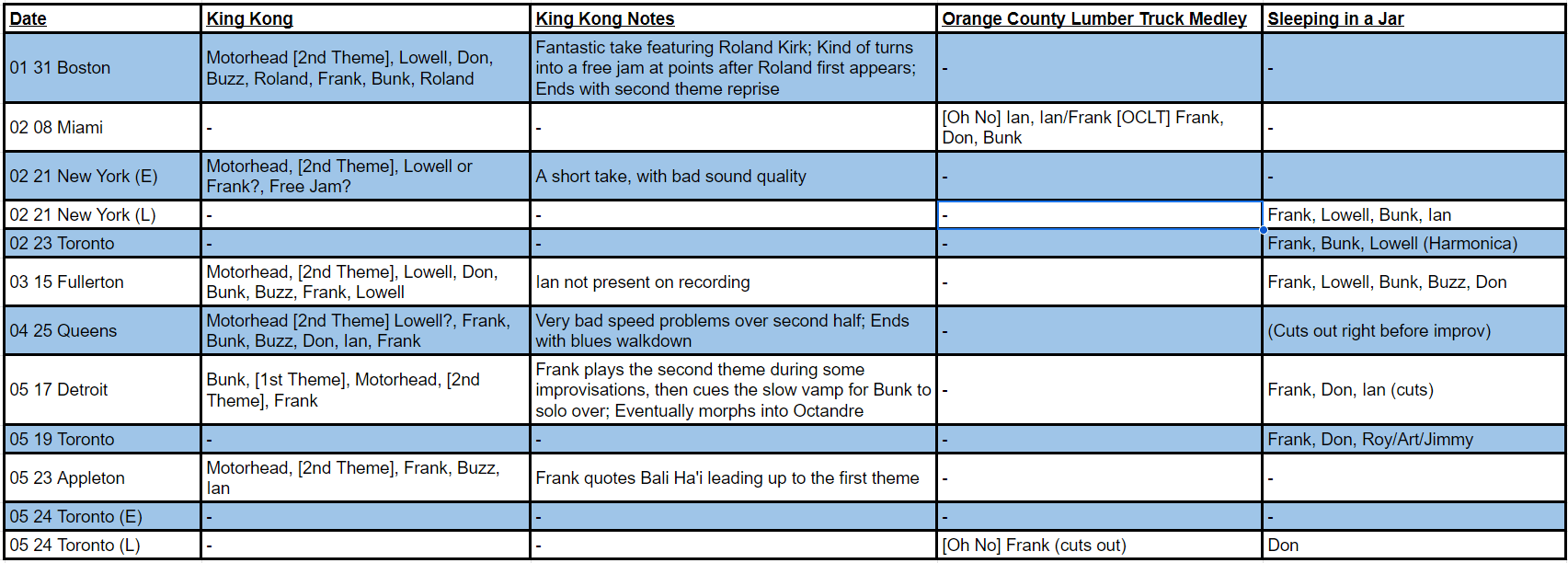
 Life On The Road