Overview:
Frank Zappa’s goal in life was to be a composer, not a guitar player, not a celebrity, definitely not a rock star, but someone who writes music. He claimed that the reason he got into “popular” music was because he couldn’t make money as a classical composer. That didn’t curb his interest in orchestras, but instead gave him the resources to occasionally work with them. At many points in his career, FZ would frequently engage in projects of “serious music” (to varying levels of success). He had a lot of trouble being taken seriously in the classical world, so often his attempts to work with large ensembles were tiring endeavors, fighting with the promoters and musicians who didn’t respect him because he had long hair and “insisted on saying fuck on stage”. Frank would continue to work with orchestras and chamber groups off and on until his final days, and here I’m going to discuss his efforts in this field during the first half of his career. He used these large ensembles both in the studio and on the stage, but this page will be focusing on the live performances. Frank also worked with larger groups for his film scores (Run Home Slow, World’s Greatest Sinner) and in the sessions for Lumpy Gravy and 200 Motels, but there were no live performances from these projects (FZ tried for 200 Motels, but the Royal Albert Hall canceled his show when someone working for the venue got a hold of the lyrics). Frank was always working on new classical projects, but was frequently held up by what he called “orchestral stupidities”. He spent the last half of the decade working on music to be performed by the Vienna Symphony Orchestra, but after years of preparation and thousands spent on copyists, the idea just fell apart. Frank’s earliest musical experiments hit the stage at a local community college in 1963, three years before Freak Out, and he would continue to push the envelope for the next 30 years, forever blurring the line between “pop music” and the classical world.
The Ensembles:
1963 – Frank Zappa (conductor, zither?), Malcolm McNab (trumpet, foreshadowing), Peter Arcaro (trumpet, brass section conductor), Philip Barnet (oboe, English horn), Barry Brisk (woodwinds section conductor), and other unidentified musicians
1968 – The Mothers assisted by 13 members of The BBC Symphony Orchestra
1970 – The Mothers with the LA Philharmonic Orchestra, conducted by Zubin Mehta
1972 – Frank Zappa and The Grand Wazoo Orchestra
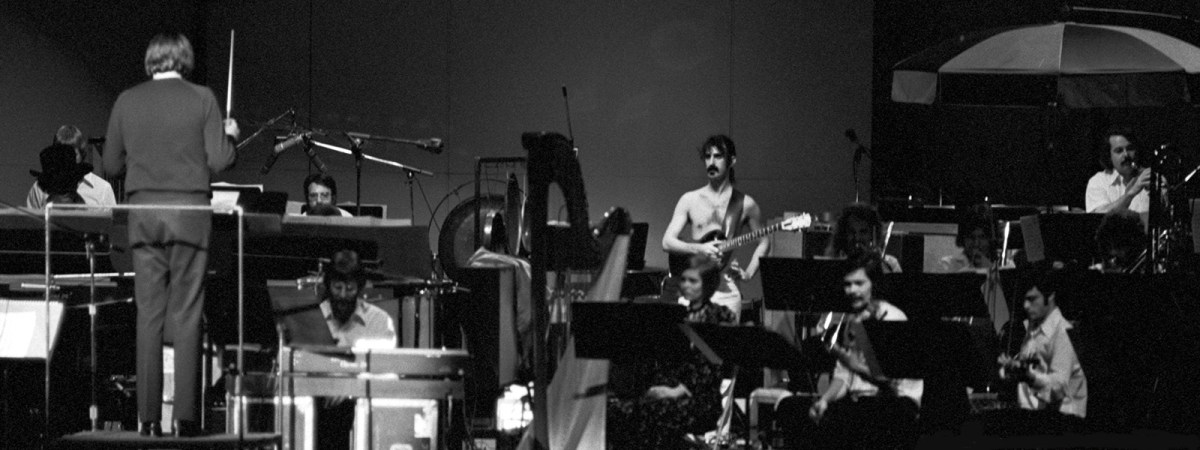
1975 – Frank Zappa with The Abnuceals Emuukha Electric Orchestra, conducted by Michael Zearott.
Recordings Available:
1963 05 19 – “The Experimental Music of Frank Zappa” – Mount St. Mary’s College, Los Angeles, CA (FM A-/B+)
“Mount St. Mary’s was the first time I had a concert of my music. As with most of the other concerts of my music, I had to pay for it. (FZ to Don Menn & Matt Groening, 1992)” Frank paid a student orchestra $300 to perform some of his earliest musical experiments. The group played one of Frank’s compositions on May 4th, as part of the college’s annual contemporary musical symposium, and then returned to the school for a night of solely Zappa’s music on the 19th. The program for the event was as follows (though Frank of course deviated from this):
I. Variables II for Orchestra
II. Variables I for Any Five Instruments
Intermission
III. Opus 5, for Four Orchestras
IV. Rehearsalism
V. Three Pieces of Visual Music with Jazz Group
Question and Answer Period
The recording we have comes from a KPFK radio broadcast of the event and contains most, but not all of the music performed. The recording begins with Frank’s entry in the music symposium, Piece #2 of Visual Music (1957) for Jazz Ensemble and 16mm Projector. It’s six minutes of free-jazz chamber music, and after this we cut to the 19th, and FZ announces they are going to skip Variables I, and play “a group of piano pieces taken from Opus #5”. Interesting, and occasionally haunting music. Next they play a moody piece made up of a number of overlaid cannons titled: Collage #1 for String Instruments. Following this piece, which has strong Naval Aviation In Art vibes, Frank plays a number of segments of the prepared tape that will go along with the ensemble when they perform Opus #5. Typical Early FZ Sound Experimentation/Tape manipulation stuff (like the Apostolic Blurch Injector in the late 60s). There’s a short intermission afterwards (not on the broadcast), and they return to play the Opus. It’s an insane, 14-minute atonal bonanza. The crowd has some kind of reaction, and then the recording goes into part of the following Q&A. Frank stops to explain the pieces before and after each performance, and it’s always interesting to hear him so young, and already pushing musical boundaries. The Q&A is more of the same, except Frank is more defending than explaining himself. A professor at the school seems to have his back though and calls FZ’s music a good introduction to John Cage to which Frank adds “I think you should all go to a John Cage concert and then you’ll come back to the next one I have and you’ll like it”. Frank ends up discussing his other musical interests, how he makes a living producing records, and the recording concludes when he tells the audience “I sold a record to Capital last Friday… the name of the song is The Big Surfer, you can all go out and buy it”. Frank released a very edited version of Opus #5 on The Lost Episodes, and it includes a little bit of extra dialog, letting us know the next piece they play was “actually pretty tame compared to the Opus #5. It’s called The Collage #2, and it was written last Thursday.” This is a wonderful performance and a wildly important document of the earliest moments of Frank’s musical career.
1968 10 25 – Royal Festival Hall, London, UK (Two Shows – Audience B/Official Release)
click here to listen to a playlist of the available official edits
“Throughout the [1968] tour, I had been writing chamber music pieces in airports and hotels. Somewhere in the middle of the tour, when asked about an opening act for the London show (sic), I opted to hire 14 members of the BBC Symphony to play these pieces, and build a cheesy little psycho drama around them, featuring the band doing something other than our usual stuff.” There were actually two shows on this date in London, and the Mothers, assisted by the BBC, performed “the cheesy little psycho-drama” Progress? as an “opening act” of sorts for each show. Every Mother has a part in the play, for example, the “talented” members of the band, Ian, Bunk and Art (they can read music) all quit the group to join the orchestra and play “serious music”. Frank is the announcer, Jim kinda plays himself/a proto-Lonesome Cowboy Burt, Roy plays himself (again, sorta)/The Rejected Mexican Pope, Don plays himself (and Dom DeWilde) and Motorhead seems to actually, truly just be playing himself. Also the BBC musicians are all robots and have face paint to prove it. Despite what Frank said, they were actually joined by 13 members of the BBC symphony They consisted of two french horns, two trumpets, two trombones, a tuba, two clarinets (one doubling on bass clarinet), two oboes (one doubling on English horn), a viola, and a conductor. The music the orchestra plays (known at the time as “Music For The Queen’s Circus”) mostly consists of early versions of pieces that would end up in the score for 200 Motels, and later on, Bogus Pomp (not a whole lot actually ended up on the 200 Motels film or the soundtrack album). I’ll talk about the piece more itself, and how it relates to other versions, in the songs played section. The entire play runs about 30 minutes, there’s a short intermission, and the Mothers return for a “normal” set. There’s a mediocre recording of the early show available (but YouTube won’t let me upload it), and Frank released numerous different edits of the available material, in both audio and video versions, on Ahead Of Their Time, Mystery Disc, Uncle Meat (the movie) and The True Story Of 200 Motels (click here to see a comparison of edits). Ahead Of Their Time has a few small edits in a couple places, clipping out bits of dialog and music Frank decided he didn’t like in the quarter century between recording and release and using (what I assume) are the best parts of both shows. The Uncle Meat movie/documentary has a fair amount of footage of the event, while The True Story has a couple of bits not included in the other film, and these segments make a pretty entertaining watch. The story/dialog sections are definitely more fun to watch than just listen. The plot, well what there is of one, kinda falls apart at the end, but that’s pretty par for the course for Frank. Don transforms into Dom, he takes out Ian, they sing Agency Man of all things, then the piece ends with parts of What’s The Name Of Your Group. Mystery Disc and The True Stories of 200 Motels (for the most part) feature shorter edits of the same material. The music and play are really entertaining, and it’s clear all the musicians are passionate about the material (they didn’t have to do this), which really helps the performances. Ahead Of Their Time is the best available version we have currently, until the eventual release of the full shows (I’m hoping they do a box set of the 60s London Shows, maybe throw in the 1970 dates too if they’re in the vault).
1969 04-08 XX – The Mothers Of Invention – Electronic Chamber Music
Click here to read more (here too)
Not a classic music concert in the normal sense, but I thought I’d throw in a quick reference to these performances. At the tail end of the original Mothers existence, Frank was getting really interested in what he dubbed “electronic chamber music”. Tweaky pieces like Redneck Eats, Kung Fu, Igor’s Boogie, Some Ballet Music, the intro to Revised Music For Low Budget Orchestra, the chamber music section from Little House and some unreleased compositions known as “Weasel Music” all originate from this period, and were performed live by the ‘69 M.O.I. . These are chamber music pieces through and through, they were just played between more “normal” rock pieces.
1970 05 15 – “Contempo ’70” – Pauley Pavilion, UCLA, Los Angeles, CA (Audience A-/B+)
“I had the opportunity to do something I’d been wanting to do for about 15 years, which was to play with a symphony orchestra. They wouldn’t play my music unless there was a rock group on the bill called the Mothers of Invention. But we didn’t have a Mothers of Invention so what I did was put together various guys who had been in the Mothers in the past, not just from the last group. I went all the way back to the beginning. We did about a six day tour in the United States… When that was over, I disbanded the group (FZ, Hit Parader, June 1971)”. This date was the last of the short tour, and featured the LA Philharmonic Orchestra conducted by Zubin Mehta. The hastily reformed Mothers opened the show with the My Boyfriend’s Back medley and Call Any Vegetable (including Stravinsky’s Agon and Varese’s Integrales). After this 20 minute set, the orchestra comes out and starts tuning in a chaotic way, labeled by bootleggers as Blowing Discordant Sounds. Following this they go into Part One of 200 Motels (see song entry for more details). It’s a 50 minute event that was supposed to be longer, but the second act was cut by Mehta. According to a time article from June 1970,. he wasn’t a fan of parts that called “for a chorus to blow bubbles through straws and the soprano soloist to sing ‘Munchkins get me hot’”. Following the epic, Frank goads some members of the orchestra onstage to solo in King Kong, ends the show, then returns for an encore. They play the audience requested Louie Louie/Plastic People and finish the night with the Orange County Lumber Truck Medley. Frank would have had to pay an exorbitantly high union rate to even make a shitty cassette recording of this show, so there is no tape of this show in the vault. Thankfully this very nice audience recording of the event exists. This is a pretty monumental show in Zappa’s live history, and should be heard by any fan of the man’s music.
1971 02 08 – Royal Albert Hall, London, UK (Canceled)
Frank planned to have a concert around the time of the filming of 200 Motels featuring the cast of the movie with the The Royal Philharmonic Orchestra and The King’s Singers, but the management canceled the show at the very last minute due to claims of “obscenity”. Read more about the ill-fated show here, and more about the eventual lawsuit here.
1972 09 10-24 The Grand Wazoo (7 Date Tour)
Frank, after a year of recovering after his assault at the Rainbow Theatre, decided to form a sort of jazz orchestra to perform some of his recent compositions. It was a 20 piece band, and their repertoire ranged from Frank’s more abstract compositions like Greggery Peccary and For Calvin, to more accessible pieces like Dog/Meat and straight up fusion jams like the Grand Wazoo and Big Swifty. I’ve written a full page on this tour, check it out with the above link.
1975 09 17 – Royce Hall, UCLA, Los Angeles, CA (Audience B)
“I did this because I wanted to hear my music. Nobody came to me and asked me to put on a concert. […] The grand total cost is between $50,000 and $70,000, which includes costs like $10,000 just to pay the copyist for making up the scores. Every time we have a full rehearsal of the orchestra, it’s about $5,000. It’s real lunacy to even be doing this”. Using the money from his surprise hit single Don’t Eat The Yellow Snow, Frank hired 37 piece musicians to perform his classical compositions, and dubed the ensemble The Abnuceals Emuukha Electric Orchestra (after the group that recorded Lumpy Gravy). The group is largely made up of former members of the Grand Wazoo and the Lumpy Gravy orchestras, but it even includes current and former Mothers (Ian Underwood, Bruce Fowler and Terry Bozzio most notably). This is the shorter of the two shows, and Frank sadly didn’t record this one to save money. I assume he basically thought of this date as a rehearsal/warm-up show. He recorded the following night and a long rehearsal section on the 19th (to re-record the rough spots of pieces), in order to make an eventual classical album. This album of course ended up as Orchestral Favorites. Frank starts the night off in a good mood, explains that he’s going to be running around mixing the show, and that he has decided to introduce the tunes (for the benefit of the people in the orchestra who may not know what piece is next). Bogus Pomp, Revised Music and Pedro’s Dowry begin the show and make up the densest section of the show. Frank gives a fun intro to the first tune (“now I don’t want your opinion of these pieces to be tainted by their unusual titles”), but the second two are rather short. Frank says they were supposed to play a guitar solo in Low Budget, but decides against it due to mixing problems and the poor sound of the hall. All solid, competent takes of the pieces and Frank follows it with the first “rock” number of the program: Rollo. Frank plays the remnants of the Petit Wazoo tune, with a nice guitar solo in between (though Frank seems a little more occupied on the sound mixing than playing a great solo). Dog/Meat and Naval Aviation In Art? are both well performed (Frank says Dog/Meat is one of the hardest pieces they play, to my surprise. The Roxy band just makes it seem easy). FZ then declares that, just like his rock bands, they’re going to try to “make something up”. We get eight minutes of wild improvisations, with only light directions from Frank (“the most primitive, general outlines”). There’s a small cut at the end of the performance, and it misses a little bit of dialog from FZ. After this they play a short segment of Lumpy Gravy (Frank introduces it as Sink Trap, but it’s actually part of what was released as Envelops the Bathtub) and after a minute of composed material they segue into more improvisational madness. Duke of Prunes helps bring us back to a saner place (with a very nice keyboard solo from Ian) and Strictly Genteel, with guest harmonica, is always lovely. This is a nice show, but most people will be fine with hearing just the much better sounding show on the 18th. The only reason to listen to this show is for Frank’s introductions and the moments of improvisations (but I’d still recommend you skip around check those out!)
1975 09 18 – Royce Hall, UCLA, Los Angeles, CA (Official Release)
“For those of you who might be wondering—it’s not a rock & roll concert—it’s one of those other kinds of concerts. And if you were here last night, by some stretch of the imagination, you might think, you might think that you know what’s going to happen tonight, but, you don’t know what’s going to happen tonight.” This fantastic show was captured in wonderful quality and released in 2019 as part of the Orchestral Favorites 40th Anniversary set. It’s a great show, features almost all the music from the first show and more, and the performances all outshine those on the 17th (with the possible exception of Dog/Meat). Frank gives amusing intros to all the pieces too, and just hearing him talk is almost as interesting as the music. Just like the last show, Bogus Pomp, Revised Music and Pedro’s Dowry begin the program, and a short intermission follows. After the short break we go into the guitar section of the program and get wonderful takes of Rollo and Black Napkins (the earliest known recording of the song we have!). Dog/Meat comes next (and is pretty shaky) and the always eerie Naval Aviation In Art? follows. Between the two tunes someone asks for the name of the players and Frank responds: “Well, you see, we couldn’t afford a program, but uh, if you like to know who the players are at this time, would each one of you please rise and say your name”. This is of course followed by a cacophony of spoken noise. They then play a bit of music from Lumpy Gravy, followed by some exciting full band improvisations (part of which ended up on Tinseltown Rebellion). Frank then introduces the Duke Of Prunes and brings on special guest Mr Tommy Morgan to play harmonica on it. After this Frank hesitantly guides the group through parts of Greggery Peccary, skipping or restarting parts whenever they chump it too bad. Despite all the errors (and there’s even a couple edited out) it’s still a tremendous take, and it leads right into the show ending Strictly Genteel. They play through the beautiful piece, and after Frank tells the audience good night, the orchestra continues the closing vamp and Captain Beefheart appears! He’s honking his soprano sax and acting like a general madman, until he eventually stops and Frank comes in with a tasty closing guitar jam. He stops, the orchestra quietly continues, and then he blows into the Louie Louie chords to end the night. He returns to say: “okay look I’m sorry if that ridiculous spectacle offended some of you serious music lovers. I’m sorry to have put you uptight, well, y’know… Good night”. Unfortunately, everything after Frank first says goodnight is missing from the recording in the vault, so the official release fades out before the Captain appears. This is an excellent show, an excellent official release, and an incredibly important night in Zappadom. Check this show out if you have any interest at all in Frank’s classical side.
The Pieces Played:
At Mount St. Mary’s College:
Collage #1 for String Instruments – Frank explains this piece like this: “It’s called a collage because just like a collage in terms of art, things are overlaid like pieces of paper or pieces of music. In this case, this collage is built from fragments from different cannons… laid on top of another and scored for strings and woodwinds”. It’s a very atonal piece, about two minutes long. And it strongly reminds me of Naval Aviation In Art? It’s a little less successful than the later piece, but very interesting to hear.
Piece #2 of Visual Music (1957) for Jazz Ensemble and 16mm Projector – “The musicians are instructed to interpret what they see on the screen…to produce their own musical equivalent of that particular sight. Got that? That’s all you have to do.” They play about 6 minutes of very tweaky free jazz improvisations, based on what they see in Frank’s weird home movie, which probably perturbed the early 60s orchestral audience. The recording of this piece actually comes from the May 4th Symposium, though it’s possible Frank played it again on the 19th. After the piece Frank explains how he made the film collage the musicians just improvised to. I imagine it looked something like the G-Spot Tornado video from the late 80s (Frank likely used some of the same footage).
Opus #5 For Piano, Tape Recorder And Multiple Orchestras – “To me, when I hear that, the only thing I can say is that’s the way I’ve always wanted music to sound”. This is seemingly the big number of the concert. Before they play the piece in full, Frank plays some parts on their own. The pianist performs a selection of solo piano pieces from Opus #5, and connect them however he chooses. Frank described them as “two sheets of paper with nine fragments, they’re not serial, they’re not twelve tone, they’re just sound studies”. Later on Frank plays two fragments of the prepared tape to be used in Opus 5, and explains how they were made, by giving people instruments they don’t know how to play, and then running the tape through multiple filters, chopping up the tape and randomly rearranging them. The results sound like demented circus music. Frank plays two fragments, the second has many more instruments, and is much slower and moodier sounding. There’s a brief intermission (not on the recording) and they return for the full piece. The composition involves three conductors, one for the woodwinds, one for the brass, and Frank for the rest (tape recorder included). Each conductor has segments where they allow/direct their section to improvise, and I imagine that happens at different moments throughout the piece. It’s very Varese-inspired (as far as I can tell), but also very Zappa-like already, and some parts remind me of the more chaotic sections of New Brown Clouds from Greggery Peccary (I don’t think it’s just Malcom McNabb). Apparently Frank’s only direction for improv was to “try and avoid tonal passages”. FZ released a heavily edited version of the performance on Mystery Disc, but the full 13+ minute performance is really something to be heard. A true piece of music history.
At the Royal Festival Hall:
Progress? – This crazed play was only performed two times, as the “opener” for the two 1968 London gigs (see the recording entry for more of the story of the play). The music in the event (titled at the time “Music For The Queen’s Circus“) mostly consists of early versions of pieces that would end up on 200 Motels and/or Bogus Pomp. The Prologue (not on Mystery Disc [MD]) has unique music and music later incorporated into the beginning of the first section of the Orchestral Favorites arrangement of Bogus Pomp (The LSO version is similar but with three sections added to the front of the piece). Progress? (released as Don Interrupts? on MD) is all dialog (though in the unreleased early show performance, we hear a small bit of This Town Is A Sealed Tuna Sandwich). Like It Or Not (Piece One on MD) contains more music from part one of the Orchestral Favorites Bogus Pomp, about ten seconds of This Town Is A Sealed Tuna Sandwich, and all of Redneck Eats (AKA The Restaurant Scene). The Jimmy Carl Black Philosophy Lesson and Holding The Group Back (creatively titled Jim/Roy on MD) hold more amusing dialog (I love Jim), and Holiday In Berlin (also part of Jim/Roy), is just a minute long take of the final theme of the tune “sung” by Roy, with beautiful piano accompaniment from Ian. The Rejected Mexican Pope Leaves The Stage and Undaunted, The Band Plays On contain largely the same music (they were released together as Piece Two on MD), and parts were worked into Dance Of The Just Plain Folks and later Bogus Pomp. After this they sing Agency Man for some reason (I imagine the London audience wouldn’t be able to connect it to Reagan), mostly acapella but with piano and drum accompaniment. The play ends with the Epilogue, which almost entirely became What’s The Name Of Your Group? Frank made a number of edits to the pieces between their multiple releases and a comparison of them (to each other and the unofficial recordings) can be found here. He left a lot of parts out (small or large depending on the release) and combined the early and late performances into one take. You can also see how the music compares to the pieces officially released on 200 Motels and Bogus Pomp here. The play is largely improvised and often nonsensical, but still a lot of fun, and all the music is wonderfully performed. Strong recommendation, and I’m hoping we can hear both full performances someday.
At the Pauley Pavilion:
Blowing Discordant Sounds – When the LA Philharmonic first come on stage, they play a little bit of tweaky improvisations, beginning with the woodwinds, and after a little while the horns and the rest of the large ensemble join in. As far as I know the title comes from bootleggers, not Frank. I think the event was just a fun way for the group to tune up. They play for about 90 seconds before the tape cuts to Frank tuning his guitar.
King Kong – After 200 Motels, Frank invites any members of the orchestra who want to come solo in this next tune to get up on stage. They play the first and third themes before Motorhead comes in with his usual solo (for the final time). After this we get a handful of solos from the remaining orchestra, including a violin player, another sax solo (it might be Ian, or even Motorhead again), and another violin solo. Frank plays around with conducting the horns, then rips into a wild rock n roll guitar solo. It eventually slows down and Frank morphs into Integrales by Varese. A King Kong to remember for sure.
200 Motels – “It’s not really a great piece of music, but we might be able to get off a couple of times in it. So… All right, Zubin, hit it!”. This 50 minute epic is actually only part one of the May 1970 version of 200 Motels, but Zubin axed the second half for being too vile. The piece starts off with the Mother’s performing a standard take of Pound For A Brown (complete with a hot guitar solo). After a few minutes of jamming, they move into some classic, atonal, heavy, percussive unreleased orchestral music (the start of which is clearly based off of Pound). They then go into some variations on Oh No for roughly 40 seconds followed by a passage later incorporated into Envelopes! (parts of the “I’m screwing you” through “it’s devine” sections in the lyrical versions). This is followed by the beginning of the Orchestral Favorites version of Bogus Pomp (AKA Like It Or Not or Redneck Eats), they then play 30 seconds of music from the middle of Undaunted, The Band Plays On off Ahead Of Our Time and then go into a fully orchestrated version of the piano intro to Little House I used to Live In! They play the first 50 seconds of the piece followed by half a minute later used in Centerville and two and a half minutes of unreleased chaotic music. Ian then finishes out the piano intro and they go into the final theme from Frank’s movie score to the World’s Greatest Sinner! (parts of this score ended up on Lumpy Gravy as I Don’t Know If I Can Go Through This Again) After this it’s just the Mothers again and we get a lovely take of Holiday In Berlin, plucked from The Duke. Frank plays the complete Inca Roads pre-solo theme, then the whole ensemble sings the melody. FZ tries to get the audience to sing along (“15000 people should sound louder than that”). He jams for a bit, then the orchestra returns to play 30 seconds for the middle of Strictly Genteel, 30 seconds of unique music, and transition back to the Mothers for their beautiful Duke Of Prunes (with lyrics!)/Who Needs The Peace Corps medley. It’s a little mixed up, Duke of Prunes was usually played after, but there’s still cool piano and guitar solos after the instrumental take of the We’re Only In It For The Money tune. They play the theme again, a little faster after the solos, there’s a snork, a cowbell hit and the orchestra are back for a very cool, unique arrangement of Pound For A Brown. After this is ten minutes of unreleased music and passages of pieces later incorporated into the complete 200 Motels (the identified parts ended up in What’s The Name Of Your Group?, Dance Of The Rock’n’Roll Interviewers, Touring Can Make You Crazy, The Lad Searches The Night For His Newts, about ten seconds of Lucy’s Seduction Of A Bored Violinist and chunk of I Have Seen The Pleated Gazelle). Roughly 45 minutes in and we get a repeat performance of Oh No (very similar to the Lumpy Gravy arrangement), a minute of unreleased rock music, and a variation on Oh No lick from Lumpy Gravy (7:36 into Part One) is used as a transition into the ending: a fully orchestrated arrangement of The Eric Dolphy Memorial Barbecue. The performance comes to an end with a massive percussive crash and a cued “Yeee!” from the Mothers. There’s a standing ovation and they absolutely deserve it. This is a crazy moment in Zappa history, and despite being named 200 Motels there’s actually very little music that ends up in the finished score. The piece largely consists of parts of other Zappa compositions, demonstrating a lot of conceptual continuity. It’s a really fun piece of music, and should be checked out by any level of Zappa fan.
At the Royce Hall:
The Adventures Of Greggery Peccary – “Well, that’s sort of how it goes.“ Frank very reluctantly lets the orchestra perform parts of this piece (he asks the crowd first if “they wouldn’t care if they heard something that sounded absolutely disgusting?”) The piece isn’t fully put together at all, but it’s still really fun to hear. They begin with the Steno-pool section (Mvmt. II), and play that piece very well (interestingly enough they play the music that was left out of the studio Greggery from Farther Oblivion, formerly used as a transition between The Steno-Pool and The Be-Bop Tango). They move into Mvmt. III (Greggery Invents the calendar), and Frank has them repeat the end. They play most of Mvmt. IV (Greggery Is Attacked), chump the ending a bit, and quickly move into New Brown Clouds and the end of the epic. The official release includes three sections of mistakes edited out, the first is a false start of Mvmt. III (Greggery Invents the calendar), the second contains two more takes of the ending of the fourth movement (including a more complete, but still shaky performance), and the final section missing shows the group falling apart right before the ending (and Frank restarting the section). The removed sections make the piece a little more listenable, but It still would’ve been nice to have the unedited take. Overall though and despite the mistakes, this is an excellent version, and another wonderful performance of one of Frank’s masterworks.
Black Napkins – “Basically what’s gonna happen is I want to play more guitar in the concert and the easiest way I could do it is just have a vamp like this. So, here’s, here’s our little jam session for ya.” This tune reportedly first appeared at the closing shows of the Bongo Fury tour in Phoenix, but the earliest known circulating performance of this tune actually comes from the Royce Hall. Frank teaches the backing to the group on the spot (it takes about four minutes), and then proceeds to whip out a very nice, emotional solo. It’s not the most mind-boggling Black Napkins, but it’s a very nice performance and a nice change of pace for the shows.
Bogus Pomp – “This is a melancholy little extravaganza, actually, it says, ‘Short sort of ballet or choreographed ‘orch.’ number for 12 winds, 11 brass, 4 amplified strings, 1 amplified harp, 3 keyboard players, 4 percussion, 1 electric bass, and 1 drum set.’” This arrangement of music, mostly originating from the score of 200 Motels, can be divided up into six parts: Prologue, Redneck Eats, This Town Is A Sealed Tuna Sandwich, The Dance Of The Just Plain Folks, I Have Seen The Pleated Gazelle and the Bogus Pomp finale. The first part comes from the opening of the Mothers’ play Progress?, the final part has music unique to Bogus Pomp, and the middle four parts contain music from 200 Motels. Frank also had theatrics written into this piece. He describes it like this: “This tune contains a small war which takes place in the string quartet over here…[small cut] this common theory, that the viola player never gets a good solo. I don’t know how many latent viola players in this audience but if there are any you’ll identify strenuously with Pam when she jumps up on her Wah-wah pedal and gives you a great big solo. In response to the insurgence of the violist in the middle of the string quartet the other guys try to take advantage, you will see the death defying feat: Jerry Kessler taking his cello, sticking it under his chin and playing four bars in the middle of this thing just to complete with the viola player, and then there’s the mock animosity between the two violinists as they dual to the finish.” This is an excellent reworking, combining the most memorable parts of the film score and other music Frank had been working on over the last decade into a fantastic 14 minute piece. The Royce Hall/Orchestral Favorites takes are a delight, possibly my favorite version of 200 Motels, and should be heard by anyone interested in Frank’s “serious music”.
Dog/Meat – “It’s called Dog/Meat because the first part of it is the Dog Breath Variations and the second part is Uncle Meat. Now… I just hope… this is very hard to play, this is one of our hardest tunes tonight… and I hope that they can keep this sucker good”. The orchestra performs the classic arrangement of these two timeless tunes, the same played by the Grand Wazoo and the Mothers in 1973 and 1974. Both performances are a little shaky, but (I think) the earlier show is actually the better performance. It’s nice to hear these pieces played by this ensemble, but they’re far from the best takes of these songs.
Duke Of Prunes – “We have a special guest artist who is going to play some harmonica on this number.” This tune is basically performed as Duke Of Orchestral Prunes on Orchestral Favorites, but instead of a guitar solo we get a synth solo from Ian Underwood on the first night, and both a harmonica solo and synth solo on the 18th. This is a lovely little piece, and all three available takes from the Royce Hall are worth checking out. Improvisations – “I would like to try something that we usually do with the little rock and roll bands, sometimes in the middle of the concert you just decide to make something up from scratch, just to see how the musicians themself relate to your very own teenage vibes that you have… We’re going to interpret your vibes and your aura and make a piece of music out of it and all we’re going to do is give the most primitive, general outlines to the work about who comes in where and just take our chances and see what comes out”. Frank and the group do exactly that on the first night, leading to eight and a half minutes of wonderfully crazed, tweaky orchestral improvisations. A highlight of the show on the 17th, definitely worth a listen.
Lumpy Gravy – “We’re gonna play part of Lumpy Gravy. This is an extract… This is another one of our jamming tunes, folks, because uh, in the case of this one, I didn’t have a chance to finish off the arrangement for this group, so there’s fifty bars written out and then after that we wing it”. The orchestra plays about 50 seconds of music heard approximately 12 minutes into Part Two of the sound collage, in the section known as Envelops The Bathtub. After this they go into a long section of full-blown improvisations. Frank refers to the piece as “Sink Trap” on the 17th, but the piece of music that was going to be released on the original version Lumpy Gravy by that name is actually mostly made up of Oh No. Instead the piece played at the Royce Hall can be heard as parts of Local Butcher, Gypsy Airs and the Teen-Age Grand Finale on the album eventually released on Lumpy Money. This is a lovely, weird little event, and so are the 10-ish minutes of weirdo improvisations that follow. Frank used part of the chaos from the performance on the 18th as a connecting bit in the Tinseltown Rebellion version of Easy Meat. Evening At The Hermitage, or simply Hermitage, was a name Frank gave to an excerpted part of the ending improv. A wonderful dose of weirdness for these fun shows. Naval Aviation In Art? – “It’s a very, it’s a very quiet, short—it’s short and quiet, it’s one of those kind of short and quiet songs.” Mostly strings and woodwinds, lots of long scary chords. Frank actually said there’s no score for the piece on the first night. It was originally recorded, but not released, as part of the score to 200 Motels. The version heard live is, for the most part, the same heard on Orchestral Favorites. Frank ended the first night’s take by saying this: “Now we figure since that was the shortest piece that that would be the single we release from the album, so if any of you guys have a connection to [the local radio station] just tell ‘em Naval Aviation In Art is really heavy business”. Well, you heard ‘em.
Pedro’s Dowry – “This was also written as a ballet, but we still don’t have the budget for that sort of thing. Here is the plot: A woman—with ocean front property—waits for someone named Pedro in a skiff—a form of boat. She will launder his burlap shirt in the splendid sunset. He will play an inexpensive guitar. She will make him a stimulating drink, and while he drinks it, she will put on some more lipstick. Later, they’ll have a cheap little fuck and accidentally knock over an ashtray. In the confusion, she might have misplaced her necklace. Within moments, Merle has cleaned the rug.” The orchestra plays this wonderfully weird and dissonant piece with supreme excellence. They play it live pretty much as it appears on Orchestral Favorites. This piece had stage action too, including: “brass section waves hankies, orchestra lights cigarettes during rest, and lead violin rips off bow tie, tears open shirt, plays blistering three-note solo, bows, and is presented with flowers by harpist.” This is a wonderful composition and a great representation of FZ as a composer.
Revised Music For Low Budget Orchestra – “The name of this tune is Revised… and Revised again… and probably to be revised some more, Revised Music For Low Budget Orchestra” Frank announces at the first show that this tune “was originally designed to have a guitar solo in it, but we’re leaving it out at this point because of the balance problems in here, one note from me and these guys disappear”. We get a wonderful arrangement of the Studio Tan performance of the piece, but the lack of a guitar solo is pretty disappointing. I enjoy these performances, and never skip them, but if I wanted to listen to this song, the Studio Tan take would still be my first go to.
Rollo – “Last year, sort of by accident we managed to have a record that got on the radio some places… this particular piece of music, by some strange coincidence, generated money which has paid for this concert.” He goes on to say “there was a song called “Don’t Eat The Yellow Snow,” and . . . and also, also, in the end of that, there was a section called “St. Alfonzo’s Pancake Breakfast.” Now, during the “St. Alfonzo’s” area there’s a little tune that goes, “Ra-na-na na-na-na na-na-nant, ra-na-na na-na-na-na-nant . . .” Well, that little area there used to be called “Rollo” a long time ago, and I just stuck it in “St. Alfonzo’s” ’cause I thought it was cute… But basically what it’s got in the middle of it is a dumb guitar solo in the key of E minor that will lengthen the program by about, oh, five more minutes…. So, here’s Michael Zearott again. He’s gonna come up, wave the stick on it.” Frank arranged “Rollo Interior” (AKA the end of St. Alphonzo’s Pancake Breakfast) for this 37 piece ensemble. He plays a hot guitar solo, and then brings the orchestra into the original ending of Rollo (only played on the 1972 petit wazoo tour, sometimes known as “Rollo Goes Out”). I love this composition, it’s one of my all time favorites from Frank, so obviously I’m a big fan of these takes.
Strictly Genteel – “It was at one time a finale for a movie called 200 Motels. It was originally written for 120 pieces. It is now going to be played by 37”. This wonderful piece is fantastically performed by this ensemble as an ending to each show. On the 18th, Captain Beefheart makes a surprise appearance at the very end and blows the fuck out of his soprano sax. It’s a really amusing performance, but it unfortunately was missing from the tape in the vault so it can only be heard on the audience recording. Frank jams for a bit after Don, then ultimately brings an end to the program (with a quote from Louie Louie of course). FZ was quoted as saying that Strictly Genteel was his personal favorite composition he had written, and it’s hard to argue with him. It’s definitely one of his most enduring compositions, and these performances only back that up.
 Life On The Road